Loading document...
PA 22/00827/B | Proposed replacement dwelling at Rheaby Beg Supplemental information
This document has been prepared subsequent to the Planning Committee Meeting on Monday 27th February 2023 and at the request of the Principal Planner, so that an addendum Report can be prepared as requested by the Planning Committee, prior to the proposed site visit by the Committee; it deals with a number of inaccuracies and subjective opinions in the original Planning Officer’s Report which, it is considered, give a misleading picture of the proposals.
The below photographs show the stair leading to the accommodation at Second Floor, from First Floor. It can be seen that the stair is a continuation of the stair between Ground and First Floors; i.e. it is not an add-on, adjunct, or secondary feature, but a part of the original three storey dwelling.
Stair looking up from First Floor Stair looking down from half landing
As will be seen during the site visit, the existing dwelling is simply too close to the hill to the south to fully benefit from passive solar gain and good levels of natural light; both these are fundamental principles for an energy efficient building, reducing the need to use energy to heat and light the dwelling.
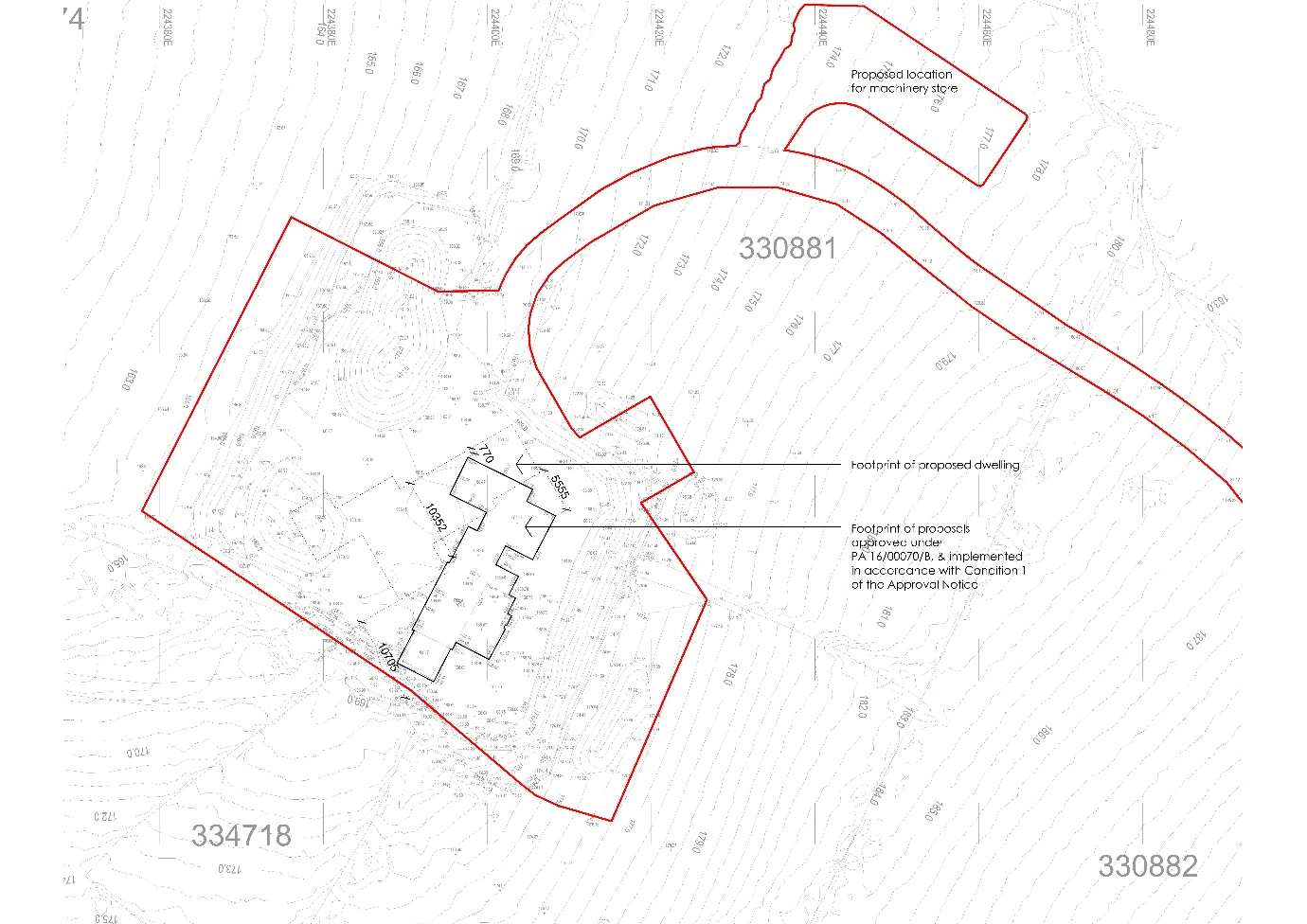
As noted during the oral presentation to the Committee, the proposed dwelling has not been moved away from the position of the previously Approved dwelling but, rather, it has been pivoted in order to benefit from the passive solar gain and natural light referred to above.
The diagram below clearly shows that the footprint of the two houses overlap at the north-eastern end, and the various dimensions indicate the extent to which the proposed house would be moved away from the Approved dwelling’s footprint.
It is noted that these relative footprints were indicated on drawing number 280/002a in the original Planning Application documents, so were available to the original Planning Officer.
In his Report the Planning Officer calculates that the original house is approximately 100m2 and acknowledges that the Approved dwelling is 400m2; therefore, the extensions must have an area of 300m2, which is clearly three times the size of the existing house and certainly not ‘modest’ as he suggests.
There is nothing in the submitted documents to suggest that the house will be constructed using anything but the highest quality materials; therefore, the use of descriptions such as ‘presumably fibreboard’ and ‘potentially plastic’ is complete conjecture and considered to be unnecessarily biased against the proposals.
The primary facades facing away from the hill will all be finished in natural stone to match the backdrop, and the proposal to use a timber alternative to the relevant areas facing the hill is to reduce maintenance, and therefore reduce the energy consumption and use of coating materials, required over the lifespan of the house. However, with the products that are currently available, there is no reason to assume that such materials would be sub-standard in any way – that would, in fact, defeat the object of trying to achieve a low energy and low maintenance house.
Whilst the existing house is three storeys, its floor to ceiling heights and floor construction depths are not in accordance with modern standards; for example, a floor zone of 600mm has been allowed in the proposed design to accommodate the extensive services, including ductwork, required for the Mechanical Ventilation and Heat Recovery (MVHR) system, that is critical to creating a highly thermally efficient and low air-permeable dwelling. Therefore, it is not unexpected that the proposed house will be taller.
It is noted, however, that the top level of accommodation is located within a slightly elevated roof structure as opposed to a full Second Floor, and the residential accommodation at this level is limited to a sitting area for the Applicant’s dependent adult daughter’s bedroom suite, and a secondary sleeping area to the Master Bedroom suite; the remaining accommodation at this level is primarily for the plant required to run the house using renewable energy sources.
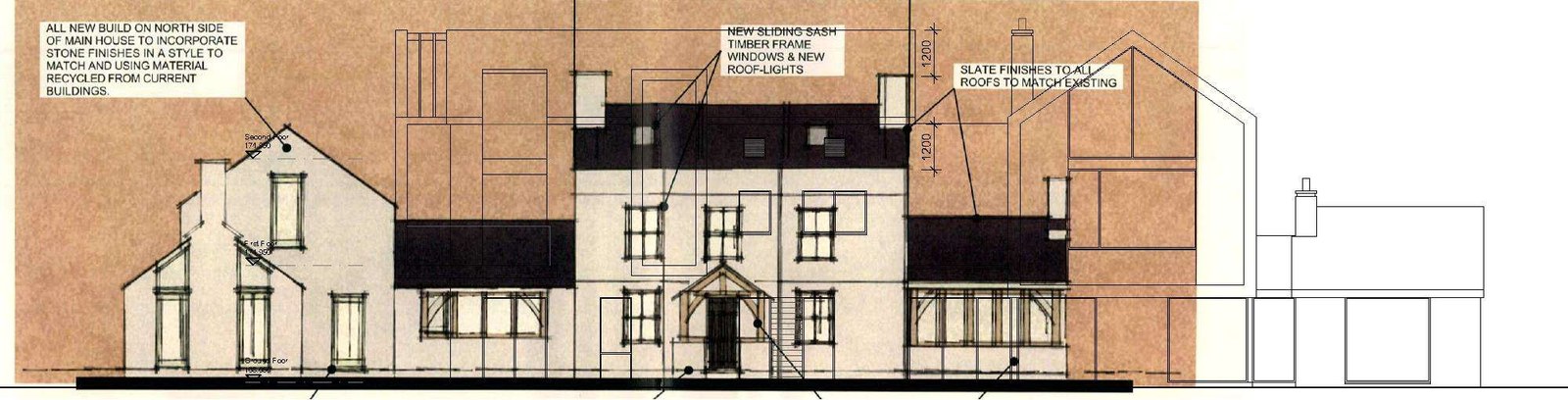
The diagram below shows the principal elevation of the Approved dwelling and the Proposed dwelling overlapped; the Approved dwelling elevation has been taken directly from the previous Planning Application documents, but with the ridge set at the correct height, established from the topographical survey submitted with this Application. As can be seen, the tallest ridge of the Proposed dwelling is 1.2m above the highest point of the existing house, and the eaves are the same distance apart. It is also noted that the Proposed house is visually arranged in three solid blocks linked by glazed features, at lower levels, and that the taller ridges run at right angles to each other, to break down any uniformity to the appearance of the dwelling.
As noted within the Application documents and during the oral presentation to the Committee, the proposed shed has been set into the existing topography to avoid skyline development and reduce its visual impact; at its ridge, the shed will only sit 1.75m above ground level on the high side and, at its eaves, 1.0m. The Applicant will arrange to represent this visually on site for the site visit by the Committee.
It is clear from the submitted drawings that the Proposed house contains four bedrooms, not six as suggested by the Planning Officer – in summary, these are a Guest bedroom at Ground Floor (primarily for older relatives who may have mobility issues), a second Guest bedroom at First Floor, and two family bedroom suites (with the Master containing two sleeping areas within a single space).
Conclusion
It is hoped that the above clarifies the Applicant’s concerns relating to how the proposals have been presented in the original Planning Officer’s Report but the Applicant will, of course, respond to any queries raised during the upcoming site visit.
Copyright in submitted documents remains with their authors. Request removal
View as Markdown