Loading document...
PROPOSED DEVELOPMENT AT NOS. 38-40 FINCH ROAD DOUGLAS ISLE OF MAN
PLANNING STAGE REPORT
0600014
ROGER HOFLER ARCHITECTS 3 AUBURN VILLAS, MONKSTOWN, CO. DUBLIN, IRELAND. T:+353 (0)1 2809322 E: [email protected]
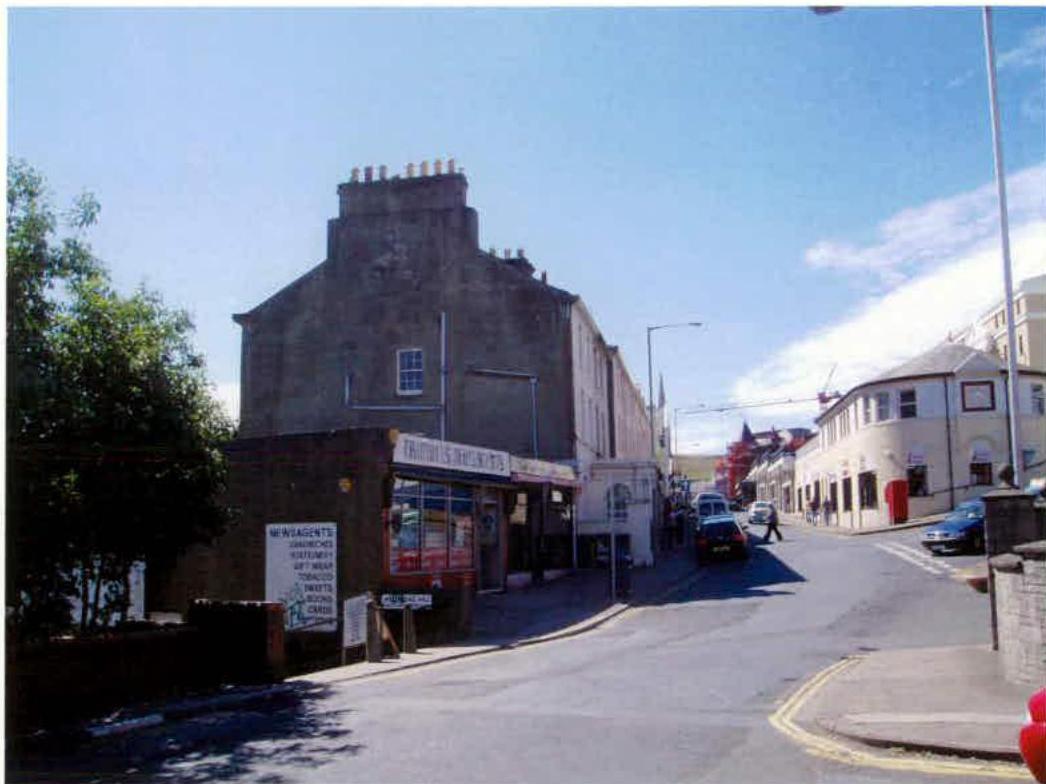
The subject site occupies a pivotal location terminating the main terrace on Finch Road's North end before the multi-storey car park. The building's main façade is viewed head on as one descends Crellins Hill, the gable elevation forms an almost monolithic grey wall when ascending from Black Marina Road and the rear elevation is prominent to pedestrians climbing Well Road Hill.
Numbers 38 & 40 Finch Road form a pair of semi-detached three-storey over basement houses. They are of very late Georgian, early Victorian period and are currently unoccupied and in a poor state of repair. The rear garden is overgrown and has been unused even before the buildings were vacated due to its steeply sloping nature. There are a number of registered buildings on Finch Road, the last of which is number 24. Finch Road is not listed as a conservation area.
The buildings owners have received a Section 24 notice under the Building control Act 1991 which required them to either undertake certain prescribed remedial works or alternatively demolish the building and clear the site.
Finch Road is zoned “Predominantly Offices” and existing uses along the street consist mainly of office with some residential at upper levels. The proposals outlined below include the provision of five apartments at upper levels, which will contribute to providing a desirable mix of complementary uses. This “Living Over the Shop” model is actively encouraged with various incentives in many European cities. It is seen as an efficient way of enlivening areas that have previously been empty outside of office hours and providing passive security through the overlooking of streets and laneways.
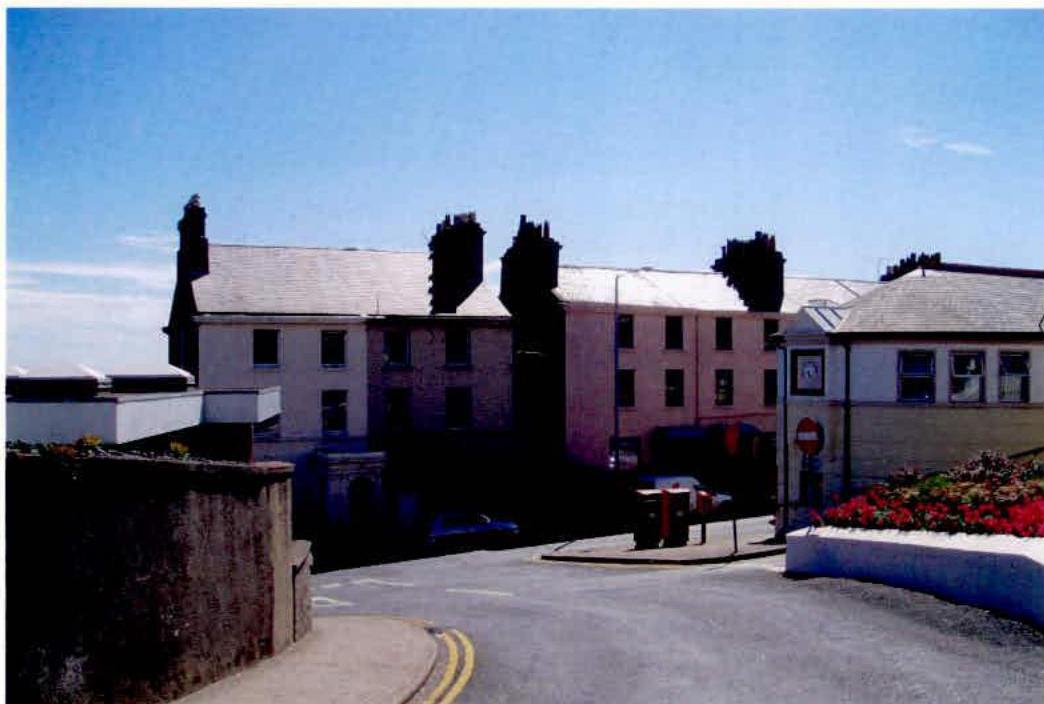
Front elevation from Crellins Hill.
{{image:402767}} Top: Gable elevation from Black Marina Road. Bottom: Rear elevation from Well Road Hill.
The current proposals are for the demolition of the existing structures and the construction of a new building containing two floors of open-plan office space (ground and lower ground floors), a basement floor as storage rooms and three upper floors accommodating five apartments.
The main volume of the building as seen from the street will remain as a three-storey building with the addition of attic level dormers. To the rear of the sloping site it is proposed to construct a three level car-park served by an hydraulic lift.
The demolition of the existing buildings and clearance of the site is necessary to accommodate the new enlarged main building, its associated car parking and car park entranceway lane. The cellular, load-bearing construction of the existing building does not lend itself to viable reuse. It conflicts with the current requirements for open-plan, well-lit and well serviced office space and would effectively preclude the incorporation of well designed modern apartments with their requirements for private outdoor space, minimum floor areas, storage areas and lift access.
Other premises on Finch Road have vehicular access to the rear, which facilitates car parking for office and apartment use. The rear gardens of Nos. 38-40 Finch Road are currently inaccessible to cars and undesirable for use as garden space due to the steeply sloping nature of the site. Demolition and rebuilding allows for an appropriately graded entrance ramp and car lift to be included between Nos. 36 and 38 providing access to 17 car spaces, bicycle parking and communal waste storage.
Recycled aggregate (crushed concrete) and rubble stone can be reused in substructure filling. Waste generated will be managed and reduced by waste-stream management including: The separation, storage and recycling of waste and the provision of storage space for recyclable materials.
The proposed Accommodation Schedule is as follows:
Site area: 575m2 Building area: 1041m2 Car park & ancillary Area: 585m2
Basement area: 127m2 105m2 (Storage area within basement)
Lower ground floor: 178m2 154m2 Office accommodation on LGF
Ground floor: 171m2 140m2 Office accommodation on GF
First Floor: 194m2 Apartment nos. 1 & 2 (See details)
Second Floor: 194m2 Apartment nos. 3 & 4 (See details)
Third Floor: 177m2 Apartment no. 5 (See details)
Car parking: 585m2 17 parking spaces over three levels, including waste & ancillary storage and bicycle parking
Apartment 1: First Floor. 80m2 with two bedrooms and 10m2 balcony
Apartment 2: First Floor. 86m2 with two bedrooms and 12m2 balcony
Apartment 3: Second Floor. 80m2 with two bedrooms and 10m2 balcony
Apartment 4: Second Floor. 86m2 with two bedrooms and 12m2 balcony
Apartment 5: Third Floor. 156m2 with three bedrooms and 16m2 balcony
The main volume of the new building replicates that of the existing buildings. The proposals are designed to be legible as combined semi-detached houses which respect the dominant parapet and string course heights, ridge heights, upper window proportions, solid to void ratios and elevation materials.
The elevational treatment to Finch Road remains faithful to the original buildings and the remaining context while incorporating a more modern and relatively minimal office frontage at ground floor. The upper floors include hard-wood sliding sash windows with reconstituted stone cills, Parapet and string courses replicated to match the original, Elegant and finely detailed dormer attic windows to be clad with standing-seam zinc, Reinstatement of the shouldered chimney stacks and a high quality natural slate roof.
The cills of the first floor windows form a stringcourse, which forms a subtle visual distinction between the upper building and the ground floor elevation. The intention here is to make a differentiation between what should read as the original building above and the more modern intervention below.
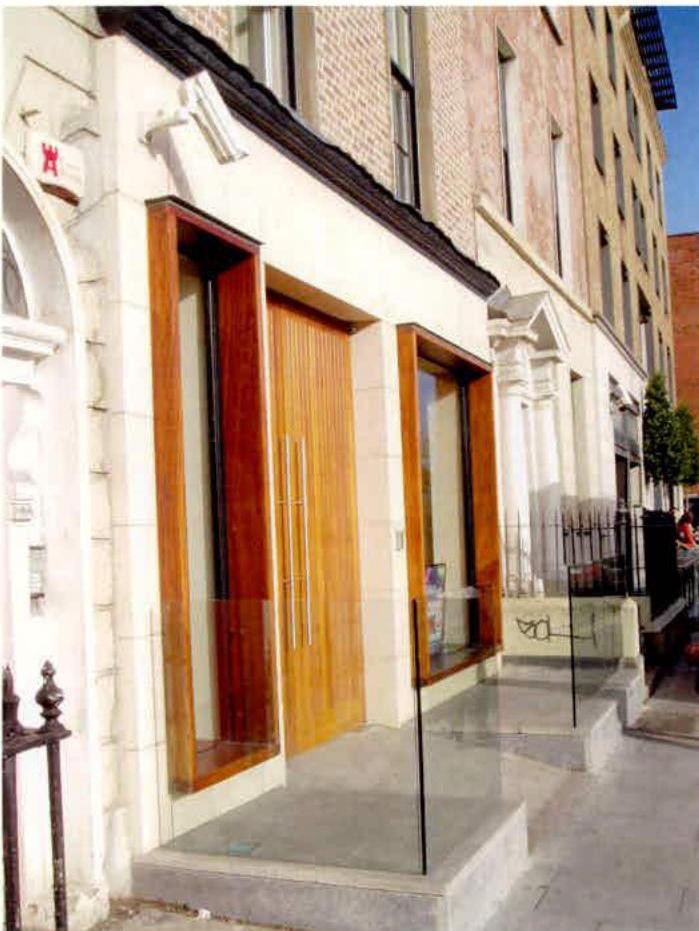
It is proposed to use a high quality stone cladding with a bushhammered finish as the main material at ground floor level. This will provide a suitably robust and formal base to the building. The entrance doors and windows to the offices and apartments are of frameless glass, which is set well back into the depth of the wall and enclosed by, painted steel channels forming shadow gaps. Guarding to the lower ground floor light well is formed from 1100mm tall frameless, toughened and laminated safety glass. This finishes at either end against a stone clad wall. The glazed guarding allows the lower section of elevation (below footpath level) to be read with the ground floor at close quarters, and along with the ‘Luxcrete’ entrance bridges admits maximum levels of daylight to the lower floor. The ground level floor plate is cut back from the windows inside the building. This again allows light to the lower level and becomes an integral part of the elevation design to the passerby.
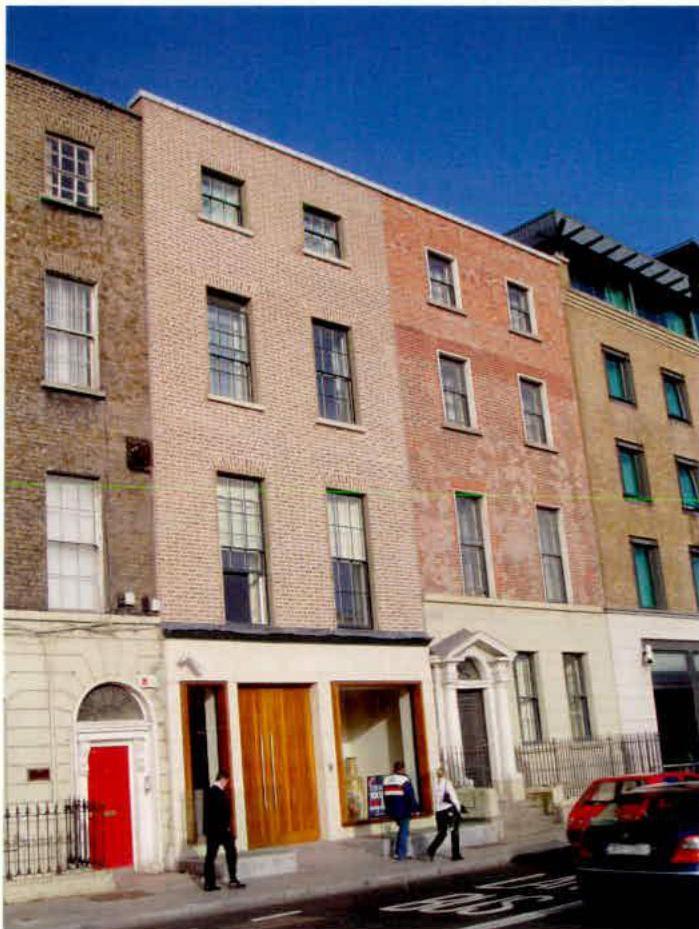
We are of the firm opinion that buildings such as this can benefit enormously from subtle, well designed and well detailed modern interventions within their fabric and that this in turn contributes much to the streetscape within which it is contained. Buildings of the period of many on Finch Road have a robustness that can accommodate sensitive adaption. The elevational treatment proposed is intended to signal some of this progressive change and enliven the streetscape with views into and out of the building as well as providing light and a ‘shop front’ presence for the occupants. Pictured below is an commendable example located in Dublin of these principals.
Above & Below: Excellent example of adaptive reuse of a period building on Dublin's quays. Incorporates modern ground floor frontage using high quality materials.
The gable elevation of the proposed building, which faces Black Marina Road, is designed to have cognisance of its prominence when approached from the north. This prominence is amplified by the fact that one is ascending towards the building.
The gable of the main volume is given clear expression with the projecting volume appearing subservient (it's roofing is standing seam zinc to distinguish it from the main volume). The two replacement windows are combined into a slightly projecting form, which will provide a simple element of relief to this elevation.
The main volume of the rear apartment addition has been kept well back from the gable wall.
The rear elevation can afford to be more modern and pragmatic. It accommodates large areas of folding and sliding glazed doors opening to private balconies. The apartments are afforded views out to sea and with the doors fully open, the balconies become much more useable spaces than with standard doors.
The balconies are framed in lightweight steel with glass guarding to give them a visual lightness against the rendered building.
The main rear walls of the building are finished with a self-coloured render.
The car parking structure takes advantage of the otherwise unusable rear garden to provide 17 car spaces for residents and office occupants. It also incorporates ancillary spaces such as waste and bicycle storage.
The three levels are accessed via a ramp and car lift.
The upper level is open to the elements and the lower levels receive abundant cross ventilation through the fixed louver panels.
Externally, the car park is finished in a self-coloured render and with precast coloured concrete stepping plinths where it meets the slope of Well Road Hill.
A secondary entrance / emergency exit is located off Well Road Hill to serve the car park and lower building levels.
We have submitted a full set of scheme drawings to the Borough of Douglas Drainage Department for their comments prior to lodging this planning application.
The Borough have indicated that they have no objection in principal to the proposals subject to compliance with their conditions. We attach a copy of letter from Mr Peter Quirk in this regard.
It is intended to re-route the existing drainage to the rear of the property by dropping its level via a cascading manhole at manhole no. 804. This will allow the drain to continue under the slab of car park level 3 before rejoining the existing drains at a new manhole on Well Road Hill. The drain passing under the slab of the car park will be constructed and made accessible as required by the Borough. We confirm that all requirements of the Borough Drainage department will be complied with in the detail design of this system.
It is intended to utilise a rain water harvesting system to minimise water run-off from the buildings roof and paved surface areas. The system will use a rain water harvesting tank and oversized pipes to store the excess run-off water. The water will then be recirculated to W.C. appliances in the building.
Please refer to notes on drawing PP-06 for further foul and surface flow rate information.
Copyright in submitted documents remains with their authors. Request removal
View as Markdown