Loading document...
5.4 To illustrate that Windsor Court is not an isolated example, Photo No.'s 4 & 5 below indicate the situation at Africa Court, a development of nine, three and four bedroom properties, together with two apartments, on a plot with a total site area of just over 2,300 Sq.m. giving a plot area of 209 Sq.m. per dwelling. The development again takes the form of a communal court providing vehicular and pedestrian access. To the rear of the properties are private gardens, which are approx. 4.5m in depth and 6m in width, bounded by stone boundary walls of adjacent properties to the rear.
Photo No.4 – Africa Court Development – Douglas
The photograph above shows that in this development, there is a shared vehicular and pedestrian access surface, which has only limited separation of the two functions close to the individual properties. This development again has little landscaping to soften the court area, with the properties arranged in a triangular pattern looking inwards into the court. Again vehicles are parked within close proximity of the dwellings, and the situation exists where adjacent residents are overlooking each others parked vehicles.
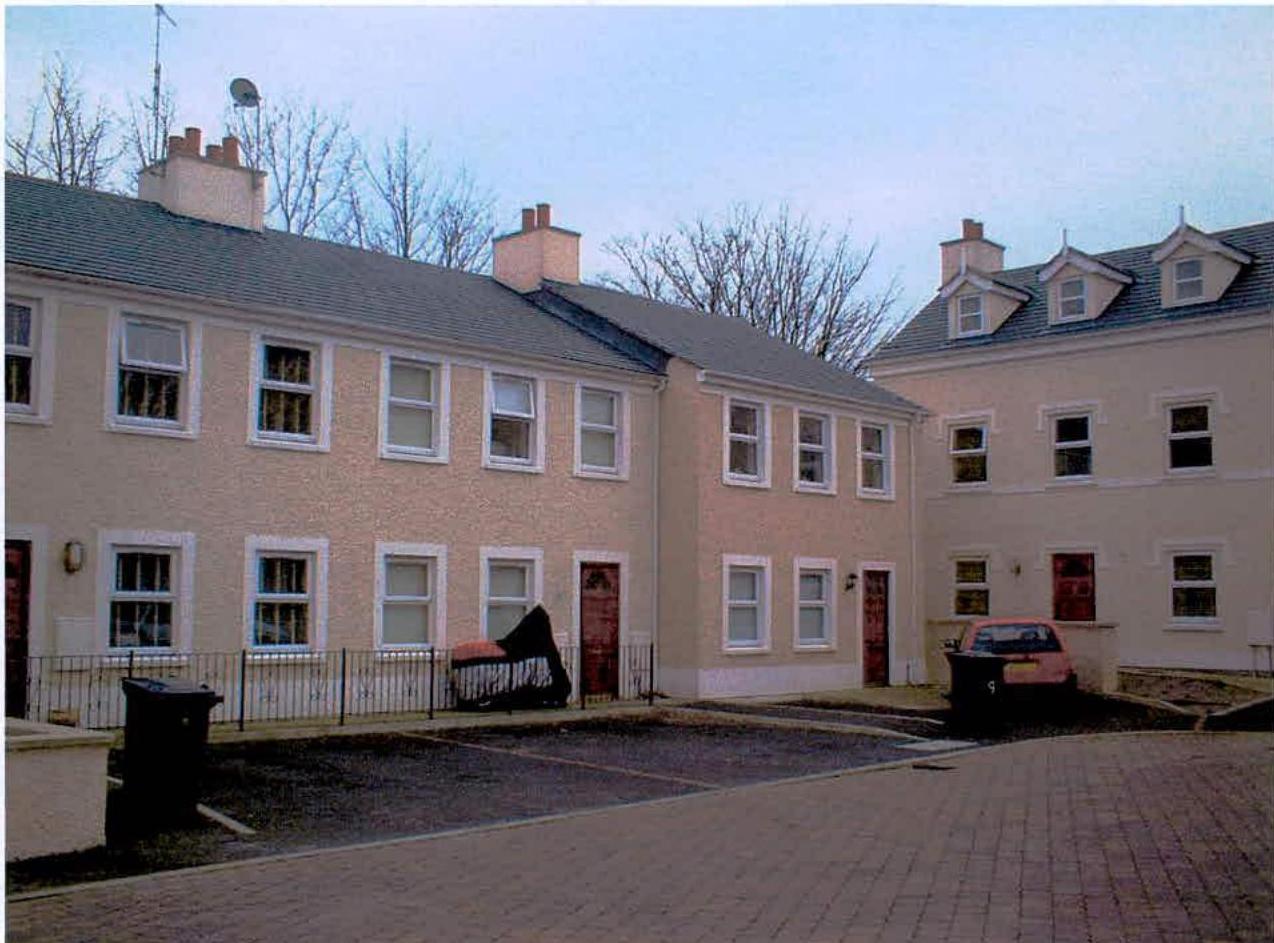
Photo No.5 below shows that there is approx. 1m separating the parked vehicles from the front of the properties, with paving between. There is little or no soft landscaping to break up this hard landscaping. However, within the application, even though there is an isolated case where two vehicles would be parked within 1.2m of the front of two properties (houses 1&2), these parking bays have soft landscaping to both sides, and to the rear of one, which acts to soften the appearance of the area, and break up the hard landscaping.
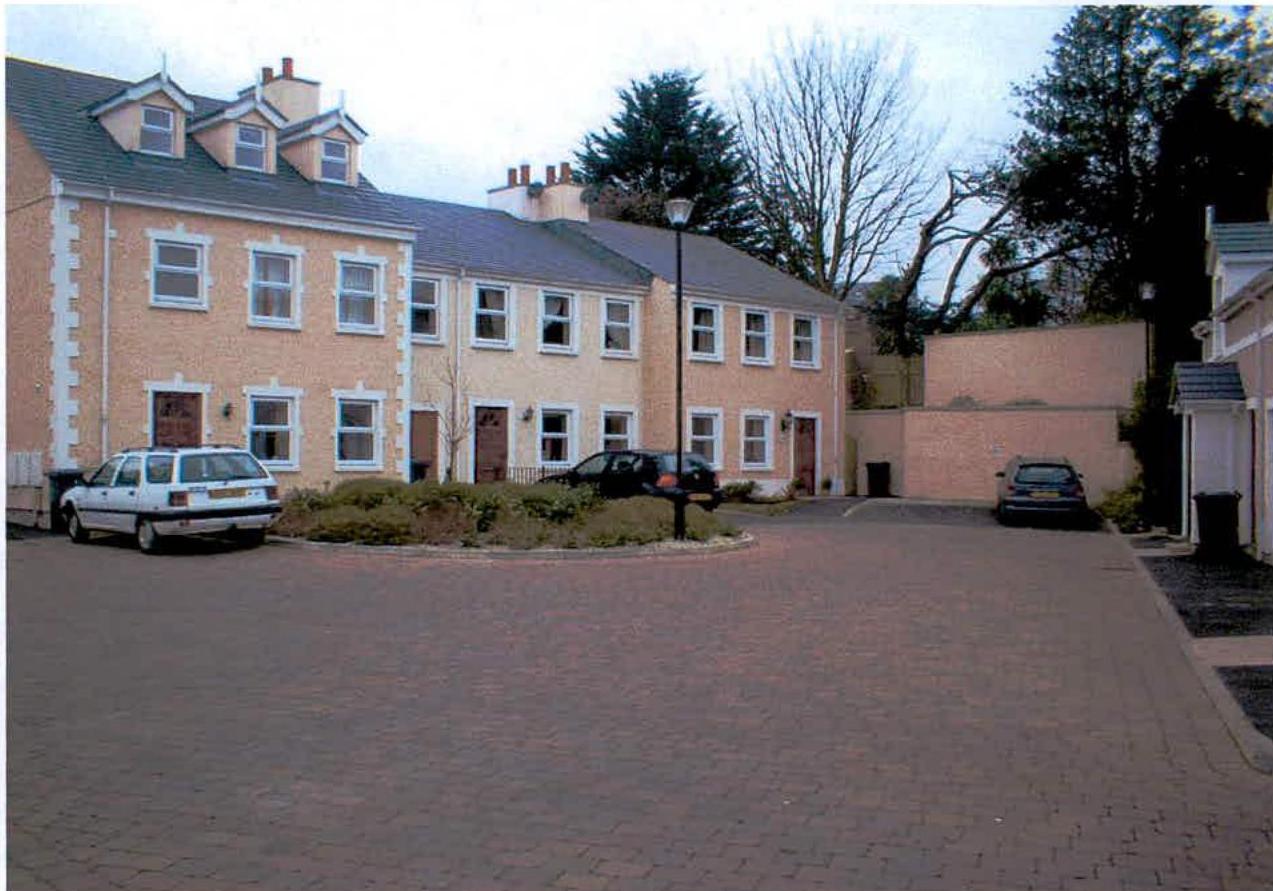
Photo No.5 – Africa Court Development – Douglas.
5.5 With regards to the Planning Committee’s concerns over vehicles from adjacent properties being parked in front of other dwellings, the applicant would note that within court type developments, it would be almost inevitable for such situations to exist. Having reviewed the drawings, the applicant believes that with specific allocation of car parking spaces, that a situation could be provided where only the house occupier’s car would be directly outside their own property, with the secondary space for each dwelling being located more remotely within the more communal bays. To illustrate this, a sketch plan has been included in Appendix C of this statement, which the applicant believes would give a satisfactory solution to this matter, whilst providing the required parking provision. This proposal would not alter the physical layout of the scheme, merely the allocation of spaces, and therefore would have no procedural impact on the application, should it be approved at appeal and the scheme implemented.
6.1 Within the review statement, the applicant advised that should this application be refused at review on grounds of over intensive use, then the only viable option would be to submit a further revised scheme with fewer dwellings. Following the refusal at review, the applicant prepared a further scheme which was submitted under a new application (PA05/92137/REM). This application sought permission for three dwellings with attached garages, parking & landscaping. This application has been approved by the Planning Committee on 2nd February 2005.
6.2 As the applicant made clear in the review statement, due to commercial realities, such a revised scheme would inevitably require the properties to be larger than those proposed in this application, to include garage facilities, separate kitchen and dining facilities, a utility, guest cloakroom and four bedrooms, at least one having en-suite bathroom facilities, all of the above being required by the marketplace for such properties. The generally triangular shape of the site does not lend itself to four or five mid-sized properties, and the market again starts to require more accommodation, even for such dwellings. Therefore three larger dwellings work best within the confines of the site.
The resulting application proposed relatively compact four bedroom dwellings with single garages and parking spaces, which are not in themselves excessive in size. Nevertheless, the built form of the three properties, are larger than the cumulative size of the six dwellings within this application. To illustrate this, the cumulative total of site area taken up by buildings within the appeal application is 274 Sq.m. Within the application for three dwellings, which has just been approved by the Planning Committee, the total of site area taken up by buildings is 314 Sq.M. This is 40 Sq.m. more built form on the approved application, than on the appeal application. To put this in perspective, that is equivalent to the footprint of a seventh dwelling of the same size as those proposed in the appeal application.
In addition to the above, the area of the application site is approx. 1,250 Sq.m. which gives a plot area of 208.33 Sq.m. per dwelling. This plot area is significantly in excess of the plot area for the Windsor Court development, and equal to the plot area of the Africa Court development. The applicant therefore believes that the proposal does not represent over-intensive use of the site, as the Planning Committee have in the past approved developments of the same or significantly higher densities, and within areas which have little or no other compensating amenity, in terms of open space and views.
6.3 Prior to the submission of any application on the site, the applicant carried out market research into the requirements of the local housing market. The resounding answer was that smaller first time buyer housing was desperately needed. This fact is borne out by the governments own list of people requiring affordable/first time buyer accommodation, which has continued to rise. The applicant therefore feels that the approval of this scheme for six dwellings has less visual impact than the new scheme recently approved, but releases six smaller dwellings to the market to provide much needed accommodation for those wishing to join the housing ladder.
6.0 CONCLUSION
To conclude, the applicant would respectfully ask the Inspector to consider the views put forward in this statement, and see fit to overturn the decision of the Planning Committee to refuse the application, by upholding the appeal and approving the application.
Copyright in submitted documents remains with their authors. Request removal
View as Markdown