Ecology Vannin: 7-8 Market Place, Peel, Isle of Man.
Ecology Vannin: 7-8 Market Place, Peel, Isle of Man.
Job number:
23_48
Title:
Howstrake B2, Preliminary Roost Assessment
Client:
Nicholas Brian Design
Prepared by:
Greg Watson – Trainee Ecologist
Verified by:
Adam Denard BSc (Hons) MCIEEM
Date of Issue:
8 December 2023
This report is prepared by Ecology Vannin Consultancy Services for the sole and exclusive use of Nicholas Brain design and their contractors in response to their particular instructions. No liability is accepted for any costs, claims or losses arising from the use of this report or any part thereof for any purpose other than that for which it was specifically prepared or by any party other than Nicholas Brian design. Any biological records for wildlife found in survey will eventually be submitted to Manx Biological Recording Partnership.<br><br>Ecology Vannin Consultancy Services is the trading name for Wildlife Limited, Reg Company No: 077379C. Wildlife Limited is a wholly owned subsidiary of Manx Wildlife Trust (MWT), Reg Company No: 005297C.This report does not prevent MWT pursuing its charitable objectives in relation to planning. This technical note has been prepared by an environmental specialist and does not purport to provide legal advice. You may wish to take separate legal advice. The information which we have prepared and provided is true and has been prepared and provided in accordance with the BS42020 2013 and Chartered Institute of Ecology and Environmental Management’s Code of Professional Conduct and guidelines for preliminary ecological appraisals (CIEEM 2017). We confirm that the opinions expressed are our true and professional bona fide opinions.<br><br>Signed (QA) Signed (Author)<br><br>
Biographies
Greg Watson BSc (Hons) is a trainee ecologist who was born on the Isle of Man with experience in protected species surveying including bats, lizards and frogs. Greg holds a first-class Bachelor of Science degree with honours in Wildlife Conservation which has given him field skills for ecological surveying and census techniques. Further, Greg has acquired a strong understanding of the legal frameworks in the United Kingdom and the Isle of Man surrounding the protections afforded to habitats and species. He also has experience in avian species monitoring including Birds of Conservation Concern (BoCC) such as hen harrier and arctic tern and has been the leader of a protection and monitoring team for the rare breeding European bee-eater in Norfolk, England.
Adam Denard BSc (Hons) has been a professional ecologist for over 10 years, with particular emphasis on recording and assessing habitats in England and the Isle of Man for their potential to support protected species. Adam regularly produces professional ecological reports within the Isle of Man planning system for ecological appraisals, impact assessments, mitigation plans and specialist protected species surveys (including bat roost and bat activity surveys and reports). Adam has been undertaking professional bat surveys since 2003 and has been licensed to disturb bats in England & Wales (English Nature Licence holder 2008-09) and is now a government licensed bat worker in the Isle of Man.
Executive Summary
A Preliminary Roost Assessment was undertaken on a building proposed for removal on the old Howstrake holiday camp. This involved an internal inspection on three sections of the building using visual observation with the aid of a high-powered torch and endoscope to survey for evidence of bats. There was no evidence of bats found during this survey.
Key constraints and mitigation are:
• Timing of works
• Pre-demolition inspection for bats
1.0 Policy and Law
Bats
1.1 Horseshoe bat (all species) Rhinolophidae and typical bats (all species) Vespertilionidae, are protected under Schedule 5 of the Isle of Man Wildlife Act 1990 (as amended).
1.2 As such, a person is deemed to have committed an offence if he or she:
“damages or destroys, or obstructs access to, any structure or place which any wild animal included in Schedule 5 uses for shelter or protection; or disturbs any such animal while it is occupying a structure or place which it uses for that purpose”.
Planning Policy
2.8 The Isle of Man Strategic Plan has been prepared in accordance with Section 2 of, and Schedule 1 to, the Town and Country Planning Act 1999. Of particular relevance to ecological impact considerations and planning are contained within Environment Policies. Key policies relating to species, habitats and protected areas are provided in Appendix V.
1.0 Introduction
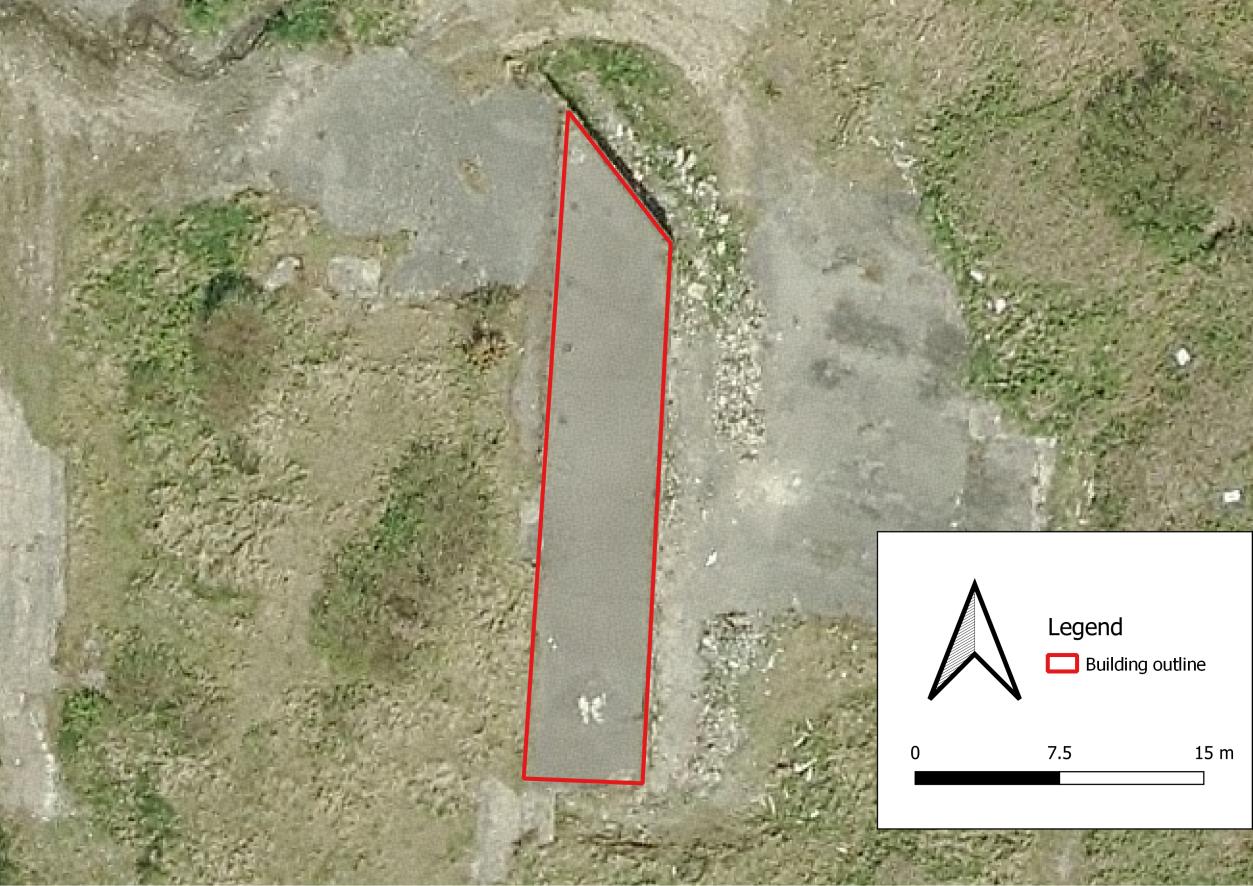
1.1 Ecology Vannin was commissioned by Nicholas Brian Design to undertake a Preliminary Roost Assessment on building 2 on the old Howstrake holiday camp, King Edward Road, Isle of Man (OS centroid grid reference SC 4192077990). This is in relation to plans remove the existing building.
1.3 The survey was undertaken on 23/11/23 by trainee ecologist Greg Watson with guidance from Senior Ecologist Adam Denard. Conditions were cool (8oC) and overcast with some sunny intervals. Site description
1.4 The building comprised of an old stone single storey structure with a flat roof and three internal sections. The surrounding an area was comprised of scrub, coastal grassland and bracken.
1.5 In a wider context, the site lies within 200m of the coastal sea cliffs on the east coast of the island. It is within a predominantly scrubby adjacent to areas of some smaller areas of natural woodland. Levels of exposure relatively high but not considered a limiting factor to the potential presence of bats.
An aerial site plan displaying a red outline of a building footprint on a grassy and paved area, with a legend and scale bar.
2.0 Methods Preliminary Roost Assessment
2.1 A PRA was undertaken to assess the suitability of the site to support roosting bats and look for any historical evidence of roosting bats within the internal niches of the buildings.
2.2 A check of all safely accessible exterior structural niches deemed suitable for use by roosting bats (e.g., roof voids, ridge beams, gaps in stonework, gaps between stonework and window and door lintels) was undertaken. Checks were made using a high-powered led spotlight (1000-1200 lumen) and an endoscope, aided by the use of 8x42 close focussing binoculars.
3.0 Results
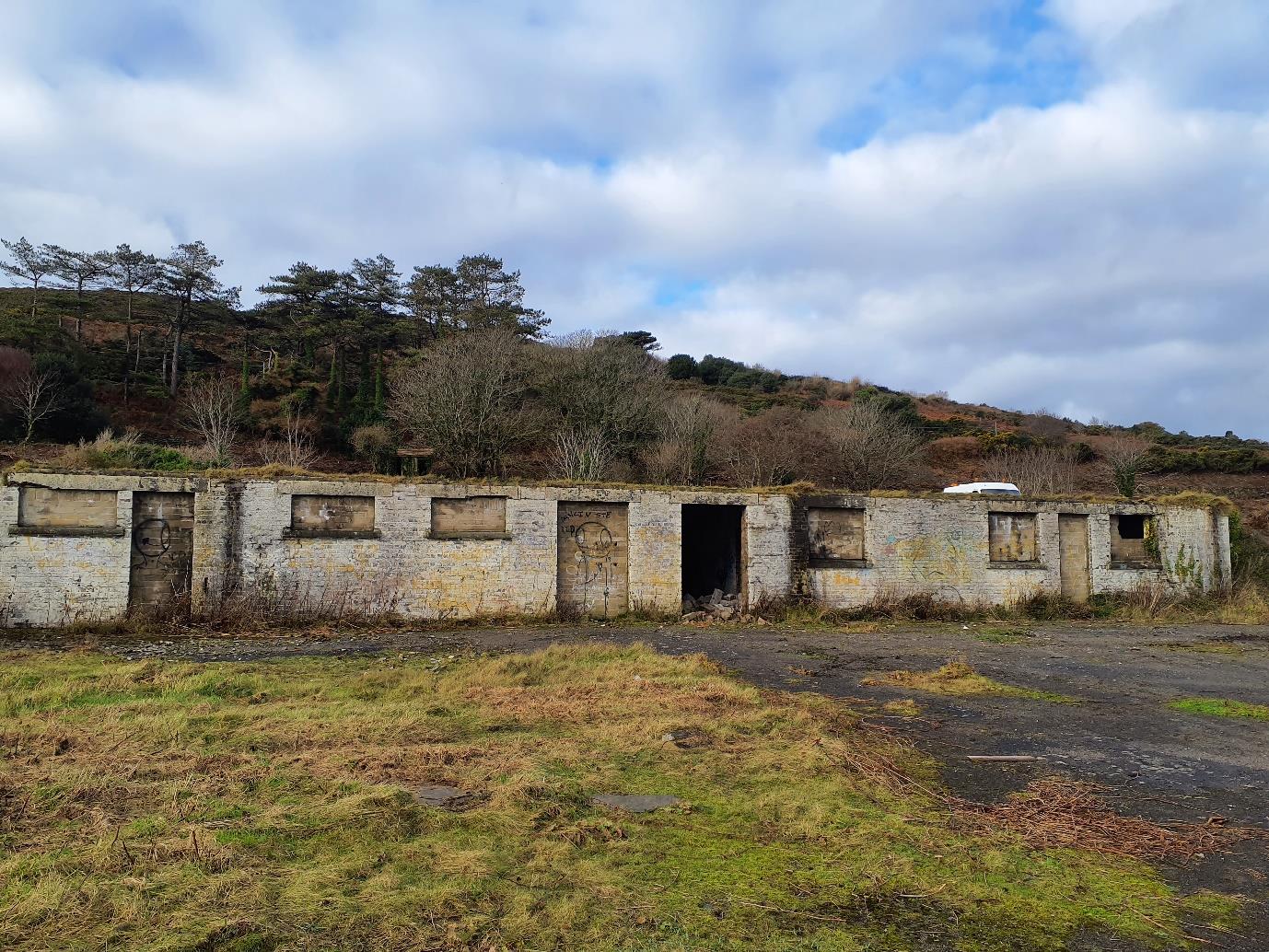
3.1 This building has potential entry points for bats through old door and window frames however it has more recently been boarded up due to trespassing individuals frequently entering the building. An entrance section at the centre of the building has recently been opened up along with a couple of window sections in order to reassess the internal conditions for bats.
Photograph 1. A photograph of the eastern face on the building, with previous entry points indicated by the yellow circles.
A photograph showing a long, derelict concrete building with multiple bays, possibly garages, situated in a grassy field with trees in the background.
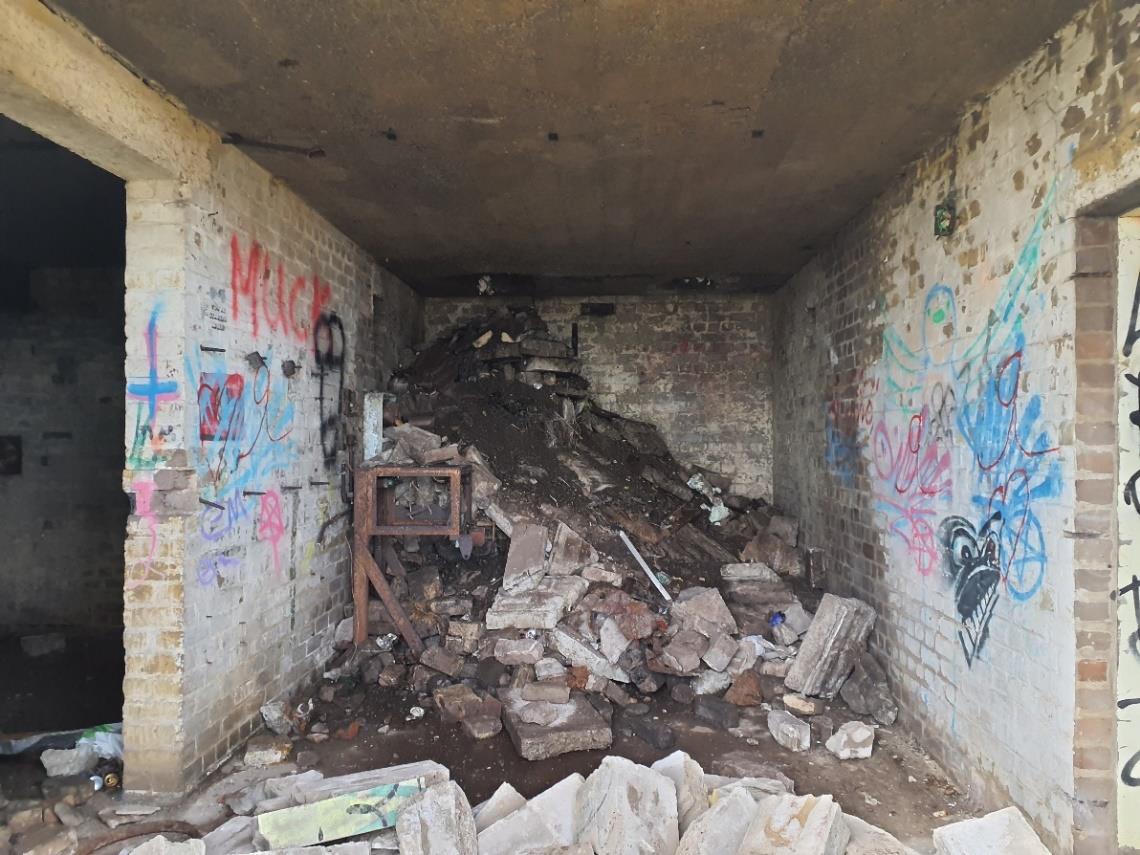
3.2 The initial entry point to the central room/hall of the building contained a pile of heaped waste material. There were crevices in the bricked wall and roof area that were able to be inspected with a high-powered torch. No evidence of roosting bats was found in this section.
Photograph 2. A photograph of the central room adjacent to the entrance into the building.
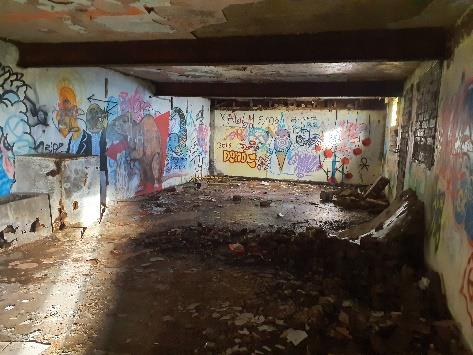
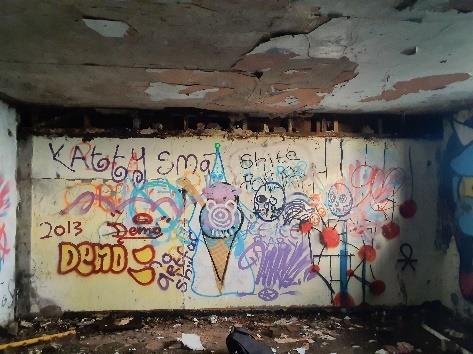
3.3 The north section of the building contained a room with concrete walls and metal beams that ran parallel across the roof. This room contained piles of rubble and stone. Crevices were inspected with torchlight and endoscope in sections of the wall where windows had been bricked up. Deeper internal cavities were found in the western wall and inspected with endoscope. The length of steel beams that presented a PRF was inspected with torchlight.
3.4 Close inspection did not find any evidence of bats in this room.
Interior photograph of a dilapidated brick structure filled with a large pile of rubble and debris, with graffiti on the walls.Interior photograph of a derelict concrete structure with extensive graffiti on the walls and debris scattered on the floor.The image displays the interior of a derelict structure featuring a wall covered in colorful graffiti and a damaged, peeling ceiling.
Photographs 3 - 6: The northern section of the building with inspected PRF’s highlighted by yellow circles.
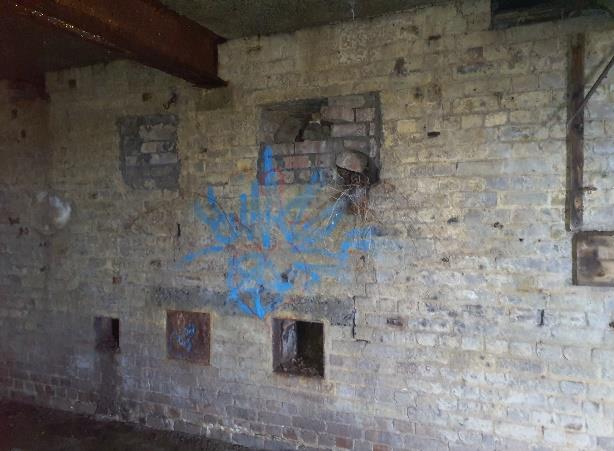
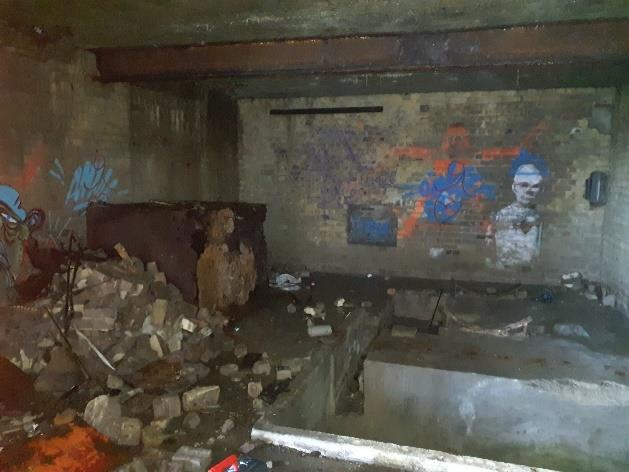
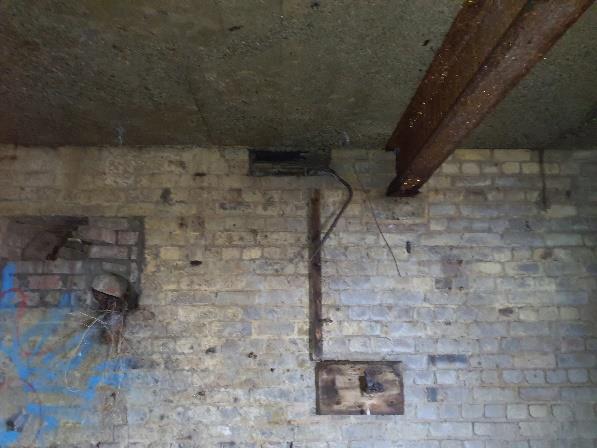
3.5 The room to the south of the buidling consists of concrete walls with steel beams on section of the roof. This room conatins piles of rubble and stone, sections of the floor have been trenched to hold water tanks. Along the western wall there are a number of inlets at different heights which were all inspected with endoscope and torch light.
3.6 Close inspection did not find any evidence of roosting bats in this room.
Photographs 7 - 9: The room to the south of the buidling with the inspected PRF’s highlighted by yellow circles.
An interior photograph of a weathered brick wall featuring blue spray paint graffiti and several blocked or open apertures.Interior view of a dilapidated brick building with graffiti on the walls and rubble scattered on the floor.Interior photograph of a dilapidated room with peeling paint and extensive graffiti art on the walls.Interior photograph of a dilapidated brick wall with a concrete ceiling and rusty metal beam, likely part of a derelict structure.
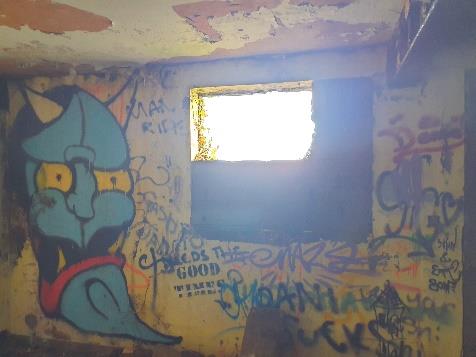
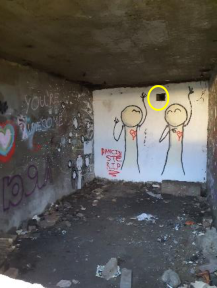
3.7 The small room to the southern edge of the buidling contains concrete walls and a bricked up window. There are crevices between the brick on the eastern side of the wall which were inspected by endoscope and torch. Holes were present in the southern wall likely for electrical fitting and/or piping, these cavities were also inspected.
3.8 Close inspection found no evidence of roosting bats in this room.
Photographs 10 - 12: The room at the southern edge of the building with the inspected PRF’s highlighted in the yellow circles.
3.0 Discussion
3.1 There were PRF’s found in all rooms of this building, this included small crevices that crevice dwelling species such as Common pipistrelle (Pipistrellus pipistrellus) may use, further, there were open spaces with structure to provided niches for bats to hang from. A high-powered torch and endoscope were used to inspect these features where appropriate. There was no evidence of bats found. Further, surfaces did not reveal dropping or other forensic evidence that may be left by historic use by roosting bats.
4.0 Conclusion
4.1 Due to the lack of evidence of the presence of bats, the demolition should proceed as soon as possible. As bats are a highly mobile species the niches identified in this report could still become inhabited, therefore, it is recommended that a final check is done within 24 hours of the building being demolished. Further, prior to demolition a suitable bat box should be erected somewhere on site to ensure that in the event if bats being found in the pre-demolition check can be translocated.
Interior photograph of a derelict room with graffiti-covered walls and debris on the floor, highlighting a small vent.
Copyright in submitted documents remains with their authors. Request removal