Loading document...
1.1 This Operational Policy document sets out the criteria the Department will follow when assessing buildings for including in to the Protected Buildings Register, a register of buildings of special architectural or historic interest. It is issued by the Department of Environment, Food and Agriculture with the approval of the Minister.
2.1 Most European countries have systems to protect and to control change on important historic buildings. The system in the Isle of Man operates under the Town and Country Planning Act 1999. Registration ensures that a building's special character and interest are taken into account where changes are proposed. The Protected Buildings Register is compiled for the purposes of the 1999 Act and for guidance of the Department in its performance of its duties set out in the 1999 Act. The 1999 Act places a duty on the Department to maintain a register of buildings of special architectural or historic interest. 2.2 The Protected Buildings Register is available on the Department's website. Registration is the statutory process by which buildings are added to the Protected Buildings Register. Once included on the Register both exterior and interior has statutory protection under the provisions of the 1999 Act. Registration is intended to maintain the character of the Island's built heritage and to guard against unnecessary loss or damage. 2.3 Any building or man-made structure could be considered for entry into the Protected Buildings Register.
3.1 As set out in Section 14(1) of the Town and Country Planning Act, the Department uses the criteria set out below when assessing whether a building is of special interest and therefore should be added to the Register.
3.2.1 To be of special architectural interest a building must be of importance in its architectural design, decoration or craftsmanship; special interest may also apply to nationally important examples of particular building types and techniques (e.g. buildings displaying technological innovation or virtuosity) and significant plan forms.
3.3.1 To be of special historic interest a building must illustrate important aspects of the nation's social, economic, cultural, or military history and/or have close historical associations with nationally important people. There should normally be some quality of interest in the physical fabric of the building itself to justify the statutory protection afforded by Registration.
4.1 As set out in Section 14(2) of the Town and Country Planning Act, the Department will also take into account when considering whether to enter a building onto the register the following:
4.2.1 When making a decision to register, the Department may take into account the extent to which the exterior contributes to the architectural or historic interest of any group of buildings of which it forms part. This is generally known as group value. The Department will take this into account particularly where buildings comprise an important architectural or historic unity or a fine example of planning (e.g. squares, terraces or estates) or where there is a historical functional relationship between a group of buildings (e.g. farm complexes). If a building is designated because of its group value, protection applies to the whole of the property, not just the exterior.
4.3.1 When considering whether a building is of special architectural or historic interest the Department may take into account the desirability of preserving, on the grounds of its architectural or historic interest, any feature of the building containing a manmade object or structure fixed to the building or forming part of the land and comprised within the curtilage of the building. The desirability of preserving such a feature is a factor which would increase the likelihood of the building being registered. However, in the absence of any other aspects of special architectural or historic interest, such features will justify the registration of the building only if they are of themselves of sufficient interest to render the building of special interest. The provision can be used for a variety of features; examples could include a finely panelled sixteenth century room, a fireplace and over-mantel that has been introduced from another building, or an elaborate plaster ceiling. This provision cannot be used to preserve in situ anything that is not a fixture, such as furniture or paintings.
5.1 In applying the statutory criteria and considerations, as set out above, the Department will also consider the following principles:
Age and rarity. The older a building is, and the fewer the surviving examples of its kind, the more likely it is to have special interest. The following chronology is meant as a guide to assessment; the dates are indications of likely periods of interest and are not absolute. The relevance of age and rarity will vary according to the particular type of building because for some types, dates other than those outlined below are of significance. However, the general principles used are that:
Aesthetic merits. The appearance of a building – both its intrinsic architectural merit and any group value – is a key consideration in judging registration proposals, but the special interest of a building will not always be reflected in obvious external visual quality. Buildings that are important for reasons of technological innovation, or as illustrating particular aspects of social or economic history, may have little external visual quality.
Selectivity. Where a building qualifies for registration primarily on the strength of its special architectural interest, the fact that there are other buildings of similar quality elsewhere is not likely to be a major consideration. However, a building may be registered primarily because it represents a particular historical type in order to ensure that examples of such a type are preserved. Registration in these circumstances is largely a comparative exercise and needs to be selective where a substantial number of buildings of a similar type and quality survive. In such cases, the Department’s policy is to register only the most representative or most significant examples of the type.
National Context. The Isle of Man is a separate entity to the UK and the unique context of the Island’s historic development must be taken into consideration as part of the selection process. Special interest is likely to be conferred on buildings which may not be the case if they were in the UK, given the Island’s unique context.
State of Repair. The Department should register a building which has been assessed as meeting the statutory criteria, irrespective of its state of repair or other factors such as implications for future use or financial issues.
6.0 IDENTIFICATION OF BUILDINGS FOR CONSIDERATION FOR REGISTRATION - 6.1 Buildings may be identified for entry in to the register in several ways:-
1 *The year 1860 was selected because of the change which followed, in terms of the of the increase in building due to the boom of the island’s tourist industry which saw building on an unprecedent scale.
The Department will generally prioritise the consideration of buildings for registration in the following way:
In certain circumstances the Department may prioritise buildings for consideration by means other than the above. For example, as part of a particular theme or when important information or evidence is uncovered that makes a clear case for a building being of special interest.
| Priority | Category |
|---|---|
| High | Buildings that are at risk of demolition or significant alteration |
| Medium | Buildings identified in the provisional list |
| Medium | Buildings identified in area plans |
| Low | Buildings not at risk and that have been proposed by any other means |
Registration Notice and Entry Documents for Ballaradcliffe House
NOTICE IS HEREBY GIVEN that at a meeting held on the 20th March 2007, the Department of Local Government and the Environment, in pursuance of its powers under the above Acts and Regulations REGISTERED
as represented by the buildings delineated on the plan hereto attached, in the PROTECTED BUILDINGS REGISTER by reason of its special architectural and historic interest.
THE EFFECT OF THIS REGISTRATION IS IMMEDIATE and prohibits the alteration or demolition of the structure or appearance of any part of the building except in compliance with an obligation imposed by or under any statutory provision or with the prior written consent of the Planning Committee.
Dated this 23rd March 2007 By Order of the Department Redacted E J Callow Secretary, Planning Committee. 1st Floor, Murray House, Mount Havelock, Douglas,
NOTE :
Under The Town and Country Planning Act 1999;
Schedule 2 The Protected Buildings Register
Notifications of entries on register etc.
(2) The owner or the occupier of, and any other person having an interest in, a building which has been entered in the register may apply to the Department to remove the building from the register-
Under the Registered Building Regulations 2005
(1) The period specified for the purposes of paragraph 2(2)(a) of Schedule 2 to the Act (period after notice of registration, within which owner or occupier may request de-registration) is 21 days.
(2) The period specified for the purposes of paragraph 2(2)(b) of Schedule 2 to the Act (period after initial period, during which owner or occupier may not request a de-registration) is 5 years.
c.c.:
| Date | 23 March 2007 |
| Comments | 07/00247/REGBLD |
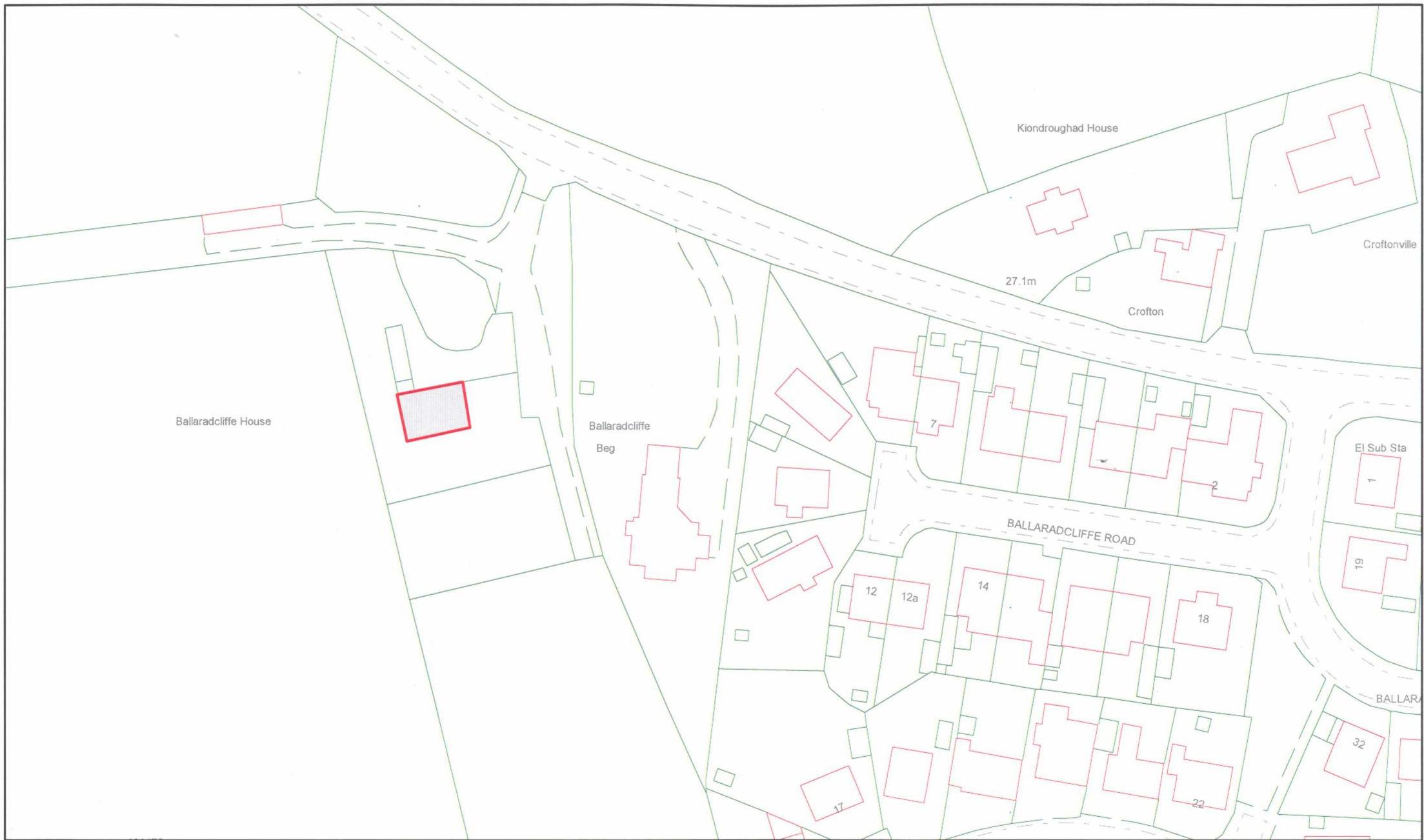
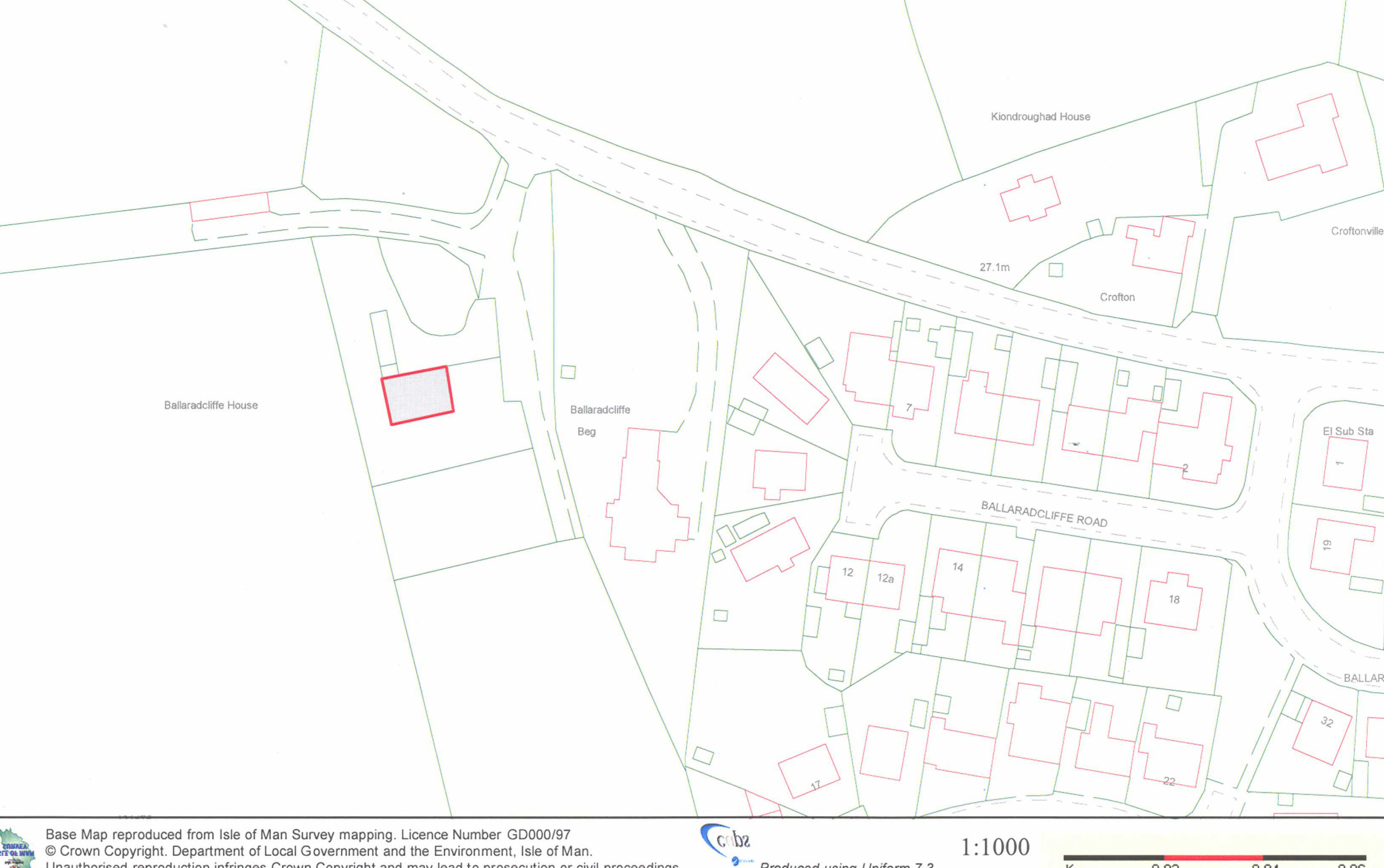
| NAME: | Ballaradcliffe House | | :-- | :-- | | ADDRESS: | Kiondroghad Road, Kirk Andreas | | POST CODE: | IM7 3EL | | LOCAL AUTHORITY: | Andreas Parish Commissioners | | GRID REF: | 407995 |
Ballaradcliffe House (plates 1 \& 2) was the quarterland farm house of the Radcliffe family who have occupied a property on this site since the sixteenth century. The current house was built during the mid-nineteenth century and was included in the Ordnance Survey map of 1869 (Appendix 3).
Ballaradcliffe quarterland was located in the treen of Ballahestine, within the Parish of Andreas, in the sheading of Ayre. Other quarterlands in Ballahestine treen were Balla Steen, Larebane (now Larivane) and Ballavoddan. The quarterland of Ballaradcliffe included a large part of the present day village of Andreas. Due to the central position of the estate within the parish of Andreas and the close proximity of the village and church, it was only a matter of time before some of the land was developed.
Andreas parish is located centrally in the northern plain, the land use is predominantly agricultural and due to the richness of its tithes, until recent times the parish was the seat of the Archdeacon of Mann.
'Ballaradcliffe' quarterland dates back to the sixteenth century when the land first came into the ownership of the Radcliffe family and the estate has remained in the same family for over four hundred years.
The Radcliffe family originated from Lancashire and came to the Island following the success of the Stanley family, who became Lord's of Mann in the fifteenth century. It is believed that the Radcliffe's first came to 'Ballaradcliffe' in the sixteenth century after a member of the family married the heiress to this part of Ballahestine treen in Andreas.
According to Constance Radcliffe there is a possibility that the first Radcliffe at Ballaradcliffe was Henry Radcliffe, previously a monk from the Friary of Bemaken in the parish of Arbory, whose father was the Abbott Thomas Radcliffe at the time of the Dissolution in 1540. It is stated that following the Dissolution of the monastery, Henry Radcliffe married a Miss Kelly (or Machellie) who was the heiress of the Balley Hastyn estate which was one of the Andreas treens, and as a result of this union 'Ballaradcliffe' was created. "Whether the Andreas Radcliffes are all descended from a
monk of Rushen Abbey or not, the Liber Assedations confirms that the original owners of Ballaradcliffe were the Machellies, and that the Radcliffes first entered there in the middle of the sixteenth century." (Radcliffe, IOMNH\&AS, vol III, no.2, pp.172/3). The dates of this correspond with accounts of the Radcliffe's moving to Andreas and there would have been few Radcliffe's on the Island at that time so it is possible that there was a connection.
Charles Bland Radcliffe (b.1822, d.1889) Although he was born in Brigg, Lincolnshire, Charles Bland Radcliffe was the son of Manx parents. His father Charles Radcliffe was a Wesleyan minister who had originated from Ballaradcliffe, he happened to be stationed at Brigg when Charles Bland, his eldest son, was born.
Charles Bland Radcliffe is known for being one of the earliest investigators of the electrical physiology of muscle and nerve. Two of his brothers became Wesleyan ministers like their father and a third brother was an antiquarian.
William John or 'Willy' Radcliffe was the Member of the House of Keys for Ayre from 1903 to 1916. He was also a member of the School Board, the Parish Commissioners and had been a Wesleyan local preacher for 30 years. He never married and lived at Ballaradcliffe until his death in 1916.
On the 24th June 1906 the Lieutenant Governor Lord Raglan visited Willy's Radcliffe's home at Ballaradcliffe and a photograph was taken in order to mark the occasion (Appendix 2). Also pictures are the Andreas Benevolent Society, which was founded in 1812 in order to help the parish poor and it is the only Benevolent Society in Britain which still remains today.
Ballaradcliffe is a mid-nineteenth century farm house. There are both Georgian and Victorian influences in the property, although the exterior is a typical Georgian style house. The property has been little changed since its construction and it includes the main living areas on the ground and first floors, in addition to attic space and a halfbasement (see Appendix 7 for the current floor plans).
The front aspect of Ballaradcliffe is exceptionally striking (plate 1), sitting on the brow of a hill, well-positioned in the landscape and with southerly views across the northern plain towards the hills (plate 3). The front elevation also has a much more fashionable style than the rear, but despite this the only entrance to the house is from Kiondroghad Road at the rear where the views to the property are more modest (plate 4), and on closer viewing the rear elevation has even remained unrendered (plate 5). The Ordnance Survey map of 1869 indicates that even at that time, the property was accessed from the Kiondroghad Road and the grand views of the front of the house were only seen from the road across the fields at the front of the property and not as the property was approached.
The exterior style of the property is typical of Georgian houses in that the front façade is elegant and formal with a square symmetrical shape and there is a panelled door in the centre with a fan light over (plate 6). The design of the fanlight was originally straight lines radiating out from a central arch at the bottom above the door, but it
has since been replaced with an inappropriate style of horizontal and vertical lines, not too dissimilar than the appearance of rows of bricks. The original fan light is clearly visible in the archive photograph dating from 1906.
Further features of the house which are commonplace with Georgian properties include the tiled hipped roof, the paired chimney stacks and the sash windows which consist of six panes over six panes (plates ). The archive photograph from 1906 clearly shows that the earlier windows were six over six pane sashes, however since that time the front half have been replaced with the later Victorianstyle two pane over two pane sashes (plate 12), whilst the back half have remained in the Georgian-style.
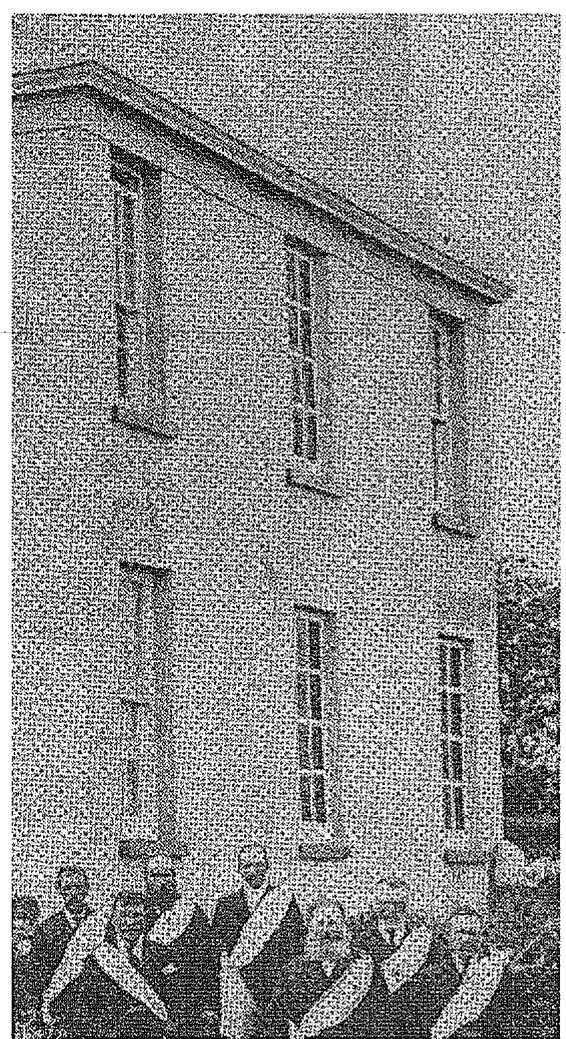
The 1906 photograph reveals an interesting feature of the house in that the three present day blocked windows on the right-hand side elevation (when viewed from the front) initially look like they were once sashes like the rest of the windows. However, on closer inspection it becomes evident that the three 'windows' were flat in appearance and the top sash didn't project out over the bottom sash; this is because these windows were actually painted onto the wall in the recesses.
Detail of archive photograph from 1906 showing the three 'dummy' sashes. (Manx National Heritage)
This process of painting 'dummy windows' onto elevations was commonplace in the United Kingdom during the entire Georgian period, as 'Window Tax' was enforced from 1696 to 1851 and property owners would dodge payment by blocking windows, camouflaging them or painting dummy windows on in order to confuse the inspectors. However, dummy windows are much more unusual in the Isle of Man because Window Tax was never introduced and these fake windows are likely to have been painted onto the elevation for aesthetic reasons, in order to make the building appear more symmetrical. Evidence of painting the fake windows can still be seen in the paintwork today (plate 13). The fake windows on the right hand side elevation are the top centre, the bottom centre and the bottom right. No windows on the front or rear elevations were blocked but there are also blocked windows on the left hand side elevation which were possibly also painted dummy windows at one point, however these cannot be seen in the archive photograph from 1906 and the area is overgrown today so it could not be inspected at the time of this report.
Three of the four elevations have been rendered whilst the rear elevation remains painted only (plate 14). A close inspection of the rear elevation revels that the house is constructed of a mixture of slates, local round stones (found widespread on northern beaches) and red bricks. Also at the rear of the house is a small porch entrance constructed of brick, this porch is unusual because it has a large single slate to the roof (plate 15).
Red bricks have been used in much of the construction of Ballaradcliffe, such as in the window surrounds, the internal walls, chimney breasts, the outbuildings and some of the garden walls. They could have been made on site or they could have originated from the Ballacorey brickworks, which was located in Andreas and in production from 1851 to 1926.
Internally, the property has retained many original features. On the ground floor, the front entrance has timber panelled walls to the lower half (plate 16) and the vestibule double doors and sidelights appear to be original (plate 17). The main internal doors on the ground and first floors are four panelled painted timber which are a Victorian style (plate 18), whilst older style six panelled painted timber Georgian doors are used in the kitchen, basement (plate 19) and attic (plate 20). This illustrates that at the time the property was constructed the modern styles of the time were used in the main living areas of the house, whilst the parts hidden from guests featured older styles.
The staircase is modest in style and has a simple wooden Victorian-style newel at the base in the main hall (plates 21, 22, 23 & 24). The two front rooms have both had their original fireplaces removed and replaced with modern styles. The windows in the reception room on the right hand side have painted timber panels surrounding them (plate 25), whilst the other reception room adjacent to the kitchen has none, illustrating that the room on the right hand side would have been more formal, away from the day to day running of the house and perhaps where guests would have been taken. A traditional fireplace still remains in a room to the rear of the property (plates 26 & 27); there is also a built-in cupboard in the recess beside the chimney breast (plate 28). These built in cupboards are often found in Georgian and Victorian houses as the proximity of the fire was made us of in order to keep dampness at bay (The Elements of Style, 1996). There are further cupboards on the first floor of Ballaradcliffe House (plates 29, 30 & 31). There is a small utility room adjacent to the rear porch which features an unusual small three over six pane sliding sash window Plates 32 & 33). A Georgian six panelled door in the kitchen leads to a stone staircase which gives access to the basement (plate 34).
Three of the first floor bedrooms retain their original fireplaces (plates 35, 36 & 37), the rear left hand side bedroom has subsequently been converted into a smaller bedroom and bathroom, therefore this fireplace has been lost. There are built in cupboards between the chimney breasts and the inner walls, hand carved hooks inside the cupboards match others attached to a beam in one of the attic rooms (plates 38 & 39). The bedrooms to the front of the house (plates 35 & 36) have a larger fireplace than the one to the rear (plate 37), this illustrates the importance of the rooms at the front, which would have been used for the owners of the property, whilst those at the back were more likely to have been the children's rooms. The interior of the cupboard in the front right hand bedroom shows the front wall and internal walls un-plastered (plates 40 & 41). It is clearly visible here that the main walls are constructed in stone,
being slate and round beach stones and the internal walls are brick built, which has allowed them to be narrower.
The staircase leads up a further flight to the attic apace, which is partitioned off with a timber wall and door (plate 42). The attic has been divided into two main rooms for storage or living space, lit by small rooflights (plate 39). The door to one of these rooms is Georgian style, painted timber with six panels (plate 20); the other door has been removed in the past. The remainder of the attic is uncovered roof space where the beams and the underside of the tiles are visible (plate 43). The door to this room is unpainted timber with two separate panels, not decorative in any way (plates 44 \& 45). This door has a wooden lock (plate 46), which is unusual and the door appears to be the oldest in the house, perhaps even originating from an earlier building which stood on the site. The uncovered beams reveal some pencilled graffiti, featuring names and dates. The earliest date found was 1852 (plate 47), which could possibly be the date of construction as it would correspond with the Georgian and Victorian styles in the house, the use of bricks in the construction (Ballacorey brickworks started production in 1851) and the house being included on the 1869 Ordnance Survey Map.
The property sits on sloping ground, the rear door being at ground level, whilst the front door is accessed up a series of steps. As a result of the gradient, the basement only covers the front right hand side of the property. In the main room in the basement there is a Georgian style six-panelled door in unpainted timber (plate 19); any door which was meant to be seen by visitors would have been painted as bare wood was thought to be very unsavoury during the Georgian and Victorian periods. The main room in the basement also features a large fireplace (plate 48) and a separate area, divided by a timber partition, presumably to be used for storage (plate 49). There are also two windows in this room which are both three panes over two sliding sash, one with a vertical and the other with a horizontal lower glazing bar (plate 50). There is a further window in an internal wall to allow light into another room, this window is a larger six pane over six sliding sash, perhaps one of the originals from the front of the house which was removed in the twentieth century.
The grounds of Ballaradcliffe have some large mature trees and although parts of the grounds have become overgrown, there are some well-maintained hedgerows and lawns, particularly to the rear of the house. It is obviously a garden which has been well looked after in the past.
There is a pair of large brick built gate posts at the rear left hand side of the house (plate 51), positioned in order to separate the house and garden from the outbuildings and farm workings. Although these gate posts are overgrown with Ivy, a closer inspection reveals that they were originally two vertical stone slates (plate 52), once a common feature in the Manx countryside in areas where they were available but are now seldom seen.
Ballaradcliffe was historically a large quarterland farm and as with other such farmsteads, there were originally a series of outbuildings and a farmyard on the site. According to the Ordnance Survey map of 1869 (Appendix 3) there were what appears to be three buildings on land adjacent to Ballaradcliffe House, but these have
subsequently been demolished. The Ordnance Survey map of 1869 includes a single storey outbuilding immediately to the rear of the house (plate 53) which is still standing, although the roof is now in poor condition. A further outbuilding is located along a farm track to the rear of the house (plate 62), along with the thie veg (plate 58), although these buildings were not included in the 1869 Ordnance Survey map. A current map of the area showing the positions of the former outbuildings is included with this report (Appendix 6).
The larger barns of Ballaradcliffe were demolished at the end of the twentieth century. Planning Application (99/786) proposed the demolition of the barns and the construction of new properties on the site. The 'Statement of Case' in the Planning Application contained the following statements with regard to the outbuildings (Appendix 9),
The site is currently overgrown with trees surrounding the boundaries bordering the main Bridge End Road and Ballaradcliffe Road residential development. There are also trees along the side boundary brick wall within the site and general scrub within the plot. Also standing on the site is a derelict two storey stone and brick built building which runs east-west across the site and was possibly constructed for some form of agricultural use with storage at first floor level. There is also the brick built shell of a single storey building adjacent to the boundary hedging of the site and numbers 9 and 10 Ballaradcliffe Road. There is substantial screening to Bridge End Road but the lower end of the Appeal site is overgrown with bushes, hedging and some palm trees.
There is already a large two storey building on the site which we wish to demolish and remove together with the remains of other outbuildings, the footprint of these buildings covers quite a large area but there is still a great deal of open space left around these buildings. Once removed, it will be easier to site two dwellings comfortably within the confines of the site.
Still remaining on the site is the house of Ballaradcliffe, an adjacent single storey outbuilding, a garage adjoining this outbuilding, the outside toilets or thie vegs and a further outbuilding located nearby on a farm track.
The outbuilding immediately to the rear of the house (plate 53) is single storey with features such as a wooden framed window (plate 54) and a fireplace (plate 55) with chimney stack still in place. The part of the outbuilding which is nearest to the house appears to have at one time been used as a water storage area. There is a brick-built garage attached to the outbuilding (in front and to the right of the house in plate 56). The garage has an interesting radial fan light over the doorway (plate 57), similar to the original fan light over the front door of the main house, as seen on the archive photograph from 1906.
Near to the garage is the brick built thie veg (plate 58) which has two rooms with wooden toilet seats, one is a single seated room and is more modest in style and now overgrown (plate 59), whilst the other is a double seated room with painted wooden
panelling and a window offering views to the surrounding countryside (plate 60). A possible theory behind this is that the smaller, more modest thie veg was for the employees of Ballaradcliffe such as the farm workers and housemaids, whilst the more 'luxurious' thie veg would have been reserved for the Radcliffe family and their guests.
A further outbuilding is located at the rear of Ballaradcliffe House, along a farm track (plates ). This single storey brick built outbuilding consists of a laundry room, a pig pen and a pigeon roosting room.
The laundry room has a floor made of round beach stones and it still contains the old built-in laundry tub or 'copper' (plate 63), which has a built-in fire underneath, necessary for boiling the water in order to kill parasites such as lice, fleas or bedbugs which might be lurking in the washing. To the left of the laundry tub is a large open hearth which may have been used for cooking or for simply heating the outbuilding for the farm labourers or house servants to use (plate 64).
The pig pen adjoining the laundry room has an open front with troughs for feeding the animals (plate 65). The room for roosting pigeons is at the end of the outbuilding. Inside there are rows of brick perching boxes which have been built into the rear wall (plate 66) and high in the gable elevation there is a small opening designed to enable the birds to fly in and out (plate 67).
Ballaradcliffe House is suggested for inclusion on the Protected Buildings Register for the following reasons;
Ballaradcliffe is a Georgian-style farm house dating from the mid-nineteenth century (possibly 1852). Architecturally Ballaradcliffe has not been altered much since it was first constructed, with only minor alterations taking place and it is therefore a good example of a Georgian property.
There are also outbuildings which should also be considered for inclusion within the Registration as they are part of the site and they contain important historic features which relate to the domestic and farming aspects of the property.
'Ballaradcliffe' quarterland dates back to the sixteenth century when the land first came into the ownership of the Radcliffe family and the estate has remained in the same family for over four hundred years. The original quarterland now includes much of the present day village of Andreas.
There are possible historical links with Thomas Radcliffe, the last Abbot of the Franciscan Friary in Arbory who married into the House of Stanley. Links with Charles
Bland Radcliffe (1822-1889) who was one of the earliest investigators of the electrical physiology of muscle and nerve and with William John 'Willy' Radcliffe (1844-1916) who was MHK for Ayre from 1903 to 1916.
The landmark qualities of Ballaradcliffe are one of the property's most important features. Ballaradcliffe sits on the brow of a hill with views southwards across the northern plain towards the hills. The property is a prominent feature in the landscape and it is surrounded with trees with a long field in front of the property which positions the house well back from the road (plates ). The excellent site is possibly the main reason for the location of Ballaradcliffe.
Calloway S. (ed), 1996, The Elements of Style. Kitto J., 1990, Historic Homes of the Isle of Man. Watt D. and Swallow P., 1996, Surveying Historic Buildings.
Cunliffe Shaw R., Story of an Old Manx Northside Family. Ramsey Courier, Wednesday December . (Source - Manx Note Book website).
Manks Advertiser, 22nd May 1832. Ploughman. Manks Advertiser, 1st January 1833. Fire at stable. Manks Advertiser, 15th January 1833. Death of William Radcliffe. Manks Advertiser, 5th February 1833. Sale of Farmstock.
Cumming J.G., 1857, Story of Rushen Castle, Chapter 3. (Source - Manx Note Book website).
Manx Heritage Foundation, 1991, Manx Farming and Country Life 1700-1900. Radcliffe C., The Radcliffe's of Andreas, IOMNH\&AS, vol III, no. 2, pp. 172-195.
Maps and Plans Wood's Atlas, 1867, DoLGE. Ordnance Survey Map, 1869, DoLGE. Current digital maps, DoLGE.
Archive photograph (1906), Manx National Heritage. Current photographs.
Manx Note Book website www.isle-of-man.com/manxnotebook Georgian Houses www.woodlands-junior.kent.sch.uk/Homework/houses/georgian.htm Georgian 'dummy windows' www.bbc.co.uk/northyorkshire/iloveny/architecture/windows/gallery/gallery25.shtml www.thisismoney.co.uk/tax-advice/council- tax/article.html?in article id=401439\&in page id=82 Details of the washroom www.schoolsliaison.org.uk/astonhall/changingtimes/themes/homes/poor/vans.htm
Copyright in submitted documents remains with their authors. Request removal
View as Markdown