This report is prepared by Ecology Vannin Consultancy Services for the sole and exclusive use of Manx Utilities and their contractors in response to their particular instructions. No liability is accepted for any costs, claims or losses arising from the use of this report or any part thereof for any purpose other than that for which it was specifically prepared or by any party other than Manx Utilities. Any biological records for wildlife found in survey will eventually be submitted to Manx Biological Recording Partnership.
Ecology Vannin Consultancy Services is the trading name for Wildlife Limited, Reg Company No: 077379C. Wildlife Limited is a wholly owned subsidiary of Manx Wildlife Trust (MWT), Reg Company No: 005297C. This report does not prevent MWT pursuing its charitable objectives in relation to planning.
This report has been prepared by an environmental specialist and does not purport to provide legal advice. You may wish to take separate legal advice.
The information which we have prepared and provided is true and has been prepared and provided in accordance with the BS42020 2013 and Chartered Institute of Ecology and Environmental Management's Code of Professional Conduct and guidelines for preliminary ecological appraisals (CIEEM 2017). We confirm that the opinions expressed are our true and professional bona fide opinions.
Signed (Author)
Gwatson
Ecology Vannin: 7-8 Market Place, Peel, Isle of Man.
Ecology Vannin: 7-8 Market Place, Peel, Isle of Man.
Job number:
23_58
Title:
Cringle Reservoir Spillway Technical Note
Client:
Manx Utilities
Prepared by:
Greg Watson - Trainee Ecologist
Verified by:
Adam Denard – Senior Ecologist
Date of Issue:
November 2024
This report is prepared by Ecology Vannin Consultancy Services for the sole and exclusive use of Manx Utilities and their contractors in response to their particular instructions. No liability is accepted for any costs, claims or losses arising from the use of this report or any part thereof for any purpose other than that for which it was specifically prepared or by any party other than Manx Utilities. Any biological records for wildlife found in survey will eventually be submitted to Manx Biological Recording Partnership.<br><br>Ecology Vannin Consultancy Services is the trading name for Wildlife Limited, Reg Company No: 077379C. Wildlife Limited is a wholly owned subsidiary of Manx Wildlife Trust (MWT), Reg Company No: 005297C.This report does not prevent MWT pursuing its charitable objectives in relation to planning. This report has been prepared by an environmental specialist and does not purport to provide legal advice. You may wish to take separate legal advice. The information which we have prepared and provided is true and has been prepared and provided in accordance with the BS42020 2013 and Chartered Institute of Ecology and Environmental Management’s Code of Professional Conduct and guidelines for preliminary ecological appraisals (CIEEM 2017). We confirm that the opinions expressed are our true and professional bona fide opinions.<br><br>Signed (Author) Signed (QA)<br><br>
1.0 Introduction
1.1.1 The construction of a new spillway wall and drain at Cringle Reservoir will require the loss of some orchid rich grassland. All orchids are protected under schedule 7 of the Isle of Man Wildlife act 1990 (see appendix III for legislation). Orchid areas were identified and marked out following a site walkover by Ecology Vannin on 12/07/24. To minimise the loss of the orchid communities identified, translocation can be undertaken to ensure their survival. Translocation of orchid-rich grass can be an effective way of preserving orchid assemblages and species rich grassland by removal, storage and relaying. Practical methods have been decided upon by DEFAs Ecosystems Policy Team to constitute lawful operations as per section 12 (3) of the Wildlife Act 1990. This document contains the methods that contractors must follow to carry out the translocation of the orchid rich grass turf and methods to seeds new grassland areas.
1.1.2 This technical note is the result of the field survey to identify orchid locations, review of best practise (Penny Anderson, 2003) and professional judgement and most practical solutions to retain the orchid colony on site at a favourable conservation status.
2.0 Methodology for Translocation of Orchid-rich Grass Turf –Preliminary Works
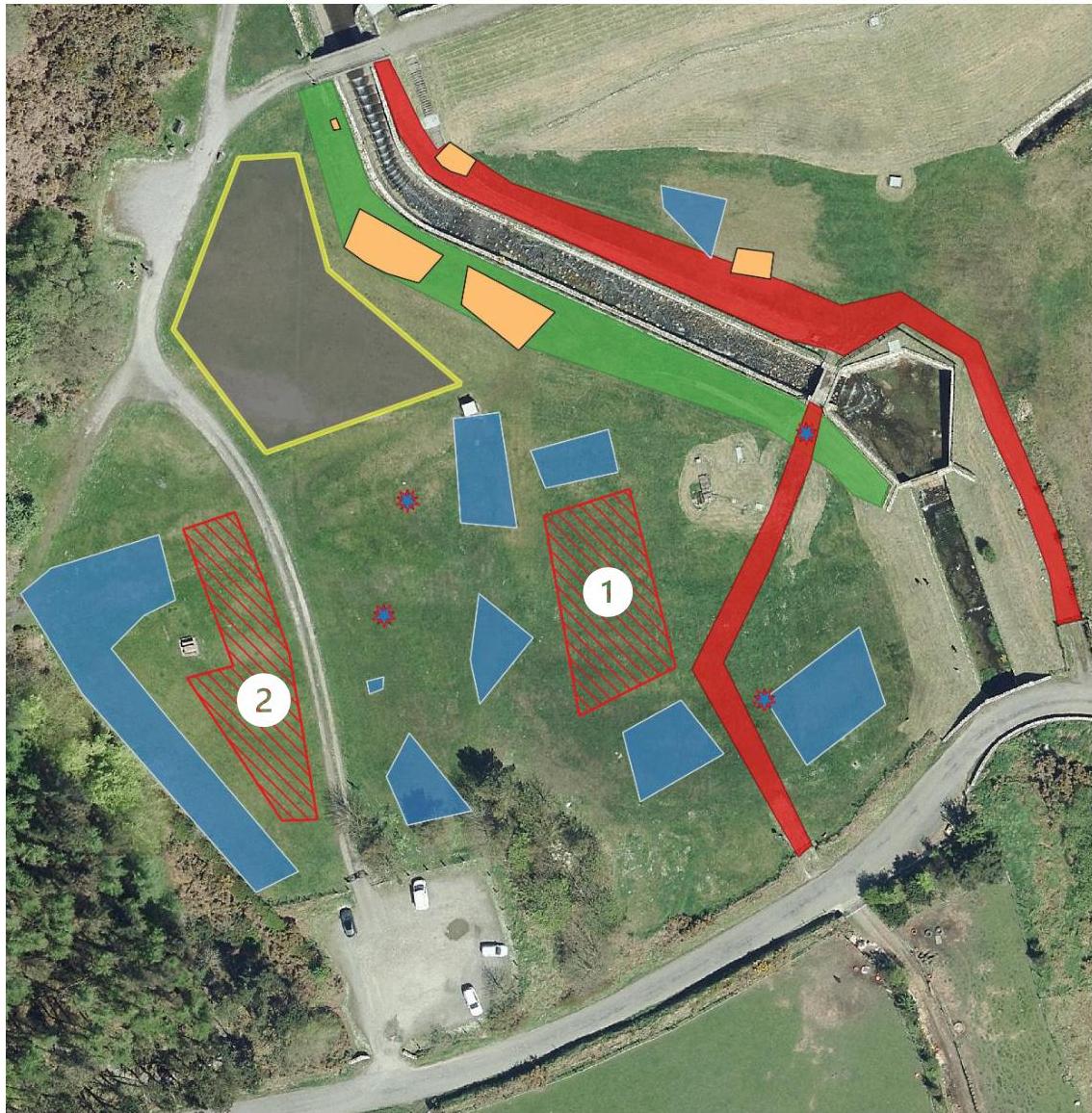
2.1.1 Areas of orchid-rich grassland will be removed (estimated 240m2) prior to development and translocated to a suitable recipient site that will not be impacted by development activities (areas highlighted in the map, appendix I). The grassland translocation work is to be undertaken by a competent Landscape/Horticulture contractor.
Grass/Turf Removal Guidance:
• Grass turf will be swapped (translocated) between the orchid-rich areas and the recipient site marked as area 1 on map (appendix I).
o Translocation of the orchid-rich turf to the recipient site will ensure that it is away from the unprotected area of works around the spillway.
o The location of orchid-rich areas has been marked out on-site using pegs and furthermore, coordinates of the areas shown on map (appendix I) are also available.
• Turf should be removed by the Landscape/Horticulture contractor in as large even stripped sections as possible to allow for more effective replacement (areas of turf for removal highlighted in appendix I).
• Excavation of turf should be to a depth of 25-30cm, this should be sufficient to contain majority of organic material, seeds, roots, soil fauna and mycorrhizal fungi. This will depend on the prevailing conditions and depth until sub soil is reached.
o Landscape/Horticulture contractors should use appropriate equipment such as a machine with a guillotine cutting edge, guidance also states that a bucket edge can be used to cut turfs. A forklift or similar can then be used to move turfs to the translocation recipient site 1 (see map in appendix I).
o If additional space is needed to translocated species rich turf, recipient site 2 can be used (see map in appendix I).
• If required, turf can be stored on wooden boarding or geotextile matting upon a hard standing area on site.
o Strips of grass turf should not be layered on top of each other but rather stored in a single layer as appropriate across the storage area.
• Replacement of turf strips on both sites should occur as tightly together as possible with any gaps being filled in with sub soil.
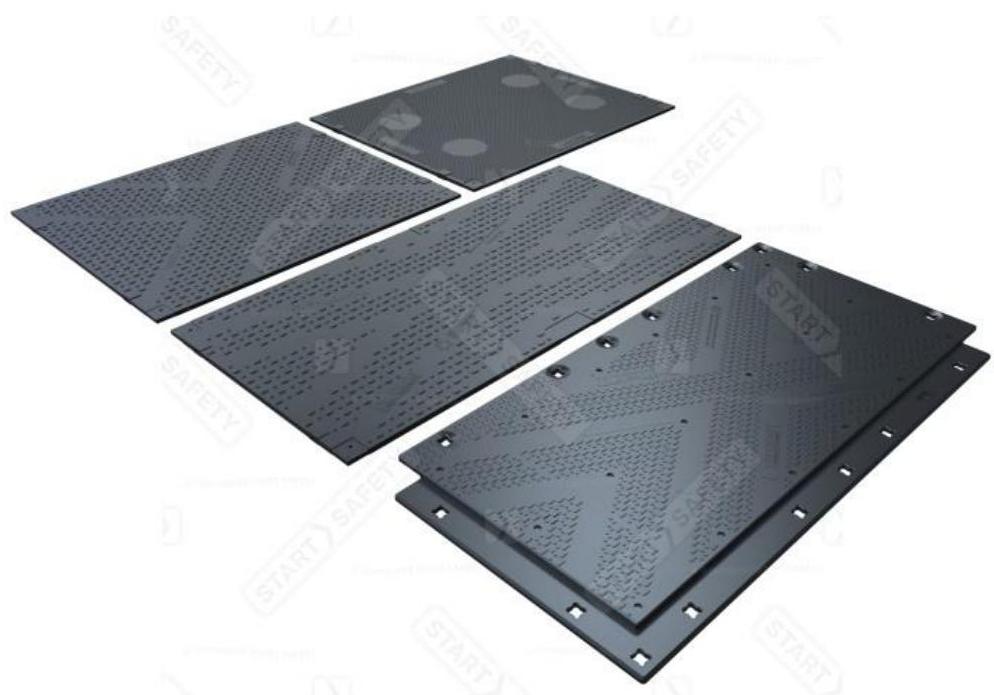
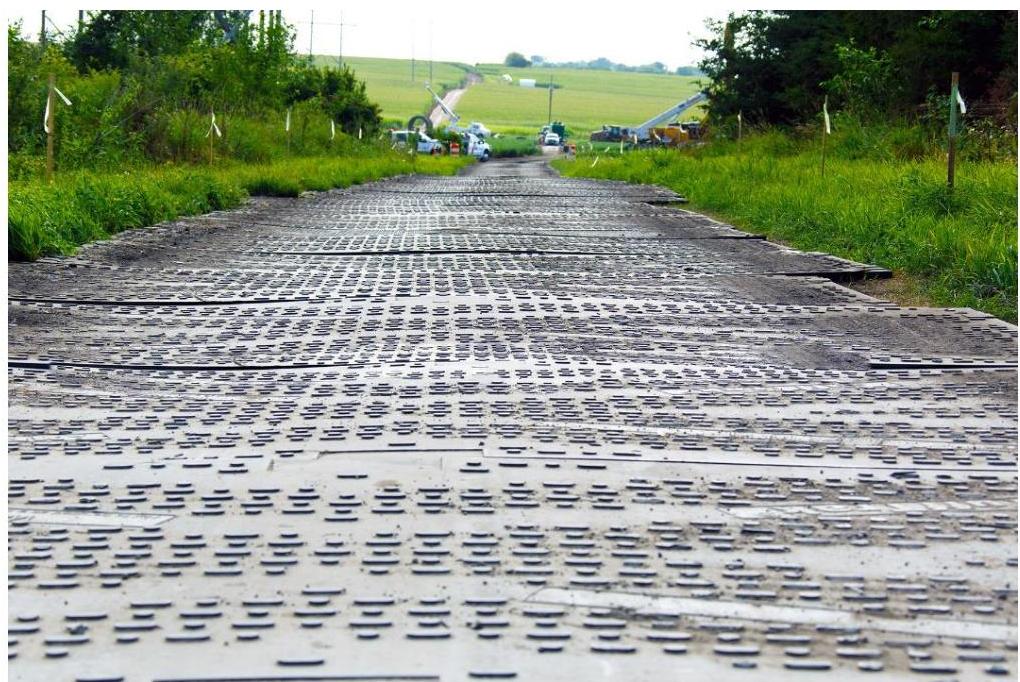
• Any access route should be protected from the tracking of heavy machinery. Therefore, protective access matting should be deployed prior to construction on these areas where heavy machinery will be required to operate on (see appendix II for example of suitable product).
• The Landscape/Horticulture contractor undertaking the grass translocation shall give a week notice to the Ecological Clerk of Works (ECoW) and DEFA Ecosystems Policy Team prior to commencing the works on site. The project ECoW and/or a member of the Ecosystems Policy Team shall be present on site when the translocation begins.
If Storage of Turf is Required:
• Once turf has been laid on the storage site it should remain uncovered to allow photosynthesis to continue.
• Exclusion fencing should be erected around the storage site to prevent damage to the turf by animals and humans.
• Watering of turf will be required in the event of 7 consecutive days with no rainfall.
• The maximum storage period should be limited to 3 weeks.
• The turf should ideally be stored on site subject to available space. Advice should be sought by Ecological Clerk of Works (ECoW) prior to storage, to identify a suitable location.
Post Translocation:
• Once the Landscape/Horticulture contractor has carried out translocation work, exclusion fencing should be erected around any translocated turf areas to prevent them from becoming damaged and/or rejected.
o The fencing shall be provided by the Landscape/Horticulture contractor for a period of 3 months.
o Only species rich turf in its new location should be fenced off.
• Following translocation, a site inspection by project ECoW will be undertaken to check the condition of the turf.
• If areas of translocated turf surrounding the spillway do not take root or become too degraded during work, then re-seeding may be advised by project ECoW (see appendix III)
3.0 Methodology for Grass Re-seeding – Post DevelopmentWorks
3.1.1 On areas of grassland around the spillway that have become degraded or compacted due to (vehicle tracking), material storage, welfare facility area or any other development related activities. Some level of restoration of the upper soil horizons may be required e.g. shallow rotavating with removal of topsoil to reduce fertility. These areas must then use the re-seeding methodology below. Grass re-seeding shall be undertaken by the civil engineer contractor undertaking the spillway refurbishment or its sub-contractor. The contractor should discuss and agree the scope and extent of seeding and restoration with the project ECoW.
Re-seeding Methodology
• A low fertility substrate should first be created on areas that will be seeded – further advice to be provided by Ecology Vannin to contactors during this stage.
o This may involve turning over (rotavating topsoil to bring subsoil to the surface.
o Cultivated areas may need require backfilling with a low fertile soil to a level just below the surrounding surface to produce a fine friable seedbed.
• Use an annual variety of (Italian) ryegrass (Lolium multiflorum) sown at 5GR/M2 and allow native wildflowers/grasses to colonise naturally as the ryegrass fades away.
o Grass seed shall be a tested mixture from an approved source and certificates of purity and germination shall be provided from the supplier.
o ECoW shall approve the grass seed mixture prior to its use.
• With the topsoil present there is no need for any fertiliser/soil additive to be used for the establishment of amenity grass.
• Some remediation of soil may be required prior to re-seeding – this should be discussed with project ECoW.
o This may include basic reprofiling or grading areas to create the appropriate cultivation conditions.
• Sow seed between March to October.
4.0 Site Care
4.1.1 Any grass cutting during the project will be undertaken by MUA in accordance withtheir current grass cutting regime. Grass cutting between late May and late Julyshould be avoided to allow for orchids to drop their seed.
4.1.2 Areas with orchid-rich turf that have been translocated prior to the start of the spillway works shall remain fenced off. Furthermore, any orchid-rich areas away from the working area but at risk of being damaged by site activities shall also be fenced off for the duration of the spillway refurbishment. The fencing shall be provided by the principal contractor upon the commencement of the spillway works for the entire duration of the works.
4.1.3 The civil engineering contractor undertaking the spillway refurbishment will be required to provide fencing around the areas of the site that will have to be reseeded following the completion of the works. The fencing around these areas shall stay in place for 4 months to allow grass to re-establish.
References
Penny Anderson (2003). Habitat Translocation – a best practice guide. London.
Appendix I: Orchid Translocation Site Map
Orchid Translocation Map
Key
Translocation recipient site Areas of orchid truf to be translocated Construction area with no protective matting Access Route with protective matting Other Orchid Areas Patch of 1-3 Orchids Fungi areas (waxcap grassland)
Appendix II: Example Product - Protective Access Matting
Product - TuffTrak Ultra Heavy-Duty Temporary Access Mats ST LITE XL XT
Appendix III: Wildlife Act 1990 - Protection of Plants