Loading document...
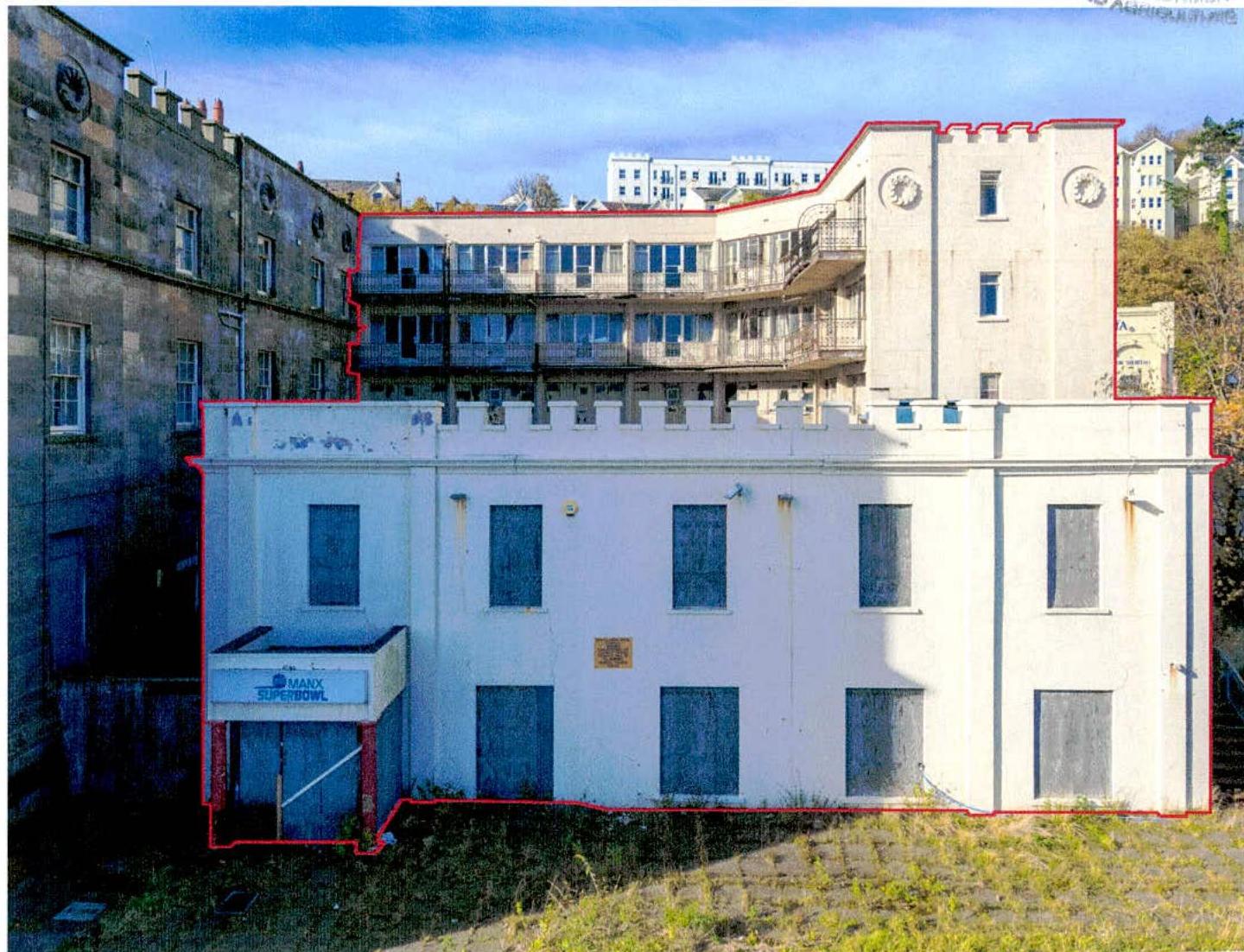
Castle Mona Hotel, Central Promenade, Douglas Registered Building 82 Douglas Promenades Conservation Area
Application for Full Planning Approval Application for Registered Building Consent
Tevir Developments Ltd • Applicant Horncastle Thomas Ltd • Agent
The core section of the Castle Mona is a registered building, the early 19th century home of the 4th Duke of Athol, subsequently an hotel, now vacant since 2006. The south west wing and north east extensions do not form part of the registration, though they do fall within a conservation area.
This application seeks approval to demolish the modern bowling alley extension and north east bedroom/ dining wing in line with the north east elevation of the main house, providing a temporary protective reinscreen cladding to the remaining section of the rear modern bedroom wing.
Castle Mona has undergone many alterations throughout its history the most significant being the addition of the bedroom/ dining wing in the early 1960s followed by the bowling alley extension in the early 1990s.
Both extensions have limited architectural value in relation to the original building. The 1960s extension, although faced in stone, is of poor quality construction, well below modern standards and is in poor condition. The 1990s extension, in particular, obscures the original elevation of the house and is intrusive.
The building, in general, had been poorly maintained since its closure in 2006 resulting in progressive decay in the main part of the building, mainly caused by water ingress from the roof. Maintenance and repair work was undertaken on the roof following its purchase in 2018. Despite repeating this in 2019 further action is required to protect the building while the new owners decide upon its future use.
This application is one of a set of three that will, if approved, see works undertaken to replace the main roof coverings, repair its structure and remove later additions to the building.
The removal of these structures will improve access for maintenance to the north east elevation of the core of the building.
Castle Mona is of a distinctive form and materials. Walls are clad in Arran Freestone, a white sandstone, and detailed with a projecting cornice at attic storey level; inset clustered columns; medallions of Coade stone; and carved swags. The walls terminate in a parapet, which have castellations to signify areas of importance, such as principal rooms and entrances.
The, essentially square, plan has an inner courtyard containing a circular tower that projects above the main form. At the rear, there is a south west wing, part of the original building at tower level but with added floors on top, finishing below the height of the main building.
The 1960s north east extension is a narrow flat roofed wing at the rear of the original building. The wing's main mass is 'L' shaped in plan, with the 'L' being infilled at the tower level. It is generally at the same height as the original house. Clad in stone, there are medallions and castellations above narrow casement windows featured in the projecting end of his wing which forms the bottom leg of the 'L' reflecting the style of the earlier building.
The 1990s bowling alley is a flat roofed, two-storey extension that projects toward from the 1960s extension toward the sea. A rendered finish references some of the detailing on the original building.
• NATURE OF PROPOSAL
It is proposed to demolish both of the north east extensions, the 1960s hotel wing and 1990s bowling alley. Both of which form part of the non-registered section of the building and have limited architectural value.
It is proposed that a temporary protective reinscreen be fixed at the end of the remaining section of the rear modern bedroom wing, covering any apertures left by the removal of the non-registered wing.
The proposal is in line with the following planning policies of the Strategic Plan 2016,
Environmental Policy 32,
Extensions or alterations to a Registered Building which would affect detrimentally its character as a building of special architectural or historic interest will not be permitted.
The proposed works remove elements that abut the registered building and, in the case of the 1990s bowling alley, visually obscure and detrimentally affect the character of the registered part of the building.
Environmental Policy 35,
Within Conservation Areas, the Department will permit only development which would preserve or enhance the character or appearance of the Area, and will ensure that the special features contributing to the character and quality are protected against inappropriate development.
By removing part of the building that obscures the registered building would enhance the character of the Area. Planning Policy Statement 1/01, Policy RB/3, The issues that are generally relevant to the consideration of all registered building applications are:
The importance of the building, its intrinsic architectural and historic interest and rarity, relative to the island as a whole and within the local context;
The particular physical features of the building (which may include its design, plan, materials or location) which justify its inclusion in the register; descriptions annexed to the entry in the register may draw attention to features of particular interest or value, but they are not exhaustive and other features of importance (eg Interiors, murals, hidden fireplaces) may come to light after the buildings entry into the register.
The buildings setting and its contribution to the local scene, which may be very important, e.g. Where it forms an element in a group, park, garden or other townscape or landscape, or where it forms a particular architectural forms or details with other buildings nearby (including other registered buildings)
Castle Mona is an important registered building, unique on the island. The removal of elements that are of limited architectural value in relation to the original building and, with regards to the 1960s wing, in poor condition and visually intrusive in regards to the bowling alley, will enhance and preserve the building's character.
Planning Policy Statement 1/01, Policy RB/5,
In considering whether to grant planning approval for development which affects a registered building or its setting and in considering whether to grant registered building consent for any works, the Department shall have special regard to the desirability of preserving the building or its setting or any features of special architectural or historic interest which it possesses.
Registered Building Consent is required for the building's alteration in any way which would affect its special architectural or historic character. There will be a general presumption against alteration or extension of registered buildings, except where a convincing case can be made against the criteria set out in this section, for such proposals.
Applicants for registered building consent for alteration or extension to a registered building must be able to justify their proposals. They will be required to show why the works which would affect the character of the registered building are desirable or necessary and they should provide full information to enable the Department to assess the likely impact of their proposals on the special architectural or historic interest of the building and on its setting. Where registered buildings are the subject of successive applications for alteration or extension consideration will also be given to the cumulative effect upon the building's special interest as a result of several minor works which may individually seem of little consequence.
The proposed works will remove the visually intrusive bowling alley allowing the north east elevation of the registered building to be revealed. Removal of the 1960s wing will also ensure easier access for maintenance to the registered building.
The contribution of the Castle Mona to the townscape will be retained.
Planning Policy Statement 1/01, Policy CA/2,
When considering proposals for the possible development of any land or buildings which fall within the conservation area, the impact of such proposal upon the special character of the area, will be a material consideration when assessing the application. Where a development is proposed for land which, although not within boundaries of the conservation area, would affect its context or setting or views into or out of the area, such issues should be given special consideration where the character or appearance of a conservation area may be affected.
The removal of both modern extensions to the registered building will ensure the character of the area is preserved whilst providing protection for the building.
Planning Policy Statement 1/01, Policy CA/6,
Any building which is located within a conservation area and which is not an exception as provided above, may not be demolished without the consent of the Department. In practice, a planning application for consent to demolish must be lodged with the Department. When considering an application for demolition of a building in a conservation area, the general presumption will be in favour of retaining buildings which make a positive contribution to the character or appearance of the conservation area. Similar criteria will be applied as those outlined in RB/6 above, when assessing the application to demolish the building, but in less clear cut cases, for example, where a building could be said to detract from the special character of the area, it will be essential for the Department to be able to consider the merits of any proposed new development when determining whether or not it should be given for the demolition of an unregistered building in a conservation area. Account will be taken of the part played in the architectural or historic interest of the area by the building for which demolition is proposed and in particular of the wider effects of demolition on the building's surroundings and on the conservation area as a whole.
In terms of the building's significance, the modern extensions to the registered building are either neutral or intrusive and both detract from the character of the registered building and conservation area.
© Glenn Whonsil • 2020 /BBUB 19AY 2020
Copyright in submitted documents remains with their authors. Request removal
View as Markdown