Loading document...
lowered skylight is protected to some extent by the raised bed/wall under front window. Again, it would be very difficult to fit a barrier within the confined recess and consideration of forming a more formal flood barrier, including raising it above threshold level, could be considered.
NOTE: Appropriate training should be made compulsory to ensure safe use, storage and maintenance of equipment.
It is noted that the rear door to the kitchen is set at a slightly lower level when compared to the front door and ground floor levels. The rear door will only be at risk should the river wall be overtopped and if this was to happen the cellar would be flooded to full depth. To prevent inundation via the rear door a low-level flood barrier or flood door maybe considered. However, if water levels in the cellar exceeded ground floor levels then bypassing defences will occur. It is understood that flood water at the front of the property rose to 200 mm of inundation via the front door. Whilst the rear of the property was afforded additional protection from the wall consideration could be given to a low-level barrier or flood door to reduce risk of inundation. It should be noted that during a larger event flood water could potentially emerge through the suspended flooring and emergency planning by the owner should be considered. It should be noted that flood doors are stiff to open and may not be considered appropriate for doorways in regular use in commercial properties. The nature of the door frames can also introduce a trip hazard unless designed appropriately.
| Location | Width* | Reveal* | Opens | Frame Materials | Further Details | Barrier Height above Threshold* | Suitable Product Types** |
|---|---|---|---|---|---|---|---|
| Front Door | 970 | 20 | In | Wood | Door height: 2940mm | 600 | 2, 5 & 6 |
| Rear Door | 850 | 20 | In | Wood | Door height: 1970mm | 600 | 2, 5 & 6 |
| Front Skylight Window | 890 | 0 | NA | Wood | Window height: 750mm | 600 | Bespoke solution required |
| Rear Skylight window | 890 | 0 | NA | Wood | Window Height: 750mm | 600 | Bespoke solution required |

This section outlines the details of the flood resilience and resistance options listed in section 7.
The type of measure or product listed takes account of the suitability of the measure for the property, owner preferences and the ability of staff to deploy. Kitemarked products should be used (where applicable), designed to provide suitable mitigation at the property given the level and sources of flood risk. All dimensions will be verified by an installer before the works commence.
The full range of products can be found in the National Flood Forum's Blue Pages Directory at www.bluepages.org.uk.
Description: Flood resilient cellar storage units (for example stainless steel, plastic or hardwood) or raised whitegoods and appliances. High level shelving
Details: Storage units could be raised above floor level to minimise flood damage. White goods could be raised above flood level. Shelving raised above flood level.
Description: Door barriers provide a relatively low-cost, simple-to-use and quick means to help prevent the direct entry of floodwater into a property. The effectiveness depends on the seal around the individual frame, sill, surrounding wall and ground.
Details:
{{image:219750}} {{image:219751}} *All measurements in millimetres (approx.).
**The type of product listed takes account of the suitability of the door for each barrier type, homeowner preferences and the ability of the homeowner to deploy. A key is provided overleaf.
To allow emergency evacuation from the building during a flood, all inward opening doors should be provided with a door barrier. Agreement of the most suitable product will be made following discussion with the product supplier/installer.
{{image:219752}} Type 1: Clips into pre-installed frame {{image:219753}} Type 3: Screws into pre-installed sockets Type 2: Free standing barrier expanding into recess/door reveals Type 4: Individual demountable planks fitted to a pre-installed frame
Type 5: Single barrier into pre-installed frame
Type 6: Flood door
Description: Provision of portable electric dewatering pumps and provision and installation of static, automatic, electric submersible dewatering pumps and sumps to help limit the level of internal flooding to the cellar. Details: Supply and installation of high capacity Sump Pump. The current condition of the existing sump pump is unknown and a higher capacity pump could be installed as a means of managing seepage. It should be noted that in a bigger event the cellar would remain at risk of inundation.
Description: This provides a low-cost and simple means to prevent ingress of water through cracks and holes in the property walls. Mortar is applied to fill gaps in the property perimeter. Details: Inspect all external walls and cellar walls and apply mortar to fill all cracks and holes, including around service entry points, up to a maximum height of 600 mm up from ground level and full height of cellar walls. NOTE: This survey will be restricted to such locations as are reasonably apparent by inspection from ground level from both inside and outside the property. No excavations will be made to try to locate other entry points.
Description: This provides a low-cost and simple means to improve the waterresistance of walls. A colourless, breathable, water-resistant coating is sprayed or painted onto surfaces, preventing damage to walls caused by prolonged contact with water during flooding. For particularly vulnerable areas, a coloured waterproof render may be applied. Details: Application of a specialist breathable waterproof sealant to all external walls up to a maximum of 600 mm up from ground level. NOTE: It is recommended that this is re-applied in accordance with the manufacturer's guidance.

Description: Repairs to any known damaged or cracked concrete cellar floors.
Further information on indicative costs of flood resilience and resistance measures is available from the National Flood Forum website: http://www.nationalfloodforum.org.uk/flood-protection-adviser/


It is recommended that all products which require deployment prior to a flood (e.g. door barriers) are tested annually, and stored:
Details of the maintenance requirements should be issued by the homeowner's contractor when the products are installed and ownership handed to the homeowner.
Alterations conducted to the property perimeter post-installation may mean barriers can no longer be installed, nor protect the property as designed, and/or may create routes for water to bypass the measures installed. It is recommended that any such alterations are undertaken with property flood protection in mind, and steps are taken to reduce the increased likelihood of water ingress into the property.
Community specific Flood Warning Services are not currently operated by Manx Utilities on the Isle of Man. However, information regarding access to forecasts and flood warning status updates for the Island can be found on the Isle of Man Government website: https://www.gov.im/transport/floodwatch/floodadvice.xml For an independent directory of flood protection products and services, please visit the National Flood Forum's Blue Pages Directory: http://www.bluepages.org.uk/
It is recommended that a Flood Action Plan is produced, which outlines the lines of communication amongst staff and emergency contact numbers. The Flood Action Plan will help to identify those staff responsible for deploying any flood mitigation measures. It should also identify evacuation procedures. The Flood Action Plan should also include a list of actions which can be quickly put in place during a flood event to minimise the disruption caused. The Isle of Man Government website provides some advice to prepare for floods: https://www.gov.im/transport/floodwatch/floodprepare.xml

Following issue of your survey report, it is important that you fully consider the outlined flood mitigation options and begin to think about the type of approach and products you feel would be suitable for you and your property.
The National Flood Forum is a national charity dedicated to supporting and representing communities and individuals at risk of flooding.
It is also recommended that you:
Prepare or review and update your own individual flood plan to ensure that you have made all efforts to help reduce the impact of flooding, as well as the time taken to recover following an event (section 10.2).
This document has been prepared for the property owner. JBA Consulting accepts no responsibility or liability for any use that is made of this document other than by the property owner for the purposes for which it was originally commissioned and prepared.
Surveyors: Craig Lucas and Mark Harvey Report author: Craig Lucas Asset Inspection Manager Reviewer: Howard Keeble Technical Director Date of report: 13/01/2018
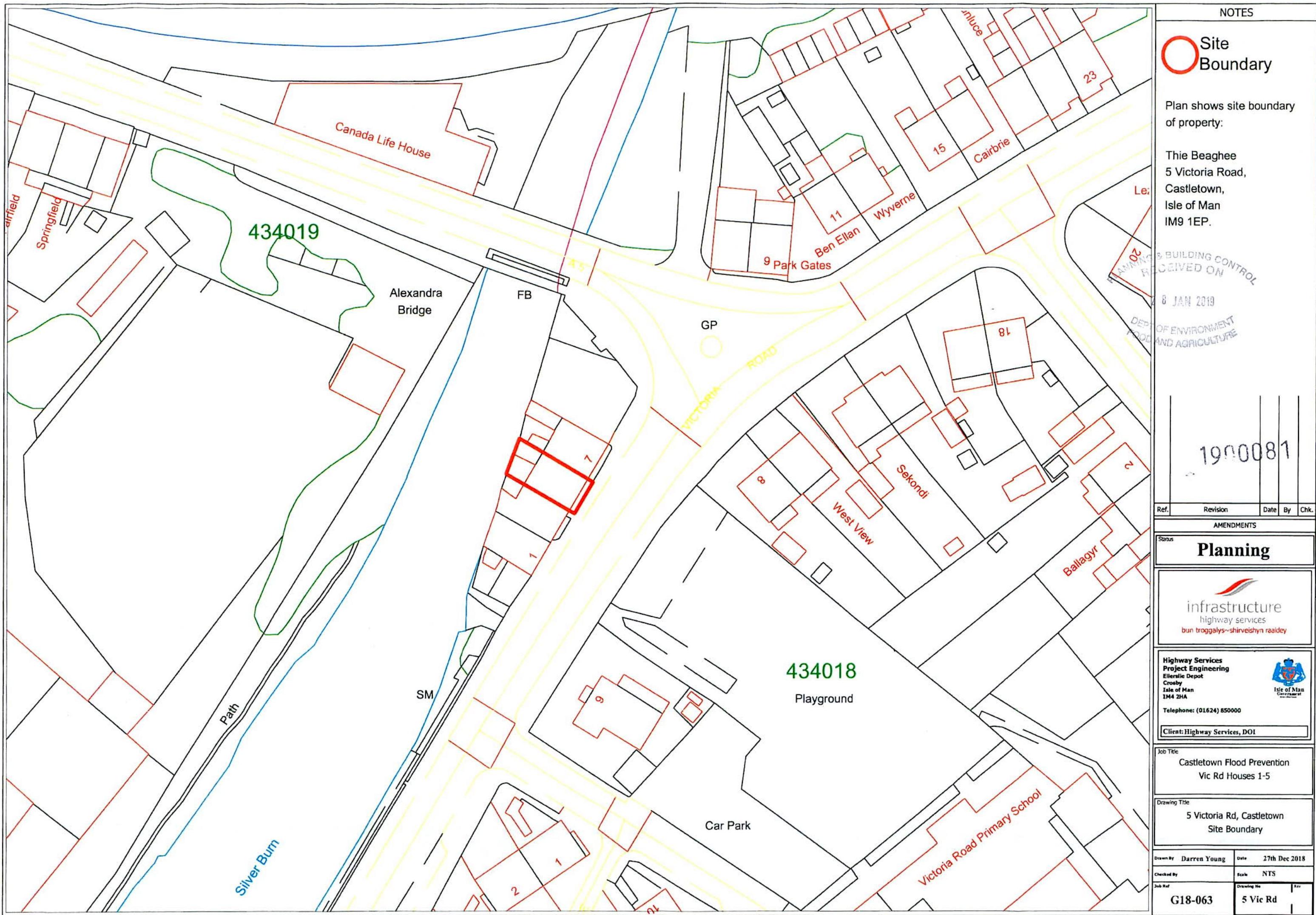
Plan shows site boundary of property:
This Beaghee 5 Victoria Road, Castletown, Isle of Man IM9 1EP.
Copyright in submitted documents remains with their authors. Request removal
View as Markdown