W: https://trees.im<br><br>October 2023<br><br>Arboricultural Method Statement<br><br>for<br><br>Former Vehicle Test Centre, Ballafletcher Road, Cronkbourne, Douglas<br><br>(Approved development 21/01368/B)<br><br>
Site Address:
Former Vehicle Test Centre, Ballafletcher Road, Cronkbourne, Douglas
Former Vehicle Test Centre, Ballafletcher Road, Cronkbourne, Douglas
Former Vehicle Test Centre, Ballafletcher Road, Cronkbourne, Douglas
Former Vehicle Test Centre, Ballafletcher Road, Cronkbourne, Douglas
Client Name:
Swagelok Ltd.
Swagelok Ltd.
Swagelok Ltd.
Swagelok Ltd.
Document Ref:
AMS-031023
AMS-031023
Consultant:
Andrew Igoea<br><br>BSc (Hons), MArborA
Report Date:
04/10/23
04/10/23
Document Checked by:<br><br>
Ben Brooker<br><br>L4DipArb, TechArborA
Signed on behalf of Manx Roots Ltd.<br><br>
Ben Brooker, Managing Director
Ben Brooker, Managing Director
Ben Brooker, Managing Director
---
Summary
The following document and its supporting plans provide details of the position and specification of tree protection measures to be implemented during the construction of a new industrial building on the site of the former vehicle testing centre, Ballafletcher Road, Cronkbourne, Douglas.
A significant number of trees were approved for removal as part of the approved development. To ensure that the remaining trees and hedgerows are successfully retained, a condition of the planning approval is that an arboricultural method statement is produced prior to the commencement of the development.
Construction Exclusion Zones will be implemented around the main working areas in two phases. Phase 1 will involve construction of the ramp to the north of the proposed development, connecting the car park of the current Swagelok complex to the new site. It will also involve alterations to the junction of the site access with Ballafletcher Farm Road. Phase 2 will involve construction of all the remaining elements of the approved development.
Two types of temporary protective fencing will be used to create physical and visual barriers to the proposed Construction Exclusion Zones.
The correct implementation and on-going monitoring of protection measures throughout the development process will be critical for the successful retention of existing trees on the site. To ensure this happens it is important that the roles and responsibilities of key stakeholders are clearly defined and communicated.
This document provides technical detail of the protective measures to be implemented (part 1) and explains how and when protective measures will be implemented and monitored (part 2).
A ‘Project Arboriculturist’ will document compliance with the recommended protective measures and be on-hand to provide advice should any unexpected arboricultural issues arise throughout the development.
Contents
1. Instruction 4
2. Scope 4
PART 1: Tree Protection Measures 5
Fencing and Exclusion Zones 5
PART 2: Arboricultural Site Monitoring 7
4. Roles and Responsibilities 7
5. Sequence of Works 7
6. Arboricultural Monitoring 7
The following documents form part of this report but are provided as separate documents:
Document name
Reference number
Information
Tree Protection Plan – Phase 1
TP-031023-P1
PDF; Scale 1:500@A3
Tree Protection Plan – Phase 2
TP-031023-P2
PDF; Scale 1:250@A1
The drawings, plans and maps associated with this report are intended for tree identification purposes only and must not be used as construction specifications.
1. Instruction
1.1. Manx Roots Limited was instructed by McGarrigle Architects Ltd to produce an Arboricultural Method Statement (AMS) to discharge condition 10 of the planning approval (21/01368/B) and ensure retained trees are adequately protected through the construction process.
1.2. This AMS has been produced to comply with the recommendations of British Standard BS5837:2012 – Trees in relation to design, demolition and construction – Recommendations (BS5837).
1.3. Details relating to individual trees within the site can be found in the associated Arboricultural Impact Assessment, AIA-171121-A, dated 17th November 2021, and submitted as part of the planning application for the development.
1.4. This AMS relates entirely to the protection of the retained trees and must not be read as a definitive engineering or construction method statement.
2. Scope
2.1. Condition 10 of planning approval 21/01368/B is as follows: Prior to the commencement of the development hereby approved a tree and habitat protection plan and arboricultural methods statement, adhering to the recommendations of BS5837:2012 (Trees in relation to design, demolition and construction - recommendations), shall be submitted to and approved in writing by the Department. The agreed protection measures and construction methods shall be adhered to in full and no alterations or variations to the approved tree and habitat protection scheme or working methods shall be made without prior written consent of the Department. Reason: required prior to commencement to ensure that all trees to be retained are adequately protected from damage.
2.2. To adhere to the recommendations of BS5837:2012, the AMS should cover two topics:
• The protection measures to be implemented.
• The arboricultural site monitoring to take place throughout the construction phase.
3. Fencing and Exclusion Zones
3.1. The accompanying tree protection plans, TP-031023-P1 and TP-031023-P2, show the location of Construction Exclusion Zones (CEZs) and temporary protection fencing that will be implemented during the two main construction phases of this project.
3.2. Phase 1 will involve construction of the ramp to the north of the proposed development, connecting the car park of the current Swagelok complex to the new site. It will also involve alterations to the junction of the site access with Ballafletcher Farm Road. Phase 2 will involve construction of all the remaining elements of the approved development.
3.3. The protection plan includes two types of temporary protection fencing: Type-A and Type-B. Type-A fencing will create a robust physical barrier between retained trees and proposed construction work and will be used only where site circumstances and the associated risk of damage necessitate (see plans for detail). Type-B fencing will create a visual barrier and act as a reminder to site personal that certain areas are off limits.
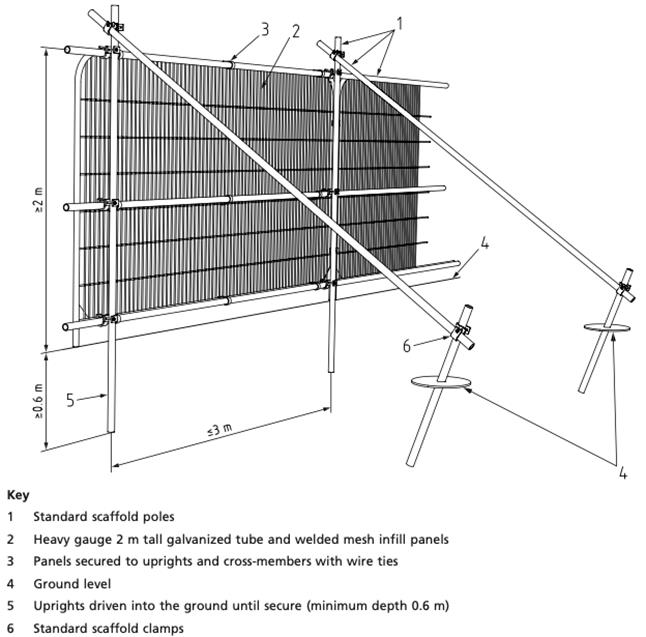
3.4. Type A fencing will consist of a frame of upright poles or posts with cross members, constructed of either scaffold poles or timber, to which heavy gauge, 2x3m tube and welded mesh panels (e.g. Heras panels) will be fixed. Additional stays to the vertical posts will only be used where required, as advised by the Project Arboriculturist. Type A fencing will be somewhat like the default specification for protective fencing provided in BS5837, shown below in figure 1. All weather notices will be attached to every second panel, clearly displaying words such as CONSTRUCTION EXCLUSION ZONE – NO ACCESS.
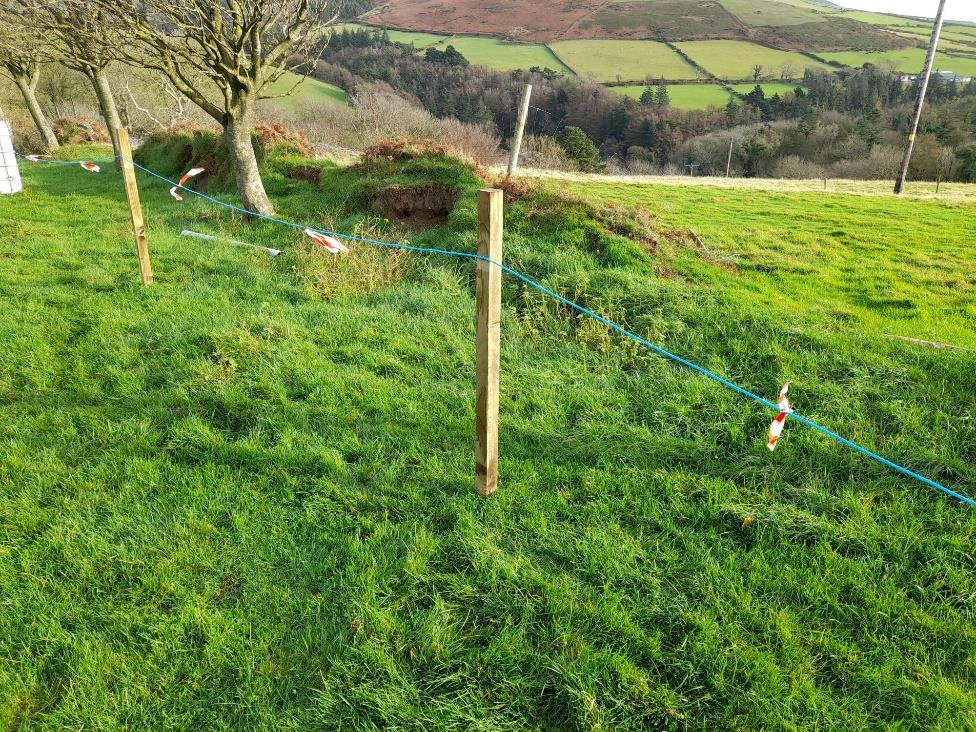
3.5. Type B fencing will consist of 3-strand, polypropylene rope, stapled to wooden stakes which are a minimum of 1m high above ground, 250mm below ground and 60x60mm wide, placed at maximum 3m centres. Hazard tape will be tied to the rope at maximum 1m centres so that it hangs down c.15cm from the rope, as shown in plate 1 below.
3.6. All protective fencing will be fully installed prior to any demolition or construction activity commencing and will remain in place and fully effective until the construction activity in that area is complete.
3.7. Within the CEZ there will be no access of any kind for construction related activities. Nothing will be stored, placed or disposed of above or below ground, the ground level will not be altered, no excavations will be made, nor will any fires be lit. Landscaping activities may take
place within the defined CEZs by agreement with the Project Arboriculturist (see part 2 for details).
Figure 1. Default specification of protective fencing recommended by BS5837:2012. Two key differences to ‘Type A’ fencing on this site are: (1) the diagonal stays/struts will be optional; and (2) the frame to which the weld mesh panel is attached may be constructed of scaffold poles OR timber.
Plate 1. Example of 'Type B' barriers
4. Roles and Responsibilities
4.1. To ensure that the proposed protection measures are implemented in accordance with this method statement and any related planning conditions, it is important to identify who will fulfil what role, and to understand the responsibilities of each role. Table 1 below identifies the key role and responsibilities for this project.
4.2. Good communication between the people fulfilling the roles identified in Table 1 is critical.
4.3. If there are changes in the personnel appointed to any of the roles identified in Table 1 all parties must be informed within 48 hours.
5. Sequence of Works
5.1. Table 2 outlines the approximate sequence of works expected during the construction process and shows when tree protection measures will be installed, monitored and removed.
5.2. The indicative programme of works shown in table 2 will be reviewed at a pre-commencement meeting (see paragraph 6.1 below) and will remain under periodic review by the PM/SM throughout the project. Progress through, and amendments to, the programme of works will be communicated to the PA by the PM so that the timing and frequency of arboricultural input and site visits can be adjusted accordingly.
6. Arboricultural Monitoring
6.1. Prior to commencement
6.1.1. A pre-commencement meeting is a vital event at which all the people fulfilling the roles identified in Table 1 must be present. All tree related matters will be discussed, including the contents of this AMS, the proposed sequence/programme of works, and the frequency of visits required to undertake monitoring.
6.1.2. The pre-commencement meeting will be documented by the appointed Project Arboriculturist (PA) and a record of the meeting sent to all those in attendance via email within 48 hours.
6.2. During the construction phase
6.2.1. Site visits will be made in conjunction with the sequence of works and their frequency determined by the programme of works and/or ongoing correspondence which identifies the need for additional visits.
6.2.2. Details of each visit will be sent to all relevant parties via email within 48 hours, including the date and time on which the visit was made; with whom the PA met and the details of those conversations; comments on the location, specification and condition of the specified tree protection measures, and details of any instances where the tree protection specifications outlined above in part 1 of this document are not being met; details of action(s) required to rectify non-compliance, including who is responsible and the deadline for undertaking the required action; and, timescales for a follow-up site visit if required.
6.2.3. No deviations will be made to the tree protection measures specified in part 1 of this document without the prior agreement of the PA.
6.3. Procedure for non-compliance
6.3.1. Any deviation from the specified protection measures, observed by the PA during a site visit, will be brought to the attention of the relevant parties via email and copied to the Department of Environment, Food and Agriculture (DEFA) for their records.
6.3.2. If, during the follow-up site visit, any action(s) required to rectify non-compliance has not been taken, the project manager will be informed within 48 hours by email and copied to DEFA for their records.
6.3.3. If the action(s) detailed in the most recent email are not resolved within the specified deadline, the PA has the right to withdraw his or her services until satisfactory steps have been taken to address the issue(s).
6.4. Following completion of the construction phase
6.4.1. Following completion of the main construction phase, but before the development is ‘complete’, some soft landscaping (i.e. tree planting) will be required within the defined CEZs. Prior to any soft landscaping operations being undertaken a precommencement meeting will take place between the PA and site manager (or the appointed landscape contractor, if different) to discuss potential tree protection issues and the need for additional/amended protection measures and ongoing arboricultural supervision.
6.4.2. Tree Protection measures will remain in situ throughout the soft landscaping works. Access points may be created through temporary barriers as required, under the
guidance of the PA, who will document the amendments via the process outlined above.
6.5. Following completion of the development
6.5.1. Following completion of all development-related activity and prior to the removal of any tree protection measures, the project manager will invite the PA to carry out the final site visit.
6.5.2. This visit will aim to identify any damage caused to the retained trees or any noticeable deterioration in tree condition. The visit will also aim to identify any obvious risks posed by the trees and the requirement for remedial works.
6.5.3. Once the final site visit has been made, the PA will request that all remaining tree protection measures are removed. This will mark the end of the arboricultural monitoring process.
Table 1. Definitions of key roles and responsibilities for this project
Project Manager (PM)
Site Manager (SM)
Project Arboriculturist (PA)
Appoint a PA and Site Manager SM to oversee compliance with the following method statement.
Communicate the required specification for construction methods and tree protection measures to all direct labour, contractors and subcontractors working on the site
Check that works are progressed in the sequence specified in the agreed sequence of works, monitor the implementation of the specified protection measures, and provide advice to the PM/SM during the construction phase if unforeseen conflict between development operations and arboricultural constraints occurs.
Circulate a list of key personnel and their contact details between all parties to facilitate communication relating to tree protection issues.
Communicate any foreseeable deviations from the agreed protection method statement to the PM and PA prior to it occurring, or immediately after if unforeseen.
Inform the PM of any deviation from the agreed tree protection specification.
Overall responsibility for ensuring that contractors and subcontractors comply with site policies and the requirements of this tree protection plan and method statement.
Liaise and co-ordinate with the PM and contractors for the agreed sequence of works.
Attend site at pre-agreed intervals and directly supervise development operations where there is a high risk of damaging occurring to retained trees on the site.
Ensure that all the equipment and materials required to implement the protection plan are available, and to provide any additional equipment and materials that might be required as the project progresses.
Provide copies of all relevant site safety policies and risk assessments to the PA for the works so that they may conduct their site visits in a safe manner.
Maintain and share records of site visits and related correspondence with the PM, SM, and any other relevant party
(Table 1. Continued)
Co-ordinate with the SM and PA to ensure the safe and proper execution of the works.
Responsible for periodically checking the tree protection measures in between PA site visits and will advise the PM and PA of any deviation from the agreed tree protection specification.
Responsible for providing the PA with an up-to-date programme of works, specifically in relation to the sequence of works, so that site visits can be arranged.
Inform the Planning Authority of any deviation from the agreed tree protection specification
October 2023 Former Test Centre – AMS-160123 Page 12 of 12
Table 1. Draft sequence of works showing the approximate timing of visits/input from the Project Arboriculturist (PA) (rows highlighted green).
Approved tree removal takes place
Pre-commencement site meeting held with Project Manager (PA), Site Manager (SM), Project Arboriculturist (PA) and relevant contractors present.
Construction Exclusion Zones (CEZ) become "Active" and protective fencing installed and erected as per the specification and relevant drawings.
PA SCHEDULED VISIT (fencing check) Ground works for new ramp and modifying the existing road junction onto Ballafletcher Farm Road. Construct the retaining walls for the main ramp area and the lower car park area.
Reduce the levels and lay new road sub-base, install new kerb lines and lay road base, including hardstanding area for main contractors site compound for Phase 2 works.
Approved tree removal takes place
Pre-commencement site meeting held with Project Manager (PA), Site Manager (SM), Project Arboriculturist (PA) and relevant contractors present.
Construction Exclusion Zones (CEZ) become "Active" and protective fencing installed and erected as per the specification and relevant drawings.
PA SCHEDULED VISIT (fencing check) Ground works for new retaining walls and excavations for buildings foundations. Erection of new steel frame structure and construction of the various floor levels. Construction of the building enclosure and the internal walls and fitout. Groundworks for new roadway around building, reduce the levels and lay new road subbase, install new kerb lines and lay road base. Landscaping pre-commencement meeting Hard landscaping.
Removal of the original site entrance roadway from Ballafletcher Road, grubbing up old macadam and removing from site as per specification and relevant drawings, Arboricultural supervision required.
Soft landscaping External Furniture signage etc, waring course applied to all roads and Lines Painted. CEZ's 'deactivated' and all temporary protective fencing removed.
End
Copyright in submitted documents remains with their authors. Request removal