Loading document...
Centre: NGR SC32800 92395 September 2023
www.curraghec.org
Dr Philippa Tomlinson: [email protected] mob 497731 Dr Peter Davey: email [email protected] mob 341820
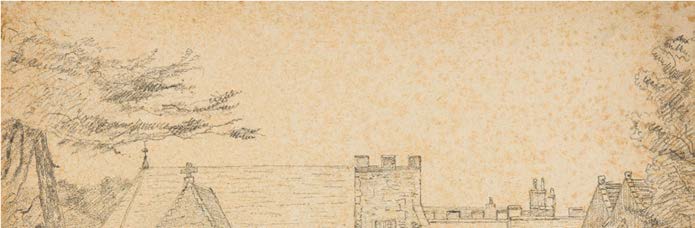
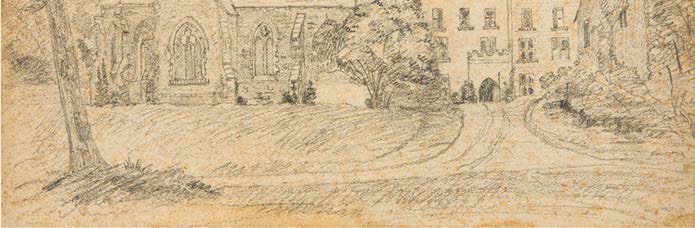
Cover illustra on: Drawing by Miss Georgina Gore Currie between 1854 and 1877 (MM1954-3601/64). Copyright Manx Na onal Heritage.
© Curragh Environmental Consultancy, 2023.
No development shall take place un l the applicant has secured the implementa on of a programme of archaeological work in accordance with a wri en scheme of inves ga on, which has been submi ed to and approved in wri ng by the Department in consulta on with Manx Na onal Heritage. The programme of archaeological work shall be fully implemented in accordance with the approved wri en scheme of inves ga on.
Reason: The informa on is required prior to development commencing as the site is of known archaeological poten al and it is important that archaeological remains are appropriately recorded prior to their damage or destruc on by the development in accordance with Environment Policy no. 41 of The Isle of Man Strategic Plan 2016 (ufm24_Approval_No ce_2020).
Curragh Environmental Consultancy (CEC) has been commissioned by Bell Burton (Douglas) on behalf of Mr. and Mrs. Giroux to produce a wri en scheme of inves ga on (WSI) for a watching brief during the reduc on of land surfaces and construc on of French drains.
As required by the planning condi on, this WSI will be submi ed to the Department of Environment, Food and Agriculture (DEFA) for approval, following further consulta on by the Department with Manx Na onal Heritage (MNH). Work on the site and the implementa on of the watching brief will not begin un l wri en confirma on of the content of this WSI is received.
date that had been filled with po ery, glass and other domes c rubbish da ng from the mid-19th to the early 20th century (Davey and Allwood 2016, 149).
In January and February geophysical surveys were carried out over the whole estate (Barker et al 2022). These were followed in June by an archaeological evalua on consis ng of the hand excava on of 22 test-pits in areas likely to be affected by construc on of the French drains (Saunders 2022). Whilst rela vely few artefacts of significance were recovered, the evalua on was able to describe the effects of repeated landscaping episodes over much of the site and to establish the varying depths of undisturbed archaeological deposits.
Figure 1: Extract from 2101297B AMD PL350B showing the area around the chapel of St Nicholas where land levels will be reduced
This area to be reduced to 28.00m, involving removal of between 100mm and 260mm of overburden.
Note: these levels are well above the landscaping layer iden fied in test pit 3 at between 400mm and 600mm below the present surface.
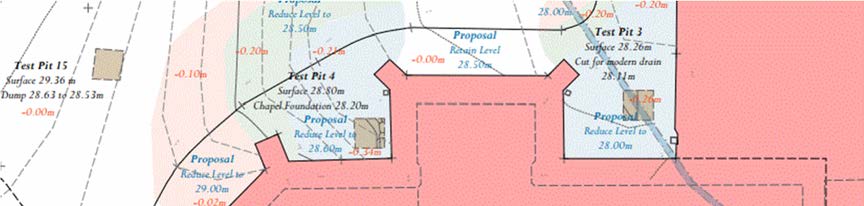
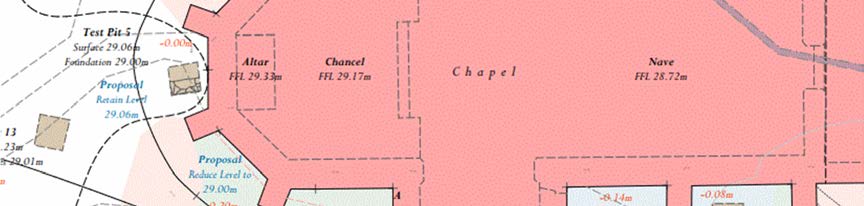
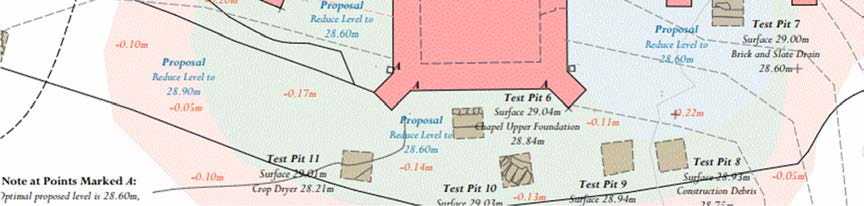
Note: these levels are well above the founda ons of the chapel as indicated in test pit 4 which were located at 600mm below the present surface, cut through a further 250mm of landscaping layers.
Note: the reduc on to 28.60m may create problems at a number of loca ons marked A on the plan because in test pit 6 the upper levels of the chapel founda ons were iden fied at 28.84m. Elsewhere the reduc on levels are well above any structure recorded in the other test pits.
In the areas to the south of the south transept and east of the east end of the chancel the present levels are to be retained.
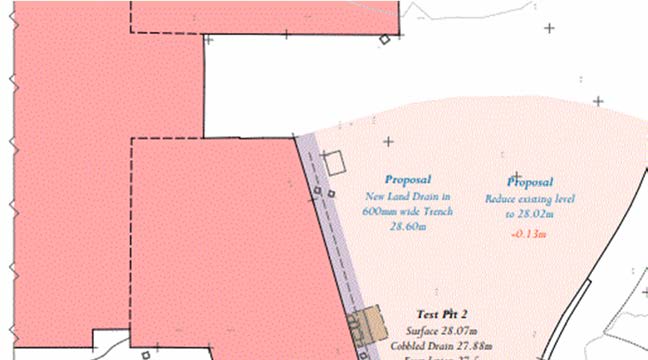
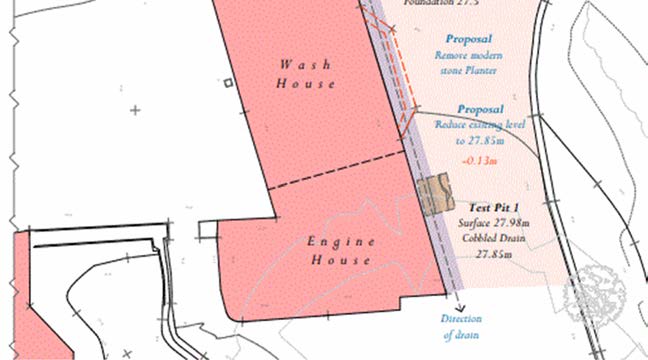
Figure 2: Extract from 2101297B AMD PL350B showing the route of the French drain and area south of the washhouse and engine house where land surface levels will be reduced
The drain
The French drain will be laid in a 600mm wide trench and connected at either end to exis ng drains. For a typical cross-sec on see Typical Land Drain Detail DN 20-167 55. The precise depth of the base of the drain trench will depend on the height required to avoid the adjacent building founda ons and at the same me to maintain a minimum of 1:150 fall. It will not exceed 600mm in depth.
Note: test pits 1 and 2 showed that at these depths the exis ng drain had been cut through recent backfill, so that preserved stra fied deposits are unlikely to survive.
The lowering of surface levels Land surface levels will be lowered in an area between the new drain and the entrance drive into the site. A maximum of 130mm will be reduced from this area.
Note: test pits 1 and 2 revealed modern made ground to a depth of at least 570 and 580mm respec vely. It seems very unlikely that this level of reduc on of surface levels will impact stra fied archaeological deposits.
The aim of a watching brief is to establish and make available informa on about the archaeological resource exis ng on a site (CifA 2014b, 4).
In order to achieve the above aims, the general objec ves of this watching brief are:
to record the presence or absence of archaeological features, deposits, structures, artefacts or ecofacts within the specified area within the constraints of the brief, to record the extent, character, date, condi on and quality of any surviving archaeological remains to place any iden fied archaeological structures or finds within a wider historical and archaeological context in order to assess their significance to make available informa on about any archaeological informa on recovered from the site by means of a wri en report.
The research objec ves are to extend and enrich the programme of specialist assessment and study of the history and archaeology of the Bishopscourt complex in which the client has been intensively engaged for the past two years (eg Barker et al 2022, Bridge 2021 and 2022, Croft, Gardiner and McDonnell 2021, Davey 2023, Denton 2022 and Saunders 2022).
All ac vi es will be undertaken in accordance with the methods set out within this WSI. Any significant varia ons to these methods will be agreed in wri ng with the Department and the client prior to being implemented.
Given the stra graphic evidence of the test pits, in the unlikely event of any unexpected structural elements or deposits being encountered that are considered by the field archaeologist to be of archaeological or historical significance, the contractor would be requested to pause the work in that specific area. The situa on would be reported to the client and to the Inspector of Ancient Monuments so that a decision could be made on how best to progress the work considering the significance of the newly revealed structures or deposits.
A full photographic record will be made of all areas concerned both before, during and on comple on of the brief.
Should any unforeseen undisturbed organic deposits be encountered they will be sampled for future assessment.
The discovery of any human remains would be dealt with in line with the standards set out in CIfA Technical Paper 13, 1993.
As required by sec on 8 of the Isle of Man Treasure Act 2017, CEC will no fy the client and the Manx Museum and Na onal Trust of the discovery of any material covered, or poten ally covered, by sec on
Should it prove necessary to remove any objects or samples from the Isle of Man for specialist study, an export license will be applied for as required by sec on 20 of the Manx Museum and Na onal Trust Act 1959, as amended.
A wri en descrip on will be made of all archaeologically significant features and deposits that are located during the watching brief.
All retained finds will, as a minimum, be washed, weighed, counted and iden fied. They will then be recorded to an appropriate level according to the methodology recommended by CifA (2014c).
Finds will be suitably bagged and boxed in consulta on with the client and generally in accordance with the standards of the CIfA (2014c).
Any environmental samples taken during the watching brief will be retained for further analysis which would be the subject of an addi onal proposal from CEC to the client.
Following comple on of the fieldwork and the evalua on of the stra graphic, artefactual and ecofactual evidence, a dra report will be submi ed for approval to the client and the Inspector of Ancient Monuments, for comment. Once approved, a final version will be submi ed.
The report will include the following elements:
Non-technical summary Project background Archaeological and historical context Aims and objec ves
Methods Results: stra graphic, finds and environmental Conclusions: in rela on to the project aims and objec ves, and discussion of wider local, regional or na onal implica ons Archive prepara on and deposi on arrangements Appendices: including site diary and tables of finds References
A copy of the final report will be deposited with the Historic Environment Record, along with any spa al digital data rela ng to watching brief.
The clients will con nue their policy of providing copies of completed survey and research reports on aspects of the history and archaeology of Bishopscourt to the HER where they will be publicly accessible. In addi on, in the case of this watching brief, informa on will be provided to the press and social media as appropriate to the significance of any findings.
The full copyright of the wri en/illustra ve/digital archive rela ng to the project will be retained by CEC under the Isle of ManCopyright Act 1991(as amended) with all rights reserved. A copy of the report and archive lis ng will be deposited at the Manx Museum where it can be used for educa onal purposes, including academic research, providing that such use conforms to the UK Copyright and Related Rights Regula ons 2003, as applied to the Isle of Man.
The copyright of figures 1 and 2 is retained by Adam Architecture of Winchester and London.
Dr Peter Davey MifA, project manager Ms Fenella Logan BA, ACifA, field archaeologist Dr Philippa Tomlinson MCIEEM, environmental archaeologist All staff are responsible for adhering to the CifA’s the Code of conduct and Regula ons for professional conduct (MifA 2014e and 2014f).
CEC will work collabora vely with clients on health and safety ma ers and with the principal contractors G.J. Ingham and Sons Limited of Peel.
ufm24_Approval_No ce_2020 Typical Land Drain Detail DN 20-167 55 PROPOSED PLAN FOR GROUND LEVELS AND FRENCH DRAIN 6296 PL350-B French Drain and Levels Eleva on PL351 Wessex Archaeology, Archaeological Evalua on Ref: 260210.03 August 2022
Service & Digital An quity Guides to Good Prac ce. Brown D H 2011, Archaeological Archives: a guide to best prac ce in crea on, compila on, transfer and cura on (revised edi on). Cifa 1993, Excava on and post-excava on treatment of cremated and inhumed remains (revised edi on 2022), Reading: CifA.
CIfA 2014a, Standard and guidance for archaeological field evalua on (revised edi on June 2020), Reading: CIfA.
CifA 2014b Standard and guidance for an archaeological watching brief (revised 2020), Reading: CifA. CIfA 2014c Standard and guidance for the collec on, documenta on, conserva on and research of
archaeological materials (revised edi on October 2020), Reading: CIfA.
project managers’ guide, Swindon: English Heritage.
Kirk Michael, Isle of Man, Upton on Severn: SUMO Geophysics ltd, report 06360.
Croft P, Gardiner M and McDonnell P 2021, Bishopscourt, Isle of Man: report on the historic architecture and decorative interior, Lincoln: Lincoln Conservation, University of Lincoln. Davey P and Allwood D 2016, ‘Archaeological fieldwork and research summaries’, Isle of Man Studies,
14, 142-9.
Davey P J 2023, Bishopscourt – landscape, history and archaeology to AD 1550, Ballaugh: Curragh
Environmental Consultancy. Denton L 2022, Bishopscourt heritage statement, Winchester: Adam Architecture. Saunders B 2022, Bishopscourt, Kirk Michael Isle of Man: Archaeological Evaluation, Sheffield: Wessex
Archaeology.
Copyright in submitted documents remains with their authors. Request removal
View as Markdown