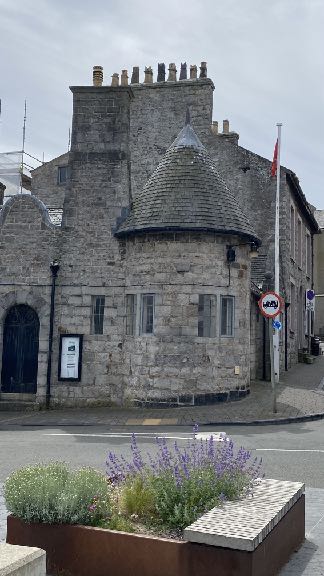
Derby House, Parliament Square, Castletown IM9 1LA Conversion of building to Class 1.3 - food and drink and Class 3.1 - tourist accommodation
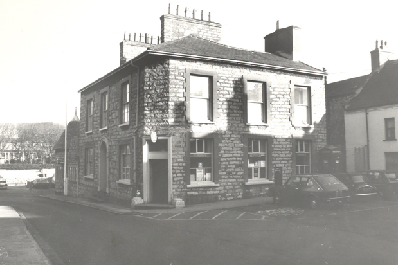
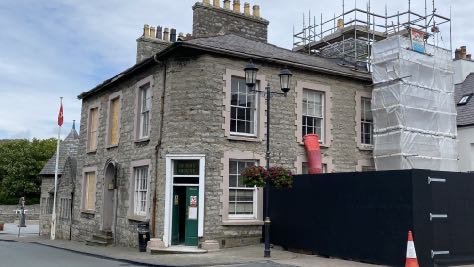
A black and white photograph showing a two-story stone building on a street corner, likely the existing offices mentioned in the application.A street-level photograph of a two-story stone building undergoing renovation, featuring scaffolding on the right and black construction hoarding.
Executive summary Prior to the submission of this application advice was sought from the Principal Registered Buildings Officer who visited the site and advised of the historically important existing features of the building. This advice has been taken into account whilst preparing the detailed layout of the proposed use of the building although some changes have been required in respect of original doors and doorways to accommodate features required by the Building and Fire Safety Regulations which cannot be avoided and where the original features are being retained and re-used elsewhere within the property where practicable.<br><br>The building was Registered in 1984 and has not recently been used for its original purpose (residential with a draper’s shop which was changed to a restaurant, the post office coming later) for some time, having been most recently used as offices which was approved in 1997 as a change from the previous post office and offices which in turn was changed from post office and living accommodation in the 1980s. The historic importance and interest of the building justifies flexibility in its use where this will ensure the continued maintenance and use of the building and where the preservation of the historic fabric is the most important consideration.<br><br>We believe that the proposal to convert the building to Class 1.3 - food and drink will sensitively accommodate a new use which will be compatible with the other uses in the vicinity whilst ensuring Castletown remains a vibrant and attractive place to live and visit, in accordance with all of the relevant planning policies.
Image included in the Protected Buildings Register. Building as it currently appears.
The Site
1.1 The site is the curtilage of an existing building - Derby House - which sits opposite Castle Rushen, on the eastern side of Castle Street and attached to the former Police Station (currently leased by the applicant from Manx National Heritage). Both Derby House and the Police Station are Registered (RBs 28 and 27 respectively) as are most in the vicinity - Castle Rushen (which is also an Ancient Monument), Ellan Vannin, 1, Parliament Square, Westminster House, 5, Parliament Square, Compton House - other than Harbour Mews immediately to the rear (also owned by the applicant).
1.2 This concentration of Registered Buildings is unusual in its extent and it is relevant that at the time of these Registrations (1984 and thereabouts), there was no provision for Conservation Area designation in Isle of Man legislation with the 1990 Conservation Areas in Douglas, Castletown, Laxey and Onchan being introduced as exceptions to the provisions of the Town and Country Planning (Permitted Development) Order of that year and with the Conservation Area legislation proper only being introduced in 1999 through the Town and Country Planning Act, 1999 which provides that:
“(1) The Department shall determine which parts of the Island are areas of special architectural or historic interest, the character or appearance of which it is desirable to preserve or enhance, and shall by order designate such areas as conservation areas. This does not, however, denigrate the historical importance of these buildings.”
1.3 The existing building is mostly stone faced. The front elevation has distinctive banding around the windows and a round headed door aperture with round headed fanlight above the timber door. There is a second, square headed door opening on the south western corner of the building which formerly had stone pillars on each side but which were previously removed and now all that remain are the bases at ground level: the grand façade continues around the corner into Parliament Square where that elevation also has the distinctive banding around the sliding sash, Georgian pane windows, some of which are currently boarded up.
1.4 The building has two substantial stone chimneys on the principal ridge and a second, rendered chimney which sits on the rear elevation looking towards Harbour Mews and 1, Parliament Square. This elevation is less attractive and until recently, had additions which were added after the building was constructed which are not in stone and did not reflect the interest of the other elevations. Planning permission was granted for the removal of these features and in implementing this, the applicant undertook work which was not shown on the drawings and which is explained later in this statement. Planning approval is being sought retrospectively for this as part of this current application.
1.5 The current internal layout of the building is as follows: there is a basement which previously accommodated storage with office accommodation: on the ground floor the layout accommodates a reception, three offices and a staff room. Above this, on the first floor are four offices and a boardroom and above this, in an attic, are two further offices/ stores and two store rooms. The floor levels in the southern section of the building are generally different to those in the northern section in all but the first floor.
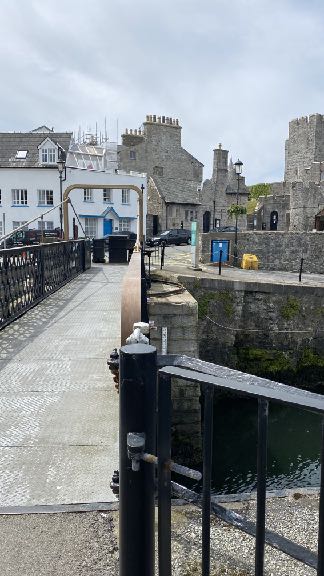
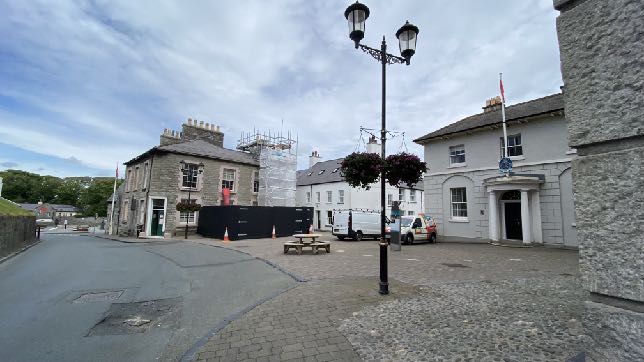
1.6 The building is clearly visible from Castle Street and Parliament Square with the northern gable appearing over the Old Police Station as viewed from in front of the former DHSS Office (now Costa Coffee) and from the bridge and Bridge Street on the other side of the harbour.
The Proposal
2.1 Proposed is the conversion of the building to Class 1.3 - food and drink on the basement and ground floors with the first floor converted to Class 3.1 in the form of two bedroom suites which are accessible for disabled users at first floor level, each having its own bedroom area, bathroom and dressing facilities. There is also an accessible toilet compartment at first floor level for guests. In the attic there is a further two bedroom suites each with en-suite and dressing facilities. Staff shower and toilet facilities together with ancillary storage and plant rooms are also provided within the attic.
2.2 Physical changes
2.2.1 Physical changes will be kept to a minimum and only where absolutely necessary. Internal changes have aimed to retain, where possible, the original elements with the introduction of four pedestrian door openings on the ground floor with the closing off of one existing door opening and the introduction of one additional external door on the eastern elevation. A small number of works have already been undertaken and the Principal Registered Buildings Officer is aware of this and his advice has subsequently been taken.
2.2.2 At the rear opposite the recently created restaurant in Harbour Mews, during the implementation of the approval for the removal of existing fabric granted under 20/00015/ GB and 20/00016/CON, the removal of the approved fabric resulted in a situation where the remaining walls above the aperture were deemed unsafe and new steel beams were inserted to support the masonry above and this was carried out under the supervision of BB Consulting Engineers as emergency work.
2.2.3 Following the demolition of the side annex which was previously approved, the fragility of the existing structure was exposed. There were several cracks evident in the gable and in the stone lintel. Historical and current failings of the timber supporting lintels was evident and the attached photographs show replacement concrete lintels that were built in by a previous owner. Existing decaying timber lintels were also evident.
2.2.4 Whilst it is accepted that this type of work on a Registered Building requires Registered Building consent it was decided that because the annexe had already been demolished and was no longer providing buttressing support, there was a significant risk of collapse and carried out the remedial structural works immediately as an emergency procedure. The design of the structural works including the scaffold design and associated needling/temporary support was carried out by and the works supervised by qualified engineers.
2.2.5 Fairly minor and minimally invasive exploratory works were carried out in the basement - notably small hand dug trial hole excavations in the floor adjacent to the external wall. These were carried out so the engineer could assess the new floor construction detailing.
2.2.6 Proposed external changes include:
1. New stone columns on the south western entrance set on the existing bases: these are to replicate those shown on the historic photograph attached to drawing 7 and which have been removed in the past
2. Alteration of the existing door set on the south west corner at head and raise doors by around 150mm to accommodate the raising of the internal floor levels at gf within the building
3. Replacement of the non-original (all) windows in the southern elevation with new Accoya framed sliding sash windows with 12mm double glazing all to match the original retained windows in Castle Street
4. Creation of a new door in the eastern elevation to provide access to new beer cellar (retrospective)
5. Introduction of new steel beams over new doors in existing opening on the eastern elevation (retrospective) and installation of new sliding aluminium framed sliding doors to allow fully accessible entrance to and exit from the building together with the introduction of new external stairs and ramps finished in dark grey paving slabs.
6. Removal of existing gas box fitted on the eastern elevation with new gas box fitted into new recessed opening (retrospective) with new Accoya door fitting flush to the external stone wall.
7. Retention of the existing light wells on the eastern elevation and fitting therein of glazed units within the landing ramp above.
8. Existing walls to all elevations are to be re-pointed using approved NHL lime mortar and the colour, texture and pointing style can be reserved for further approval with the Principal Registered Buildings Officer through a planning condition. The old paint on the ornate plasterwork and doors will be carefully removed a “Peelaway” poultice paint remover system or other approved.
9. On the Castle Street elevation the existing brick infill above the footway will be removed and a new heritage type glass block unit will be fitted to provide natural light to the basement cocktail lounge below.
10.The underside of the existing vaulted stone roof on the eastern elevation will be cleaned and repointed using approved NHL mortar and a Delta cavity membrane fitted to the vertical elements and insulated internally then finished in lime paster or Accoya timber dado boards to detail.
11. The entire roof is to be re-slated using natural Penrythyn Welsh slates with ridge and hips to be finished in terracotta or red sandstone angled tiles. The existing clay chimney pots, haunching and capping are to be inspected and repaired or replaced as necessary. New roof lights are to be installed - two in the southern plane, four in place of two in the western plane and four in the eastern plane and all Conservation type 550 x 980mm with recessed flashings and in black frames.
12. Kitchen extraction will discharge into the existing chimney flues/stack and will terminate below the top of the pots. The gas boiler fanned flues will extract horizontally through the northern gable and will be dark grey coloured so as to be inconspicuous against the stone (refer to images on application drawings)
2.3 Internal changes
2.3.1 Planning approval is not required for any internal alterations per se although Registered Building consent is required. The internal changes are listed here for information only.
2.3.2 All original existing ornate plaster ceilings and coving including joinery detailing to the ground and first floor northern side of the building including the hallway are to be retained along with the roof members in the attic although they will be reinforced in accordance with the recommendations of the Structural Engineer.
2.3.2 Internal works include:
1. The old paint on the ornate plasterwork and doors/joinery will be carefully removed using the “Peelaway” poultice paint remover system or other approved.
2. The removal of the non-original ground, first and attic floor structures on the southern half of the building to accommodate new compartment floor constructions incorporating underfloor heating and acoustic insulation.
3. Removal of all internal modern interventions on the Parliament square side of the building to be including plasterboard partition walls and wall linings, plasterboard ceilings, new joist floors, chipboard floorings, modern internal doors, architraves and skirtings which have previously been approved by the Principal Registered Buildings Officer and will also assist inspection and assessment of the underlying structure.
4. Within the ground floor hallway, new wine bar lounge and garden room lounge (the northern part of this floor) the existing original ornate plasterwork and joists are to be retained and new acoustic floor applied on top.
5. Introduction of new openings within the ground floor and fitting with half hour fire doors from the hall into the northern and southern halves of the building and removal of the existing non-original internal staircase within one of the rooms in the southern part of the building.
6. Introduction of a new lift shaft within the southern half of the building serving the ground and first floors.
7. New waste drainage pipework will be required to discharge waste water from the basement kitchen/bars to the existing drainage to the east.
8. Internal stud walling will be introduced in the basement within the proposed kitchen area and the existing walls where they are not to be left as exposed stonework, which will be repointed using approved NHL mortar, will be repointed using approved NHL lime mortar with Delta cavity membrane system which is recommended for historic buildings, to allow free draining to a subfloor cavity drainage system discharging to a submersible sump pump. The cavity membrane system on the walls will be rendered or plastered with approved NHL lime mortar (K Lime 213 setting mortar and 112 finish mortar).
9. The extraction system from the kitchen canopy will be connected to the extraction duct adjacent to the existing chimney stack above.
10.The external perimeter walls to the southern side of the building will be underpinned in accord with the structural engineers drawings’, all as shown in the proposed floor plans. Levels will be reduced through the removal of the existing cement screed and finished in new natural stone floor tiles/slabs above a 50mm liquid screed incorporating underfloor heating pipes.
11.On the first floor the non-original staircase will be removed and space re-arranged to accommodate the new layout.
12. The existing doors leading onto the staircase which require 30min fire integrity will be replaced with new doors manufactured by a specialist manufacturer to replicate the existing and meeting Fire Safety Officer and Building Regulation conformity. All existing doors being removed to accommodate the fire doors will be removed, refurbished and refitted within the building where fire integrity is not required. The details of the replacement doors can be provided prior to related works and be conditioned.
2.4 Other works are shown on the plans but for which planning approval and Registered Building consent are not being sought at this time, including works to the adjacent Baillie Scott former Police Station building and the creation of a pavement external dining and drinking area.
Policy
3.1 The site lies within an area designated on the Area Plan for the South adopted in 2013
as Mixed Use and within the town’s settlement boundary. The site does not lie within any area at risk of flooding according to the national flood risk mapping and there are no trees, Registered or otherwise, on the site.
3.2 The property is Registered and also lies within Castletown’s Conservation Area both of which invoke policies and proposals in the Strategic Plan and Planning Policy Statement 1/01
Conservation of the Historic Environment of the Isle of Man - which aim to protect the historic and architecturally important fabric of the Island including changes of use thereof. These policies - Strategic Policy 4, Environment Policy 32, Environment Policy 35 and the PPS are listed in Appendix One of this document.
3.3 The Strategic Plan also contains policies which protect the environment generally and the living conditions of those who live in an area - General Policy 2 b, c and g and Environment Policy 22. For Class 1.3 the Strategic Plan does not have policies which specifically deal with this other than Community Policy 4 and the preceding text which clarifies the importance of public houses as well as local shops, which is set out below: as such, the policies which relate to retail have been included in the assessment of planning policy here.
“10.8 Retention of Existing Local Shops and Public Houses The loss of facilities such as neighbourhood shops in towns and or village shops and public houses reduces customer choice and can also necessitate people travelling further to meet their needs. This is a particular problem in rural areas where village shops, post offices and public houses can be central to village life. It would be preferable to retain viable facilities, or those that can be made viable and where a change of use or re-development is proposed developers will be expected to show evidence of attempts to market the property as a business in these areas.
Community Policy 4: Development (including the change of use of existing premises) which involves the loss of local shops and local public houses, will only
be permitted if it can be demonstrated that the use is no longer commercially viable, or cannot be made commercially viable.”
3.4 Castletown is identified in the Strategic Plan’s settlement hierarchy as a Service Centre where “ development will be concentrated…to provide regeneration and choice of location for housing, employment and services” (Spatial Policy 2).
3.5 Business Policy 1 encourages “The growth of employment opportunities throughout the Island…provided that development proposals accord with the policies of this Plan” and Business Policy 9 explains that “The Department will support new retail provision in existing retail areas at a scale appropriate to the existing area and which will not have an adverse effect on adjacent retail areas. Major retail development proposals will require to be supported by a Retail Impact Assessment(1).”
3.6 Business Policy 10 states that “Retail development will be permitted only in established town and village centres,” with some exceptions which are not relevant to the current application.
3.7 The Strategic Plan acknowledges the value of sustainable tourism and its historical importance to the Island (paragraph 9.5.3).
3.8 Car parking is required by the Strategic Plan to be provided (Transport Policy 7) although Appendix Seven explains that “Most shopping facilities in established centres do not have on site parking provided due to the intensive form of development and their location off the main highway, often in pedestrianised streets” with particular reference to Castletown, Ramsey, Peel and Douglas and goes on to state that it is “impractical” to require on-site parking for either staff or customers in such locations although it must be feasible for retail developments to be serviced. It also states that it is essential that there are sufficient areas of public car parking either in car parks or on street and that adequate controls are in place for these spaces to be available to those who need them.
3.9 The standard expressed for town centre shops is only that space for service vehicle use is provided. Car parking for tourist accommodation is one space per guest bedroom. The standard for the offices (current use) is one spec for every 50 sq m of floor nett space (227 sq m excluding the areas used purely for storage). Appendix Seven also states that these standards may be relaxed in some circumstances, specifically referencing development which would secure the re-use of a Registered Building or a building of architectural or historic interest; where it would result in the preservation of a sensitive street scene, where is it otherwise of benefit to the character of a Conservation Area and where it is within a reasonable distance of an existing or proposed bus route and it can be demonstrated that a reduced level of parking will not result in unacceptable on street parking in the locality.
3.10 In February, 2013 the Amey Castletown Town Centre Parking Study and Parking Policy Development Options was published by Department for Infrastructure. This stated that there were 16 restricted on street spaces in and around The Quay and 258 publicly available off street spaces in the area between the site and Market Square inclusive considered the
present demand and supply for car parking in the town and concluded that in these areas, on Saturday day time the car parking spaces are reaching capacity use although there are spaces available slightly further away, but otherwise there are spare spaces in most places
at most other times. This report recommended that Department for Infrastructure and Castletown Commissioners review the provision and management of parking and consider introducing the introduction of parking charges, additional parking spaces, cycling and signage improvements, shared parking spaces, a review of disabled persons’ spaces, highway maintenance and improvements in parking enforcement with monitoring and review of all.
3.11 Since then there has been no change in the available parking areas within the town but there has been a change to more pro-active enforcement of parking restrictions and talks are on-going in respect of pay to park and the acquisition of additional parking areas within the central part of the town. In 2019, Castletown Commissioners consulted on the introduction of 2 hour parking periods within Chapel Lane (designated as Car Park on the Area Plan for the South) other than on a Sunday. This is now in effect and further changes to the parking restrictions are being discussed. Area Plan for the South (2013)
3.12 This refers to Castletown having the third largest amount of office accommodation on the Island which provides not only local employment but also support for shops, restaurants and public houses with the steam railway bringing many visitors to the town and again providing support for shops and restaurants (paragraph 3.9.2) and highlights the importance of Castletown to tourism with its array of heritage sites (paragraph 6.1.3).
3.13 The Area Plan states that “In order to achieve town and village centres which are attractive, viable and full of vitality it is essential to encourage a mix of different uses to locate within the Mixed Use areas. This will include elements of retail, office, light industrial, community facilities, leisure and tourism uses and residential as well as dedicated public spaces which will be a focus for community activity. Uses which are not compatible with residential developments will not be supported within the Mixed Uses areas. Generally there will be a presumption in favour of changes of use between the range of approved uses. Whilst planning approval may be required for some changes, this would normally be supported subject to the buildings being suitable for the new use.”
3.14 Mixed Use Proposal 1 states that “In order to maintain and enhance the vitality of the Mixed Use areas in Port Erin, Castletown and Ballasalla, there will be a presumption in favour of the retention of existing retail units on the ground floor although each case will be determined upon its circumstances and merits” reiterated in paragraph 6.6.4 and Mixed Use Proposal 5) and with residential use encouraged on the upper floors and where office use may be acceptable but not at the expense of residential uses (paragraph 6.6.5 and Mixed Use Proposal 4).
3.15 Section 6.14 talks of the role of each settlement and the needs of its residents which each is expected to meet with a range of employment opportunities and Castletown and Port Erin being the focus for retailing in the south. It refers to the Isle of Man Retailing Study in 2009 whose purpose it was to carry out a comprehensive review of the retail sector on the Island with view to providing broad pouch options and recommendations to assist in the future development of retailing on the Island. In terms of Castletown, it refers to current provision being focused on Arbory, Malew and Castle Streets with a good variety of traders including some specialist shops and with Callow’s Yard having provided additional opportunities for retail in the town.
3.16 Paragraph 6.6.1 refers to the need to achieve attractive, viable town centres which are full of vitality and the encouragement of a mix of different uses within Mixed Use areas including retail, office, light industrial, community facilities, leisure and tourism as well as residential and dedicated public spaces and where uses which are not compatible with residential uses will not be supported within Mixed Use areas with a general presumption in favour of changes of uses between the range of approved uses and “whilst planning apparel may me required for some changes, this would normally be supported subject to the buildings being suitable for the new use.
3.17 Paragraph 6.6.2 goes on to encourage Mixed Use areas having residential, shops, financial and professional services, food and drink, research and development, light industry, hotels and hostels, hospitals, nursing homes and residential institutions, community uses, leisure tourism and open space with the mix and types of usage to be determined in accordance with the merits of each proposal measured against the proposals in the Area Plan and policies of the Strategic Plan (taken to be GP2 and EP22 as stated above).
3.18 Paragraph 6.22 discusses the historic layout of buildings in Castletown which brings with it a presumption in favour of the retention of the historic fabric and paragraph 6.24.1 refers to the recommendations of the Retail Study in respect of the focus of activity lying in the improvement of the quality of the town centre retailing and leisure environment.
3.19 Paragraph 6.30.1 talks about priorities for tourism in the south, the most important being the protection of tourist attractions including the many heritage sites and just before this, at paragraph 6.29.1 and 6.29.2 talks of the declining number of hotels and tourist bed spaces and the importance of the retention of hotels and the development of new tourist accommodation being the approach of Department for Enterprise.
3.20 Chapter 5 of the Area Plan for the South deals with the natural environment, the built environment and our cultural and historic heritage and refers to the concentration of Registered Buildings in Castletown and its Conservation Area but contains no new policies which add to those in the Strategic Plan and the Planning Policy Statement 1/01 Conservation of the Historic Environment of the Isle of Man.
Planning History
4.1 The building has been the subject of a number of applications for alterations including the following:
20/00015/GB - demolition of existing annexe structure to the south east elevation, secure window and door aperture and repointing of walls - approved
20/00016/CON - Registered Building consent for the works set out in 20/00015/GB approved
15/00932/CON - registered Building consent for the installation of replacement windows approved
15/00931/GB - approval for replacement windows - approved 14/01272/CON - installation of replacement windows to rear elevation - refused as the installation of uPVC windows whose style did not replicate the originals was not considered to accord with Environment Policies 32 and 35 or Planning Policy 1/98. 14/01271/GB - installation of replacement windows to rear elevation - refused for the same reason as 14/01272/CON. 97/00755/GB - conversion of post office and meeting rooms to office accommodation approved 92/00596/B - erection of TV aerial - approved IDO 54739 - provision of rear entrance and for sanitary accommodation, 11, Castle Street (Post Office Building) - approved 11.09.81. This application described the existing use of the premises as post office, stores with living accommodation and proposed was post office, stores, meeting rooms, toilets etc. 4.2 Harbour Mews to the rear has been the subject of recent applications for conversion to a restaurant (19/00690/B and 19/01223/B).
Assessment
6.1 The issues in this case is whether the works (external in the case of this planning application) would have an adverse impact on the special character or appearance of the Registered Building (Strategic Policy 4, Environment Policy 32 and Planning Policy Statement 1/01 - Conservation of the Historic Environment of the Isle of Man RB/3 and 5 and having regard to RB/8) or on the character or appearance of the Conservation Area (Environment Policy 35 and Planning Policy Statement 1/01 - Conservation of the Historic Environment of the Isle of Man CA/2) or the area generally (General Policy 2b, c and g). It is also relevant to
consider whether the proposed uses of the site are appropriate in terms of the building itself (Environment Policy 33 and PPS RB/5) and the area (Community Policy 4, Business Policies 1 and 4 and Area Plan for the South Mixed Proposals 1 and 4) and the impact on the living conditions of those in adjacent properties (General Policy 2 g and Environment Policy 22), car parking (General Policy 2h, Transport Policy 7 and Appendix Seven) and highway safety (General Policy 2i).
6.2 Impact of the external changes on the Registered Building
6.2.1 The external works are generally limited to removal and replacement of non original features (the windows facing Parliament Square), repair (repointing of walling) and replacement of the roof) and reinstatement of original features or replicas thereof (the door columns) all of which will enhance the character and appearance of the Registered Building in full compliance with Strategic Policy 4, Environment Policy 32 and the RB Proposals 3 and
5 in the Planning Policy Statement and will also accord with Environment Policy 34 which expresses a preference for the use of traditional materials in the maintenance, alteration or extensions of pre 1920 buildings.
6.2.2 The alterations to the exterior which change the building are the raising of the door head on the south western corner of the building, the introduction of the new pedestrian access to the beer store and the ramped access into the building, the provision of glazed covers to the light wells, the replacement of the existing gas meter boxes and their replacement with a new recessed box and the introduction of the new door at the rear where the former annexes were removed. The re-slating of the existing building will also result in a minor change to the appearance of the building as will the installation of the rooflights which are conservation style.
6.2.3 All of the changes are required to facilitate the change of use as proposed which will result in a new use which will generate investment in the building which is of historical and architectural importance to the Island. The installation of the roof lights will allow better use of the attic space and will be conservation type, not uncommon in Castletown for example alongside at 1, Parliament Square. The introduction of glazed covers to the light wells will preserve the lower floor glazing and enable more light to enter the lower levels of the building with a fuller use of these areas of the building.
6.2.4 The new door to access the beer cellar will allow this element to be provided with minimal change to the existing fabric with a simple solid timber door which will match the proposed recessed gas meter box which replaces the former surface mounted and in a location which is the least visible and on a non-principal elevation.
6.2.5 The new ramped accesses will result in a visible change to the building but again on an elevation which is less visible than the other two principal elevations and which has already been changed somewhat through the approval of the external dining area associated with Harbour Mews. Planning Policy Statement 1/01 - Conservation of the Historic Environment of the Isle of Man makes it clear that those will disabilities should be allowed a dignified access into an historic building and that this should be where possible without
significant change to historic fabric. In this case, the two principal entrances are not suitable for wheelchair access nor could be without significant change to the building and as such, as recommended by the PPS, alternative access is to be provided which makes use of disturbed fabric on the least publicly visible elevation.
6.2.6 We believe that the changes either preserve or improve the appearance and importance of the building or where there is change, that this is acceptable, particularly given the resulting new life for this building and consequent continued investment therein.
6.3 The impact on the Conservation Area and the area generally
6.3.1 The external changes to the building are considered to be negligible in terms of the overall Conservation Area and the area generally and it is important that historical buildings are well maintained not only in terms of the appearance of the area but also to ensure that such buildings are kept aired, heated and weather tight. It is considered that the works proposed will have an acceptable impact on both the Conservation Area and the area generally in accordance with General Policy 2, Environment Policy 35 and PPS CA/2.
6.4 Use of the building
6.4.1 There will be two impacts from the proposed new use of the building: one on the building itself and the other on those around the site.
6.4.2 The PPS and Strategic Plan both make it clear that new uses for Registered Buildings will only be permitted if the use is appropriate and the changes necessitated by it will not have any detrimental impact on the important of the building. They also suggest that the most appropriate use for an historic building is that for which it was first built and in this case, what is proposed is more akin to the original use of the building as a dwelling certainly on the upper floors, than the current use as offices. The changes to facilitate the use as tourist accommodation are minor and largely remove more modern internal interventions to the building.
6.4.3 The changes to facilitate the use of the building for Class 1.3 are, as stated above, considered acceptable in respect of the impact on the Registered Building.
6.4.4 There will be a change to those in the surrounding area from the proposed use, particularly in respect of the different hours of use of the building, from largely daytime and weekday use as offices to all day and evening use. The Area Plan makes it clear that retail is the most appropriate use of ground floor accommodation and that above this, residential is the most acceptable. It also specifically refers to the leisure use of town centres and the need to permit uses which will enhance the vitality and interest of them. The introduction of tourist accommodation will accord with the objectives of the Department for Enterprise as stated in the Area Plan. The installation of an internal lift and ramps will also extend the range of persons who will be able to access and use the building
6.4.5 The proposed use will extend the times into the evenings and weekends when people will visit this part of the town, thus enhancing it as a destination at greater parts of the day and week. Whilst Community Policy 4 discusses the loss of retail units, it is clear that this recognises the value and acceptability of retail uses which should be retained: what is proposed is the re-introduction of such a use in compliance with the objectives of this policy.
6.4.6 In terms of the impact on those in the vicinity of the site, it is relevant that a great number of the closest buildings are owned or leased by the applicant and as such, it is in their interest not to create activities which will result in nuisance to the occupants of those buildings (diners, residents or tourists). It is also relevant that the site is in a town centre with nearby restaurants, public houses and public spaces. There are licensing laws which govern how restaurants and public houses (all Class 1.3) operate and where unsatisfactory operations can be forced to cease.
6.4.7 It is considered that the proposed use complies completely with the Strategic Plan, Area Plan and Planning Policy Statement requirements and is acceptable and will be beneficial to the town.
6.5 Car parking
6.5.1 The existing use will requires at least 4 parking spaces, none of which is provided on site as there is no opportunity for such. The proposed Class 1.3 use would require no parking spaces for customers or staff of the Class 1.3 uses and four spaces for the Class 3.1 uses for the four tourist accommodation rooms. As such, given the lack of on site spaces, the proposed use results in no change to the deficit in the satisfaction of the parking standards from the existing situation. It is also relevant that the tourist accommodation may well result in a greater possibility of the occupants not having their own vehicle compared with the office use whose occupants are more likely to have their own vehicle which needs to be parked in Castletown and for longer periods during the day. It is relevant that those staying in the proposed tourist accommodation would be choosing to stay in an historic town with a frequent bus service which passes the site and with an historic railway operation within walking distance.
6.5.2 Even if this were not the case, the Strategic Plan clarifies that parking standards may be relaxed in certain circumstances and we believe that our proposal accords with all of the instances where exceptions may be made: it concerns a Registered Building, sensitive streetscene and a Conservation Area and is also within close proximity of the public transport services of both buses and the steam railway. Given the reduction in demand for parking spaces from the proposed use, it is concluded that there cannot be any adverse impact from any change in on street parking, as stated in Appendix Seven.
6.5.2 The local authority has made it clear in discussions with them that they will work with the applicant in providing parking spaces within the car parking areas within their control and they have also introduced a variety of different types of parking provision and more effective enforcement thereof and are continuing to work towards addressing all of the recommendations in the Amey Parking Study.
6.5.3 We do not believe that the proposed us will create any adverse impact on car parking and accords with the standards set out in the Strategic Plan.
6.6.Highway safety
6.6.1 Given the satisfaction of the parking requirements of the Strategic Plan it is considered that there will be no adverse impact on highway safety from the proposal. The site is within walking distance of the town’s shops, restaurants and service as well as its public transportation and whilst some of the town’s pavements are not overly wide, given its historical layout and character, there are safe and acceptable ways of getting to and from the site from other parts of the town.
6.6.2 It is believed that the proposal is acceptable in terms of highway safety.
CONCLUSION
7.1 The application is considered to accord with Strategic Policy 4, General Policy 2, Policies 22, 32, 33, 34 and 35, Transport Policy 7 and Appendix Seven of the Strategic Plan and Planning Policy Statement 1/01 - Conservation of the Historic Environment of the Isle of Man 1/01 proposals RB/3, RB/4, RB/5, RB/8 and CA/2 and the application should be approved.
Appendix One - relevant planning policies
Strategic Policy 4: Proposals for development must: (a) Protect or enhance the fabric and setting of Ancient Monuments, Registered Buildings, buildings and structures within Conservation Areas buildings and structures within National Heritage Areas and sites of archaeological interest.
General Policy 2: Development which is in accordance with the land-use zoning and proposals in the appropriate Area Plan and with other policies of this Strategic Plan will normally be permitted, provided that the development:
(a) is in accordance with the design brief in the Area Plan where there is such a brief;
(b) respects the site and surroundings in terms of the siting, layout, scale, form, design and landscaping of buildings and the spaces around them;
(c) does not affect adversely the character of the surrounding landscape or townscape;
(d) does not adversely affect the protected wildlife or locally important habitats on the site or adjacent land, including water courses;
(e) does not affect adversely public views of the sea;
(f) incorporates where possible existing topography and landscape features, particularly trees and sod banks;
(g) does not affect adversely the amenity of local residents or the character of the locality;
(h) provides satisfactory amenity standards in itself, including where appropriate safe and convenient access for all highway users, together with adequate parking, servicing and manoeuvring space;
(i) does not have an unacceptable effect on road safety or traffic flows on the local highways;
(j) can be provided with all necessary services;
(k) does not prejudice the use or development of adjoining land in accordance with the appropriate Area Plan;
(l) is not on contaminated land or subject to unreasonable risk of erosion or flooding;
(m) takes account of community and personal safety and security in the design of buildings and the spaces around them; and
(n) is designed having due regard to best practice in reducing energy consumption.
Environment Policy 22: Development will not be permitted where it would unacceptably harm the environment and/or the amenity of nearby properties in terms of:
i) pollution of sea, surface water or groundwater;
ii) emissions of airborne pollutants; and
iii) vibration, odour, noise or light pollution.
Environment Policy 32: Extensions or alterations to a Registered Building which would affect detrimentally its character as a building of special architectural or historic interest will not be permitted.
Environment Policy 33: The change of use of Registered Buildings will only be permitted if the proposed use is appropriate and any alterations associated with the change are not detrimental to its character as a building of special architectural or historic interest.
Environment Policy 35: Within Conservation Areas, the Department will permit only development which would preserve or enhance the character or appearance of the Area, and will ensure that the special features contributing to the character and quality are protected against inappropriate development.
Transport Policy 7: The Department will require that in all new development, parking provision must be in accordance with the Department’s current standards.
Planning Policy Statement 1/01 - Conservation of the Historic Environment of the Isle of Man
POLICY RB/3 General criteria applied in considering registered building applications The issues that are generally relevant to the consideration of all registered building applications are:-
- The importance of the building, its intrinsic architectural and historic interest and rarity, relative to the Island as a whole and within the local context;
- The particular physical features of the building (which may include its design, plan, materials or location) which justify its inclusion in the register; descriptions annexed to the entry in the register may draw attention to features of particular interest or value, but they are not exhaustive and other features of importance, (e.g. Interiors, murals, hidden fireplaces) may come to light after the building’s entry in the register;
- The building’s setting and its contribution to the local scene, which may be very important, e.g. Where it forms an element in a group, park, garden or other townscape or landscape, or where it shares particular architectural forms or details with other buildings nearby (including other registered buildings).
POLICY RB/4 USE In considering a proposal for change of use of a registered building, the principal aim should be to identify the optimum viable use that is compatible with the fabric, interior and setting of the building, all of which affect its special character as a building of merit. An applicant will have to illustrate that the effect of any proposed changes upon the architectural and historic interest of the building will be minimised.
POLICY RB/5 ALTERATIONS AND EXTENSIONS In considering whether to grant planning approval for development which affects a registered building or its setting and in considering whether to grant registered building consent for any works, the Department shall have special regard to the desirability of preserving the building or its setting or any features of special architectural or historic interest which it possesses.
Registered building consent is required for the building’s alteration in any way which would affect its special architectural or historic character. There will be a general presumption against alteration or extension of registered buildings, except where a convincing case can be made, against the criteria set out in this section, for such proposals.
Applicants for registered building consent for alteration or extension to a registered building must be able to justify their proposals. They will be required to show why the works which would affect the character of the registered building are desirable or necessary and they should provide full information to enable the Department to assess the likely impact of their proposals on the special architectural or historic interest of the building and on its setting. Where registered buildings are the subject of successive applications for alteration or extension, consideration will also be given to the cumulative affect upon the building’s special interest as a result of several minor works which may individually seem of little consequence.
POLICY RB/8 ACCESS FOR PERSONS WITH DISABILITIES It is important in principle that persons with disabilities should have as dignified and easy an access to historic buildings as is reasonably possible. If this consideration is treated as part of an integrated review of access requirements for all visitors or users, it should be possible to plan suitable access for such persons, without compromising a building’s special qualities. Alternative routes or re-organising the use of spaces may achieve the desired result, without the need for damaging alterations. Innovative solutions, such as de-mountable structures, may be possible, thus giving ready access to the building for all users, without disfiguring destruction of historic fabric.
BUILDING AND FIRE REGULATIONS In exercising the responsibility for the safety of buildings under the Building and Fire Regulations, when dealing with a proposal for the repair or conversion of a Registered Building, the appropriate authority should deal sympathetically with such a proposal. The Regulations should operate in such a way so as to avoid the mutilation or removal of features which contribute to the character of the Registered Building and if at all possible, alternative acceptable solutions should be sought. It is particularly important that there should be a flexible approach to structural matters, to ensure that any changes are in character with the rest of the building and that there is no avoidable damage to the fabric. In order to ensure that requirements which might be unacceptable in terms of an historic building, can be considered as part
of a Registered Building Consent application, the precise Building and Fire Regulation requirements should be made explicit before an application has been determined. Application for consideration of the Fire Regulations should be made to the appropriate local Building Control authority and a successful outcome is more likely to be negotiated, if the relevant authorities have been consulted from the outset.
POLICY CA/2 SPECIAL PLANNING CONSIDERATIONS When considering proposals for the possible development of any land or buildings which fall within the conservation area, the impact of such proposals upon the special character of the area, will be a material consideration when assessing the application. Where a development is proposed for land which, although not within the boundaries of the conservation area, would affect its context or setting, or views into or out of the area; such issues should be given special consideration where the character or appearance of a conservation area may be affected.
Appendix Two - Application Documents Register
Author Document Title Reference
Kelly-Lewthwaite Building Design Plan as existing 1 Kelly-Lewthwaite Building Design Elevations as existing 2 Kelly-Lewthwaite Building Design Basement & Ground – Existing - Photos 3 Kelly-Lewthwaite Building Design First & Attic – Existing – Photos 4 Kelly-Lewthwaite Building Design Proposed Basement & Ground Floor Plans 5 Kelly-Lewthwaite Building Design Proposed First & Attic Floor Plans 6 Kelly-Lewthwaite Building Design Proposed Elevations 7 Kelly-Lewthwaite Building Design Section 8
Kelly-Lewthwaite Building Design Location Plan 10 Kelly-Lewthwaite Building Design Block Plan 11
APPENDIX THREE
Photographs of the site
A street-level photograph showing a paved walkway with railings alongside a stone wall and water, with historic stone buildings in the background.A street-level photograph of a town square in Castletown showing stone buildings, one of which is under renovation with scaffolding and hoarding.A photograph of a historic stone building with a turret and conical roof, showing scaffolding on the left side and a flag pole on the right.
Copyright in submitted documents remains with their authors. Request removal