Loading document...
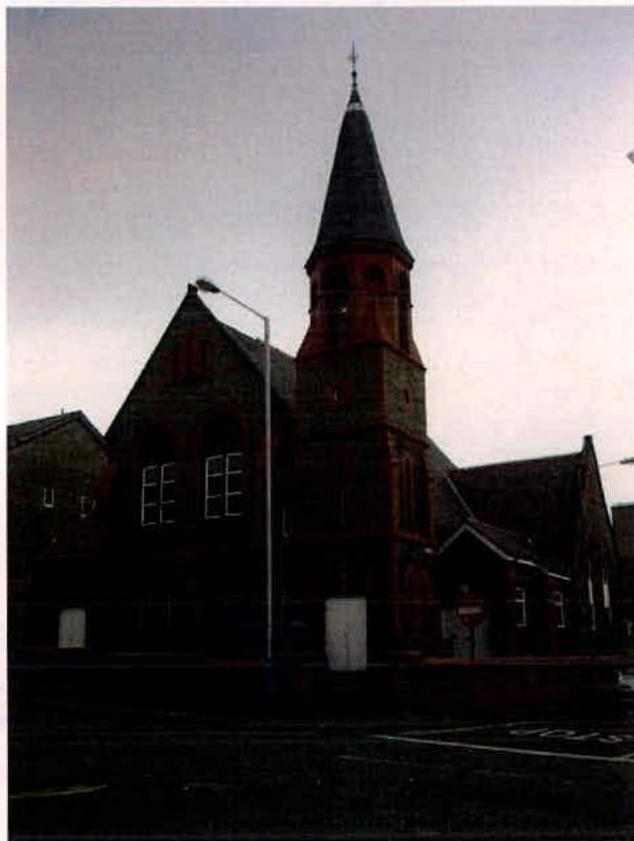
Manx National Youth Band acquired the Jim Crosbie Memorial Bandroom building (formerly the Red Cross Headquarters) on the corner of Derby Road and Park Road in Douglas in 2012. At the time it was identified that the building was generally sound and in reasonable condition but would require maintenance and repair in the short, medium and long term.
Photograph 1 – Jim Crosbie Memorial Bandroom
The building is registered under the Isle of Man Government Department of Infrastructure Registered Building Conservation scheme, reference number 244, and as such any repairs, alterations or improvements require Registered Building Consent under the Registered Buildings Regulations 2005. This document provides a method statement for the proposed external repairs to the walls, roofs and surrounds as detailed in the following sections and is to be read in conjunction with the associated RB consent application and applicable drawings (see section 5).
In general qualified, registered tradesmen will be employed to carry out the works and where particular skills are required, specialist companies shall be appointed to provide expert advice and services.
A minimum of two competitive quotations shall be obtained for the different work packages described in this method statement.
At all times the work shall be carried out in accordance with the requirements of the local Conservation Officer and if applicable, any planning and building control regulations.
All necessary health and safety provisions shall be employed to ensure a safe working environment for contractors, those using the building, and the public in general. Compliance with the requirements of the Construction, Design and Management (CDM) regulations will also be ensured.
It is anticipated that a full scaffolding system will be erected during the works as required for access.
The tower roof appears to be in good condition and was completely re-roofed around 10 years ago. This will be inspected during the roof work and any necessary repairs carried out but it is not anticipated that any major works will be required on this section of the building.
The main roof of the band room will be re-covered. This will involve removal of the existing slates and battens, repair of any damaged or rotten roof rafters, treatment of exposed roof timbers with a suitable preservative solution, introduction of a breathable fabric membrane over the rafters, fixing of new pressure-treated battens and re-covering the entire roof with new Welsh blue slates of the same size as the originals.
Ridge tiles will be replaced with similar style red clay angled socketed ridge tiles bedded on mortar with galvanised steel hip irons where ridge tiles terminate at the end of sloping sections.
Valley lay boards will be replaced and valleys reformed using Code 4 lead-work with minimum 150mm lap under slates. All flashings will be replaced where required using Code 4 lead with minimum 150mm lap under slates and up the wall face cut minimum 50mm into the brickwork, sealed with approved lead-sealing mastic. All lead sheets to be treated with patination oil before and after installation.
Verge slabs on the south gable will be checked for soundness and any loose items re-set on mortar. All fixings used will be either suitably protected from corrosion (galvanised if steel) or be of non-ferrous material (copper, aluminium or similar).
The chimney stack to the north gable wall will be re-pointed, mortar haunching to be repaired and the pots capped with ventilated clay covers.
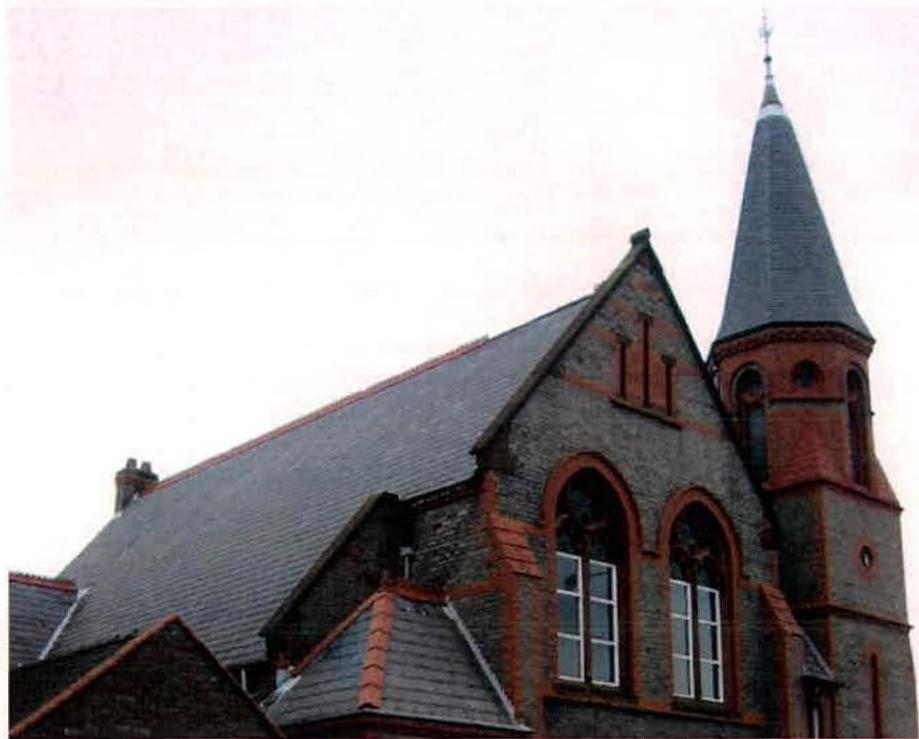
Photograph 2 – Main roof and tower
The roofs to the east and west transepts will be re-covered in the same way as the main roof. The west transept has the slate verge finished in a cement render band, which will be reformed with new render. The east transept gable has verge slabs and these will be re-set after rebuilding of the gable (see below).
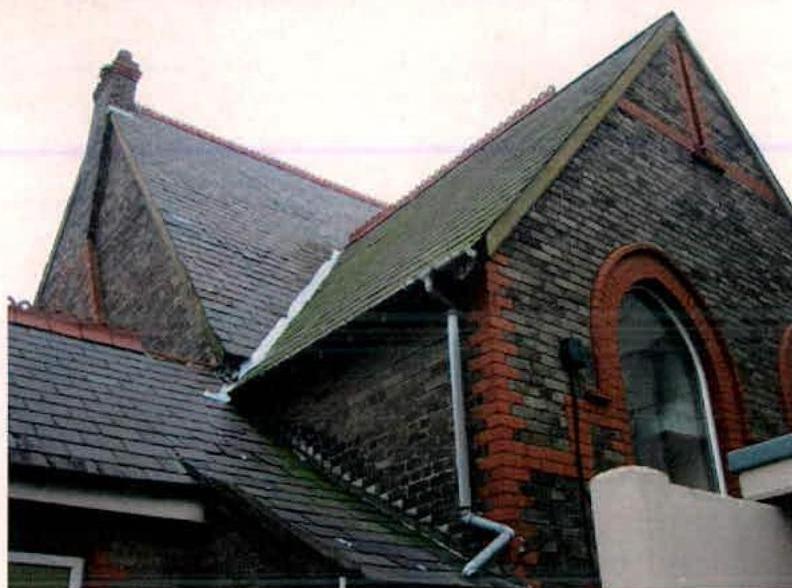
Photograph 3 – West transept roof and north gable
iii. East transept gable
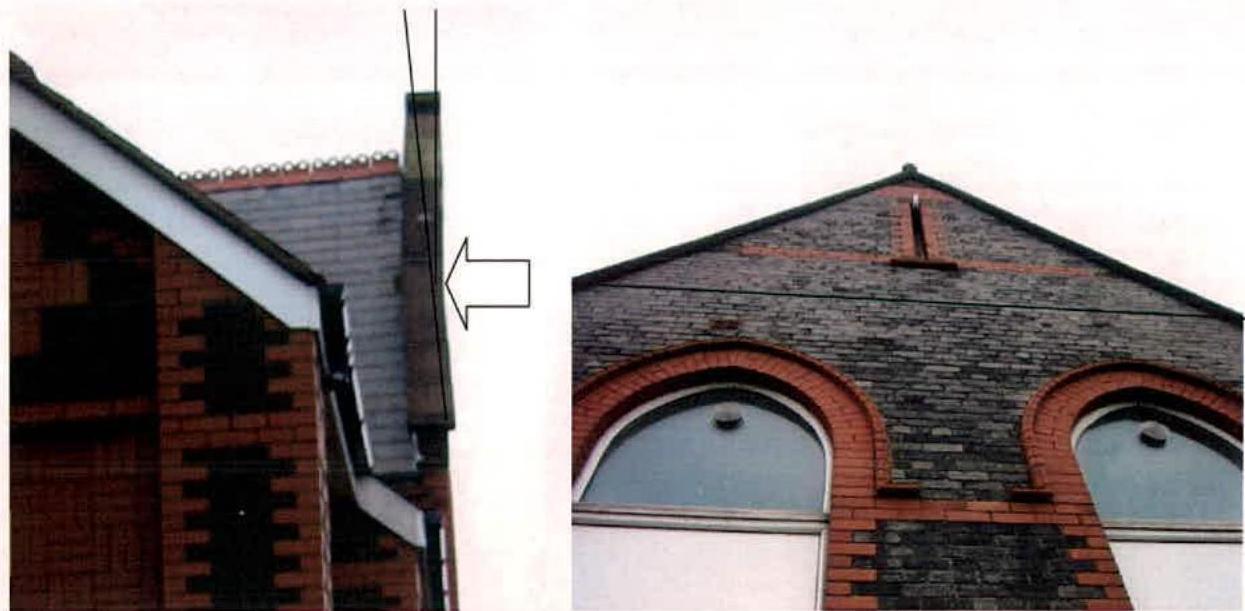
The gable of the east transept roof has a pronounced lean in the upper section. As part of the re-roofing works, this will be carefully dismantled and rebuilt using the same materials. Brickwork patterning, gauged mortar bands and all details will be reproduced using photographs before and after to ensure accurate reproduction of original features.
Photographs 4 & 5 – East transept gable showing outward lean and approximate rebuild line
iv. Rainwater goods
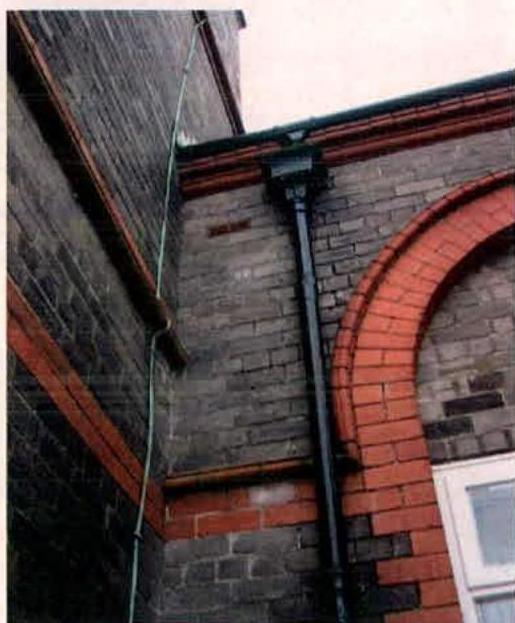
Rainwater goods will be replaced where required using black PVC gutters and downpipes similar to those already used, with attention to correct discharge diameters and outlets.
Photograph 6 – Rainwater goods
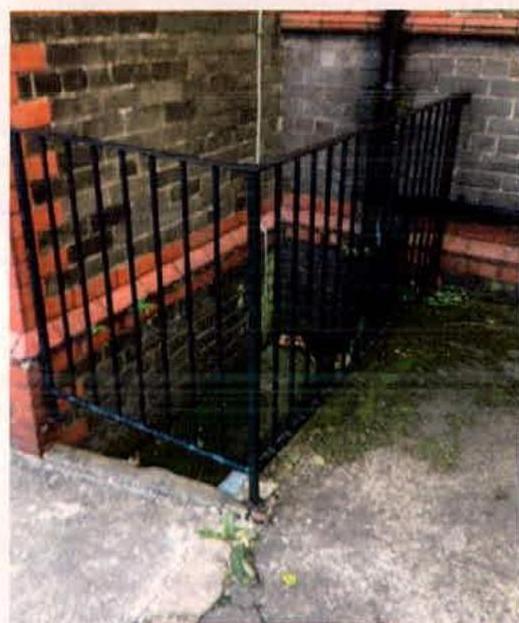
Photograph 7 – Drainage pit and railings
Near to the main entrance is a rectangular pit in the concrete footpath with a surface water drain in one corner and iron railings around it (Photograph 7). This acts as a litter and leaf trap, causing the drain to be often blocked. It is proposed to fill in this pit and remove the railings. Appropriate provision will be made for the drain and the filled hole will be made level with the surrounding concrete, finished in the same manner as the existing.
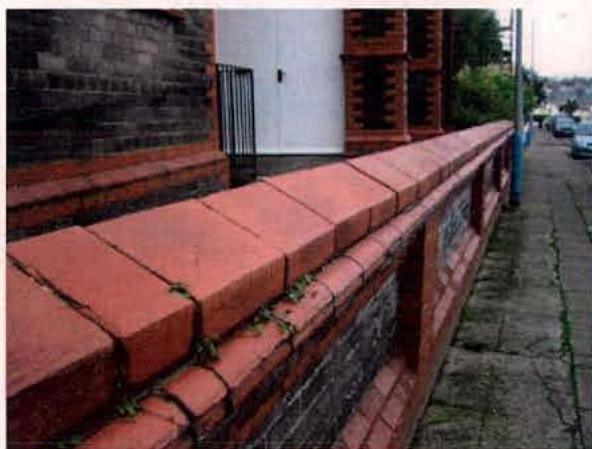
The boundary wall of the curtilage on the east side along Park Road has attractive red copings that are loose and require re-setting, as do the capitals on the entrance gate pillars. It is proposed that the walls are carefully dismantled down to sound masonry and then rebuilt using the same materials in keeping with the original design.
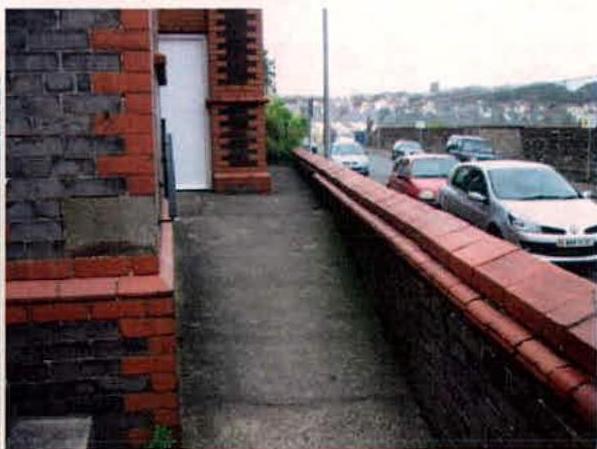
Where the entrance footpath ramped access runs parallel with this wall there is a need for handrails to prevent users of the band room accidentally falling over the wall. It is proposed that black-painted galvanised steel handrails are erected here, in compliance with Parts K and M of the current Building Regulations. The design of these will be simple vertical bars with flat handrail similar to those already on site (see Photograph 7).
Photographs 8 & 9 – Boundary wall to Park Road and ramped access
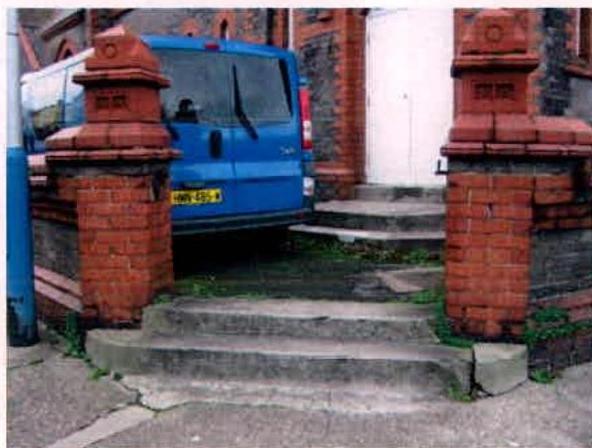
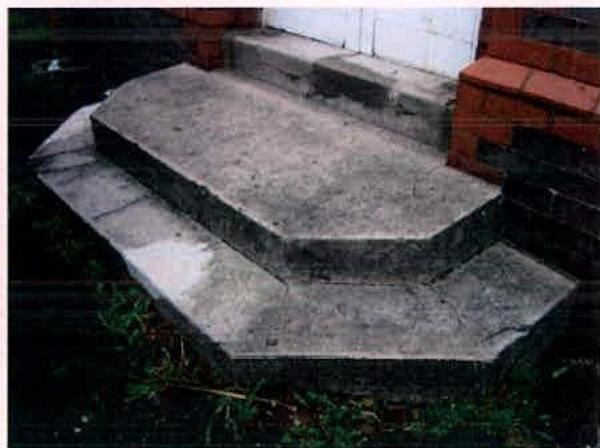
The concrete steps at the entrance gateway and in front of the fire exits on the south elevation are in poor condition and it is proposed to repair/replace these with new concrete steps of the same dimensions. These will be cast in situ with suitable non-slip tread finish.
The surrounding hard standing, parking spaces and footpaths will be repaired and resurfaced using dense bitumen macadam (DBM), with attention to existing ironwork levels and drainage gullies.
Photograph 10 – Steps at front entrance gate
Photograph 11 – Fire exit steps, south side
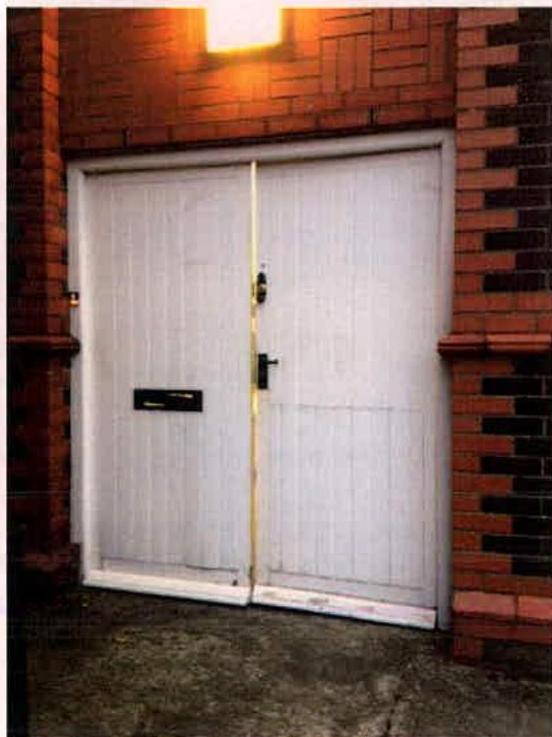
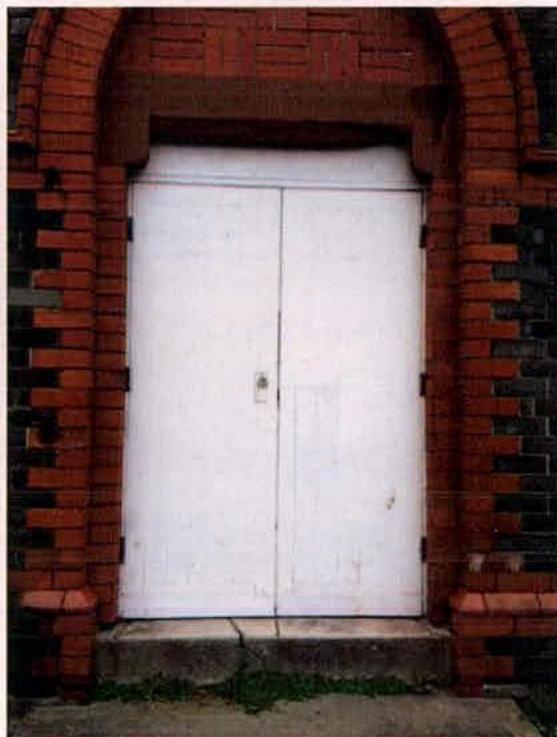
The timber doors to the main entrance and the two fire exits on the south elevation will be replaced with similar style timber doors (framed, ledged and braced). These will be painted white as before and fitted with moulded weather bar detail to match existing.
Photograph 12 – Front entrance doors
Photograph 13 – Fire exit, south elevation
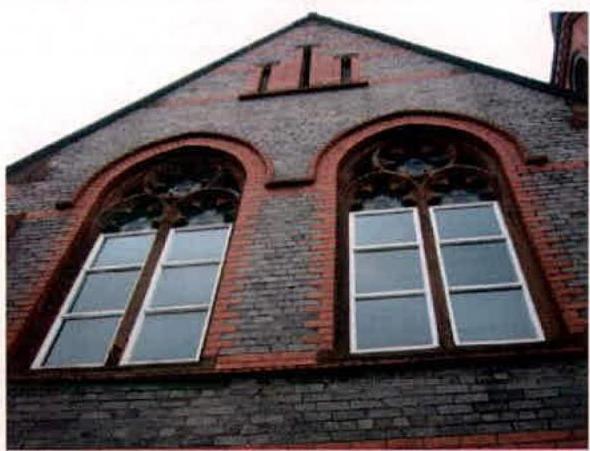
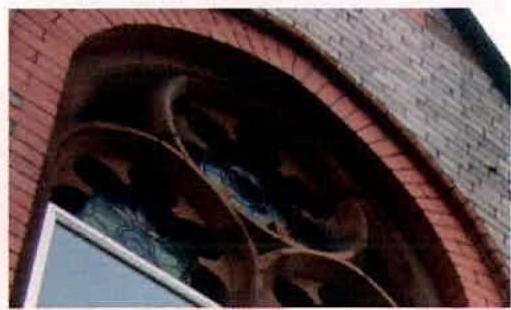
Stonework tracery and details around the feature gable window on the south elevation require repair and/or replacement. The windows leak rainwater, which is causing decay to the timber framing and saturation of the stone sills. Where possible the stonework will be retained and repaired with suitable stainless steel ties fixed into the existing and profiles built up using approved repair mortar of similar colour and texture to the existing stone.
Where replacement of sections is necessary, cut sandstone of similar colour to the original shall be used, or approved reconstituted stone of appropriate colour and weathering properties. In particular care will be taken to ensure any repair does not accelerate or exacerbate erosion and/or weathering of any adjacent original stonework.
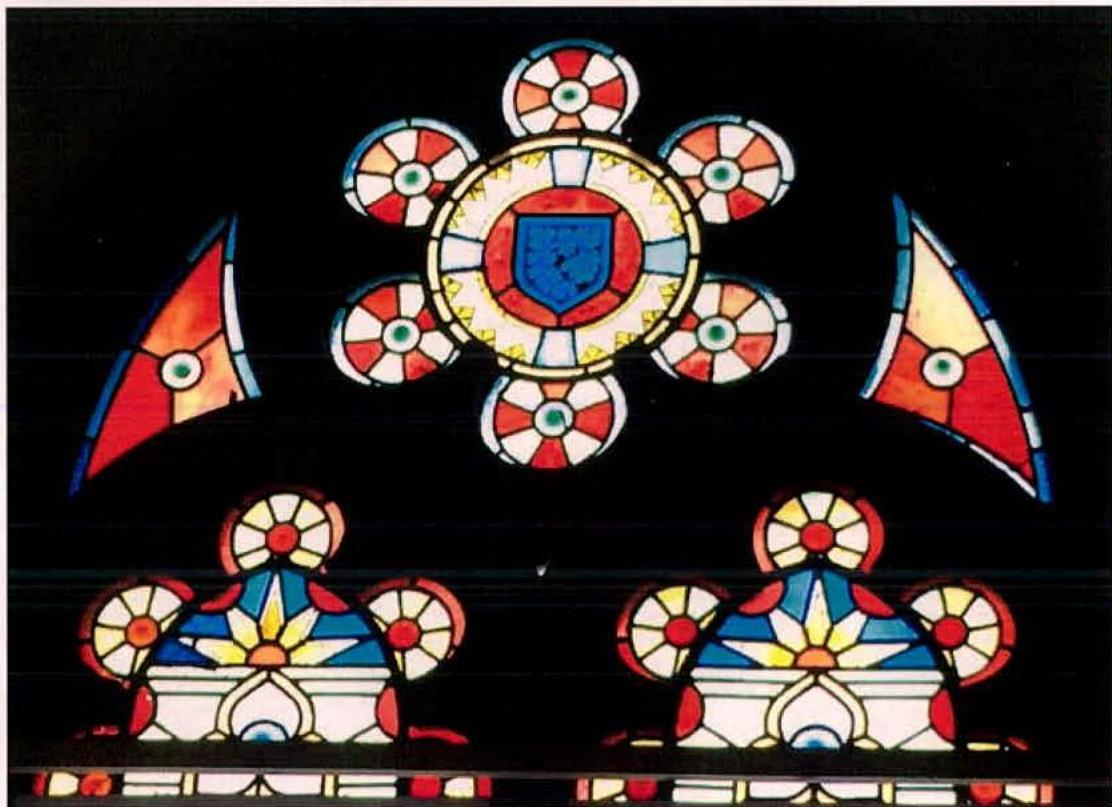
The plain glazed lower panels of these windows will be replaced with an approved design of decorative stained glass windows in galvanised steel frames. Where possible, the glazing design should be in keeping with the original window style and period (see photograph 16).
Photograph 14 – South gable feature window
Photograph 15 – Tracery damage
Photograph 16 – Existing stained glass pattern (from inside)
A temporary protective cover will be installed over the gable window as an interim measure to limit water ingress and prevent further deterioration of the stonework and stained glass. This will take the form of transparent polycarbonate sheeting in a timber frame fixed to the building exterior over the window opening using drilled fixings in discrete locations. This will only be in place until the window repair is competed and after removal the external walls will be made good and otherwise unaffected.
Damage to the other stained glass windows is limited to minor cracked panes and small missing pieces of glass. These will be repaired using similar materials and colours.
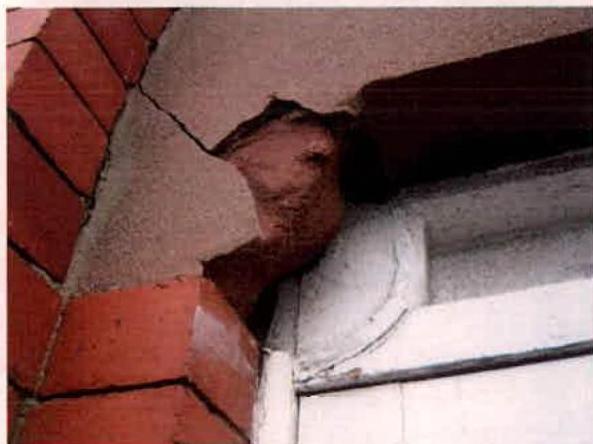
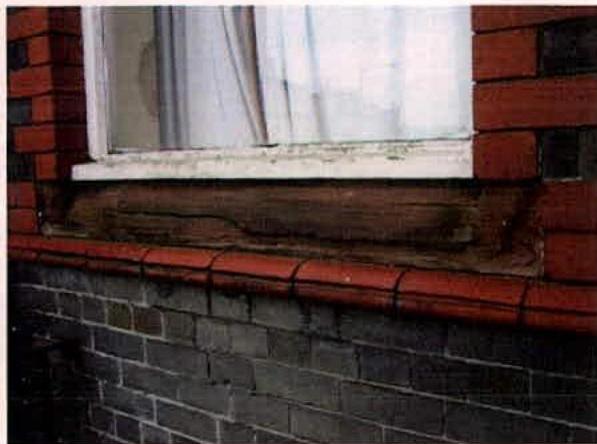
Several of the building’s soft sandstone door heads and window sills are eroded and in need of repair and/or replacement. Where possible the original stonework sill/head is to be retained and repaired with suitable approved repair mortar of similar colour and texture to the existing stone.
Where replacement of a sill or head lintel is necessary, cut sandstone of similar colour to the original shall be used, or approved reconstituted stone of matching colour and weathering properties. In particular care will be taken to ensure any repair does not accelerate or exacerbate erosion and/or weathering of any adjacent original stonework.
Photograph 17 – Door head lintel damage
Photograph 18 – Eroded window sill (replace)
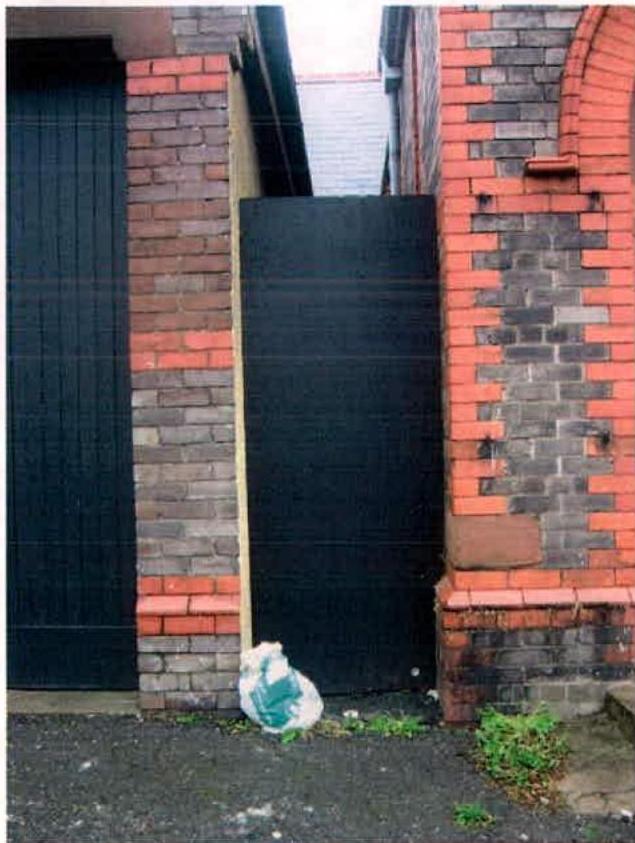
Presently the gap between the main building and the detached garage is boarded up at the Derby Road end. It is proposed to replace this with a simple gate to allow easier access for maintenance, fuel oil deliveries and general pedestrian access to the rear of the buildings.
Photograph 19 – Boarded-up access between garage and main building
This method statement is to be read in conjunction with the associated Registered Building Consent application and related drawings as listed below.
Prepared by: P Foxton
Date: 12/1/15
| Drawing number | Title | Scale | Size |
|---|---|---|---|
| JCMB 01 | Location Plan | 1:1000 | A3 |
| JCMB 02 | Site & Roof Plan | 1:250 | A3 |
| JCMB 03 | Ground Floor Plan | 1:50 | A1 |
| JCMB 04 | Elevations | 1:100 | A1 |
| JCMB 05 | East Transept Gable Details | 1:50 | A3 |
| JCMB 06 | Front Door Detail | 1:20 | A3 |
| JCMB 07 | Proposed Handrail Detail | 1:50 | A3 |
| JCMB 08 | South Gable Window Details | 1:20 | A3 |
Copyright in submitted documents remains with their authors. Request removal
View as Markdown