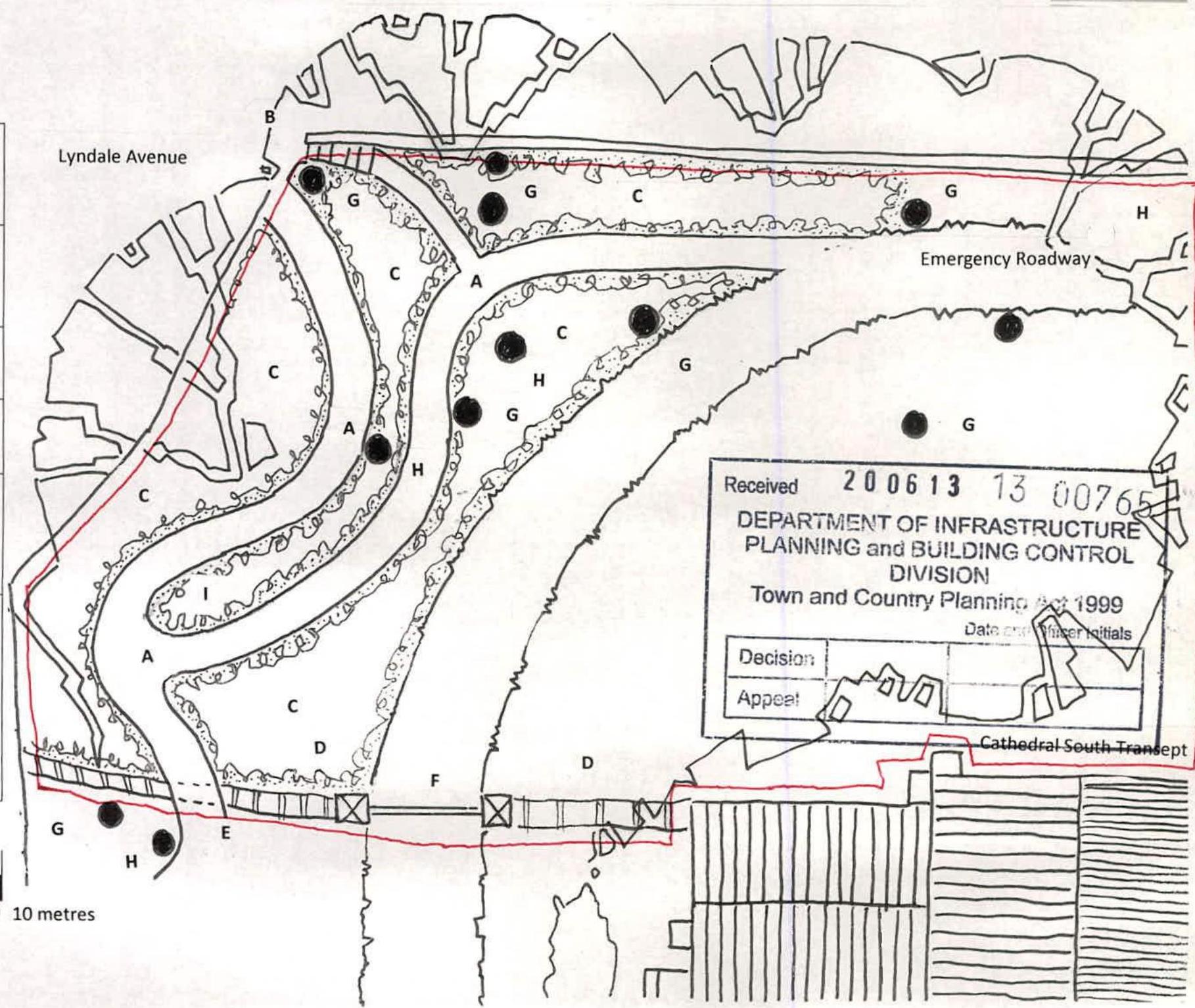
A site plan showing a winding pedestrian path route with vegetation symbols and nearby roads like Lyndale Avenue.
Introduction
A risk assessment has been carried out relating to the Lyndale Avenue entrance to the Cathedral. Currently access is via a private path with steep and far from uniform steps. There is no right of way as this entrance is closed to the public from time to time. Nevertheless this is a very useful cut through to Atholl Street and offers access to the general public to the Cathedral grounds. It is used by many people daily, not just by people in living in Lyndale Avenue. The current path and steps, however, are slippery and especially dangerous in the winter and many elderly people choose not to avoid them. The Cathedral authorities are faced with the dilemma of either improving access or closing the entrance. Planning permission has been given for disabled access, but when beginning to build the path which needs to join up with others it was found that a direct route was not possible, as this would not achieve the necessary gradient permitted for disabled access. The path has therefore been lengthened by turning it back on itself in order that it can comply with best practice and guidelines relating to disability access given the constraints of the site. The plan attached is the deviation necessary to cope with the gradient. Initially fencing will be provided along the path.
Key to Plan
A The Pathway is 1.5 metres wide with a maximum gradient of 1:15. The plan in the first instance is to make the surface of compacted stone 'scalpings', but eventually to apply a top coat of resin bonded pea gravel with a red hue. B The existing steps will be regularised and will be as broad as the narrowest point between the sycamore tree and the boundary wall. It will be made clear this is the secondary route and will rejoin the path travelling to the Atholl Street entrance at the lower level. C Planting under the trees will be the Common Laurel, (Prunus laurocerasus), which will be grown and trimmed at 1.3 metres height acting as a dense safety barrier. D The sandstone wall to the north of the site, which forms a boundary to the new enclosed landscape garden which is capable of being shut off at night will have a pedestrian entrance in it. E The Pedestrian entrance will be a door of 2 metres in height and 1.5 metres wide (the width of the path) F The gates across the roadway for emergency vehicles will be wrought iron; those currently closing the Derby Road entrance to the Cathedral. (The Derby Road entrance will be widened under an existing planning application for a new car park entrance). G Sycamore Tree (Acer pseudoplatanus) H Elm tree (Ulmus minor var. vulgaris) I Site for sculpture
June 2013 NPG
Copyright in submitted documents remains with their authors. Request removal