Loading document...
From: Costain, Sophie (DEFA) Sent: 07 August 2020 15:25 To: DEFA, Planning Subject: PA 20/00686/B – Installation of rear dormer window, 18 Stanley Road, Peel Attachments: Swifts Nest boxes at Your Home.pdf
Good Afternoon RE: PA 20/00686/B – Installation of rear dormer window, 18 Stanley Road, Peel
The Ecosystem Policy team would like to highlight the following wildlife enhancement which we hope the applicant will consider including on the property when the alterations are taking place.
Action for Swifts is a joint Manx Ornithological Society and Manx Birdlife initiative which aims to learn more about and increase the nesting opportunities for Swifts on the Isle of Man. They are looking for appropriate properties where Swift bricks or nest boxes can be installed in order to help increase the breeding numbers of these specially protected birds.
Swifts are a quintessential sign of British summertime and are often seen soaring over rooftops on late summer evenings, with their dark sickle-shaped wings and distinctive ‘screaming’ calls. Swifts are entirely reliant on buildings to nest but a significant number of nest sites have been, and are continuing to be lost when buildings are demolished or refurbished. Because swifts are faithful to their nest site, their breeding success is being severely affected and their numbers are declining dramatically.
In order to help out with efforts to increase Swift breeding numbers in the Isle of Man, the applicant may wish to consider installing a swift nest box, high up under the eaves on the rear elevation when the dormer window is be erected. Nest boxes are easy to install and furthermore, if used, the birds will make no mess and the box won’t need maintenance.
Though not a necessary addition to the building, the installation of a nest box would be a great ecological enhancement for wildlife in the area and any efforts to help increase the number of breeding swifts across the Isle of Man would be greatly appreciated.
I have attached a leaflet containing more information about swift nest boxes. More information about Swifts and nest boxes can be obtained from Janet Thompson, Secretary of the Manx Ornithological Society on 01624 835524 or from www.manxbirdlife.im/manx-birds/action-for-swifts.
Best wishes
Miss S Costain, Ecosystem Policy Officer Department of Environment, Food & Agriculture, Thie Slieau Whallian, Foxdale Road, St John's, Isle of Man, IM4 3AS Tel +44 (0)1624 685963 Fax +44 (0)1624 685851Email [email protected] Website: www.gov.im/defa DEFA - working for a clean, safe, healthy, attractive and vibrant environment which will beenjoyed by present and future generations alike.
Our Island, Our Environment, Our Future.
A special place for people and nature
Boayl er-lheh son sleih as najoor
WARNING If you are not the intended addressee of this e-mail, you must not copy or deliver it to anyone else or use it in any unauthorised manner.
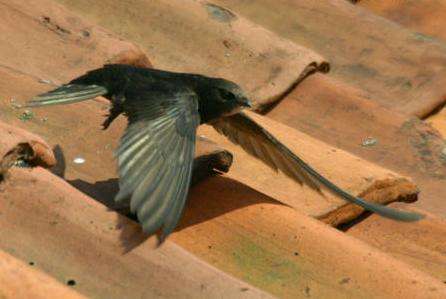
A Swift leaves its nest under pantiles near Lincoln: © Bill Ball
Why Swifts need our Help
Swifts arrive back in the UK from Africa in May and their exciting calls mean that Summer is here. Nesting through to August in buildings, in small holes in the eaves, gables or upper walls, feeding only on insects and spiders and living in cities, villages and towns, they fill the evenings with stunning aerobatic flight. They add immense excitement and life to any area. They have shared our buildings for over 2000 years, but new building techniques and materials and insulation of older buildings are preventing them from nesting. As buildings are replaced, insulated or repaired, Swifts find themselves excluded, and they are now declining fast. But we can stop this happening!
How you can help Swifts
Installing simple nest boxes at your home will preserve inner-city Swift populations, enhance local biodiversity. Just like flowers and trees, Swifts will make us feel happier! Creating Swift nest places is not difficult. Using simple DIY carpentry skills you can make low cost Swift nest-boxes. Or you can buy readymade boxes; see the www.swift-conservation.org “Shopping” page for details of types and suppliers. They cost from under £20 upwards, depending on type and materials used.
Help is available Ask us and we will help you. Contact [email protected] Choosing the site
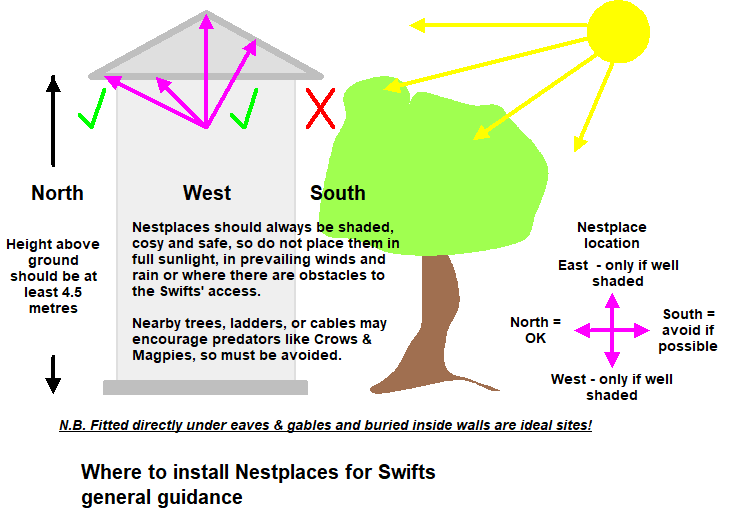
Place the nest box or brick on a side of the building that gets some shade during the day. If possible install it under an overhang or under the eaves, to give it protection from weather and heat. It should be sited at least 5 metres above ground, with clear adjacent airspace so the Swifts can access it in high-speed direct
flight (they usually fly straight in to avoid the risk of predation). Make sure that predators (cats, crows, magpies, squirrels, and rats) do not have easy access to the nest (e.g. by climbing up creepers or flying in from nearby trees).
You can find a good range of Swift nest boxes illustrated and described below. Select the box that meets your needs, your budget, and your ability to fit it! Please remember that the longer lasting the box and the more soundly it is fitted, the better for your Swifts.
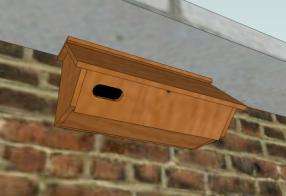
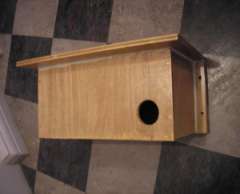
This economical plywood “Zeist Type Swift Nest Box” is available from John Stimpson.
It is well-proven and is light and easy to fit compared to cement boxes. The downside of plywood is a shorter life, but careful positioning and occasional external surface treatment should prolong it.
A version of the Zeist box is available in strong recycled plastic plank from Filchris Recycled Materials Ltd.
They will also make up bespoke nest boxes in the same material to your own design for sites where this is needed.
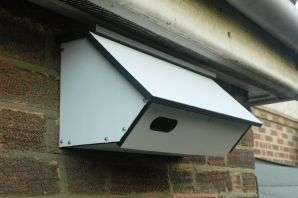
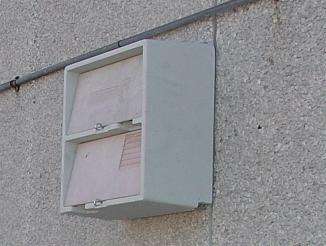
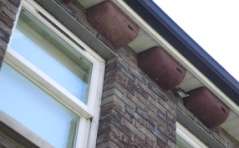
Several designs of Swift nest boxes from Schwegler are made from a cement mixture known as “Woodcrete”. A mixture of cement and plant fibre, it is strong and long lasting. Such boxes have the potential to last a very long time, making them particularly attractive and cost effective. Opposite is a double Swift and Bat box, which also comes as a smaller single model.
The UK agent for these boxes is Jacobi Jayne
http://www.jacobijayne.co.uk/nest-boxes-by-species/swift/
Several of the commercial designs can be surface fitted under eaves or onto walls. This type opposite is a strong and popular Woodcrete model from Schwegler. We have had success with this box at our project at London Zoo in Regent's Park, and it has also been used very successfully elsewhere.
We show some D.I.Y designs for Swift nest boxes on our web site. Choose the one that suits your site and skills. These boxes are light compared to the concrete ones, and require much less effort to fit, but they will not last as long. Nonetheless they will, if well made, have a useful life span and are a valuable way of providing Swifts with nest places.
For a choice of designs please see http://www.swift-conservation.org/Nestboxes&Attraction.htm#D.I.Y. A Swift comes in to land in its nest: © Doug M Dodds
Use strong corrosion-resistant fixings appropriate to the wall material. If you have any doubts at all about your ability to fit the box, ask a professional to do it for you.
Before fixing or servicing your Swift nest box, make sure your working conditions are safe. Take special
care when working at high level. Use appropriate personal protective equipment.
A Swift brings a meal home to its chicks, its mouth is stuffed with flying insects it has caught in flight: © David Moreton
Occupation of the nest boxes can be speeded up if a recording of Swifts' attraction calls is played to prospecting birds. Recordings are available from us - see our web site's “Shopping!” page. Full instructions are supplied with the calls.
You don't need to clean out the boxes unless other species use them. Swifts nest naturally in holes and crevices, without any cleaning, but the integrity and fixing of the box needs to be assured regularly.
If your box is successful, put up some more. Swifts usually nest in colonies, and they like a few neighbours. Indeed, a busy Swift colony will be a powerful attraction to other Swifts to come in and nest.
You may wish to fit CCTV to observe the lives of the birds. Use only wildlife-compatible cameras with infrared lighting. They must only be fitted and adjusted outside the breeding season. If a camera fails while the birds are breeding, it should not be replaced until they have left the nest for good.
Do give the birds’ peace and quiet and every chance to breed Do try and keep a diary of the birds’ activity Do try and put your CCTV pictures onto the Internet so others can share them Do check the box each winter to make sure it is still sound and firmly fixed If a bird falls from the nest and cannot fly, consult the Swift First Aid pages of our web site http://www.swift-conservation.org/SwiftFirstAid.htm
Don't stand and stare up at the nest box when the Swifts are around. It will put them off Don't disturb the Swifts at any time - they will desert the nest Don't allow creepers or plants to encroach on the nest. They will give access to predators
If you need more advice, please contact us at [email protected]
Leaflet 1 – Swifts Nest-boxes & Your Home Copyright © Edward Mayer & Swift Conservation 2018
Copyright in submitted documents remains with their authors. Request removal
View as Markdown