Loading document...
Ecological Management and Monitoring Plan
February 2026
 | |
| Job number: | 25_39 |
| Title: | Clocktower Industrial Estate – EMMP |
| Client: | Cornerstone Architects |
| Prepared by: | Adam Denard – Senior Ecologist |
| Verified by: | Amy Dunderdale - Ecologist |
| Date of Issue: | February 2026 |
| Version: | 2 |
| Revisions: | 1 |
| Status: | Final |
This report is prepared by Ecology Vannin Consultancy Services for the sole and exclusive use of Cornerstone Architects and their contractors in response to their particular instructions. No liability is accepted for any costs, claims or losses arising from the use of this report or any part thereof for any purpose other than that for which it was specifically prepared or by any party other than Cornerstone Architects. Any biological records for wildlife found in survey will eventually be submitted to Manx Biological Recording Partnership. This report does not prevent MWT pursuing its charitable objectives in relation to planning.
This report has been prepared by an environmental specialist and does not purport to provide legal advice. You may wish to take separate legal advice.
The information which we have prepared and provided is true, and has been prepared and provided in accordance with the BS42020 2013 and Chartered Institute of Ecology and Environmental Management's Code of Professional Conduct and guidelines for preliminary ecological appraisals (CIEEM 2017). We confirm that the opinions expressed are our true and professional bona fide opinions.
Signed (Author) Electronic Signature
Signed (QA) Electronic Signature
Amy Dunderdale BSc (Hons) MSc is an ecologist with several years’ experience in baseline ecological survey and assessment, and some specialist protected species surveys including for bats and reptiles. Amy graduated with a First Class Honours degree in Biology bachelor’s degree from the University of Durham and a Master’s degree (achieved with Distinction) in Wildlife Management and Conservation from University of Reading. She has experience working in ecology consultancy in the UK including experience in completing PEAs and BREEAM Land Use and Ecology reports.
Adam Denard BSc (Hons) MCIEEM is Senior Ecologist with Ecology Vannin and has been a professional ecologist for over 15 years, with particular emphasis on recording and assessing habitats in England and the Isle of Man for their potential to support protected species. After graduation with First Class honours in Conservation and Land Management, Adam worked on professional bat surveys for Oxford University before going onto work for ecological consultancies in England 2004 –
ASSI Areas of Special Scientific Interest ASP Areas of Special Protection BCT Bat Conservation Trust BoCC Birds of Conservation Concern CEMP Construction Environmental Management Plan DBH Diameter at breast height LWS Local Wildlife Site MBG Manx Bat Group MBL Manx Bird Life MBRP Manx Biodiversity Recording Partnership PWMS Precautionary Working Method Statement PRA Preliminary Roost Assessment PRF Potential Roost Feature SAC Special Area of Conservation SPA Special Protection Area SUDS Sustainable Urban Drainage
Ecology Vannin Clocktower Industrial Estate EMMP 3
Consultants, 2022)
2023) and Common Lizard (Ecology Vannin, 2023).
Ecology Vannin Clocktower Industrial Estate EMMP 4
| Area | Habitat/species aim | Methods and treatments |
|---|---|---|
| A |
• Development of scrub and succession to woodland. • Stabilisation of the mine deads on the bund, in the wood at the southern tip and on the steep slope alongside the stream. |
• This area to be left undisturbed with the exception of JK/HB treatment. • Remove other Schedule 8 species on the northern boundary of the site. If replacement is possible, please use native, fruit or berry bearing species. • Any dead trees should be left to provide habitat for insects and fungi. • No vegetation should be uprooted. • Some cutting back of gorse may be necessary on the inner boundary of area A. • If any tree planting or seeding is required for stabilisation, locally grown native stock of birch and oak should be used. |
| Ai | Maintaining open areas on the deads for bryophytes and insects |
• The area shown with orange stripes will need regular control of gorse and broom. • Divide this area into 5 parts and cut one part each year in rotation. • Start this cycle before construction. • Ensure there is access to this area for machinery that might be used for gorse cutting |
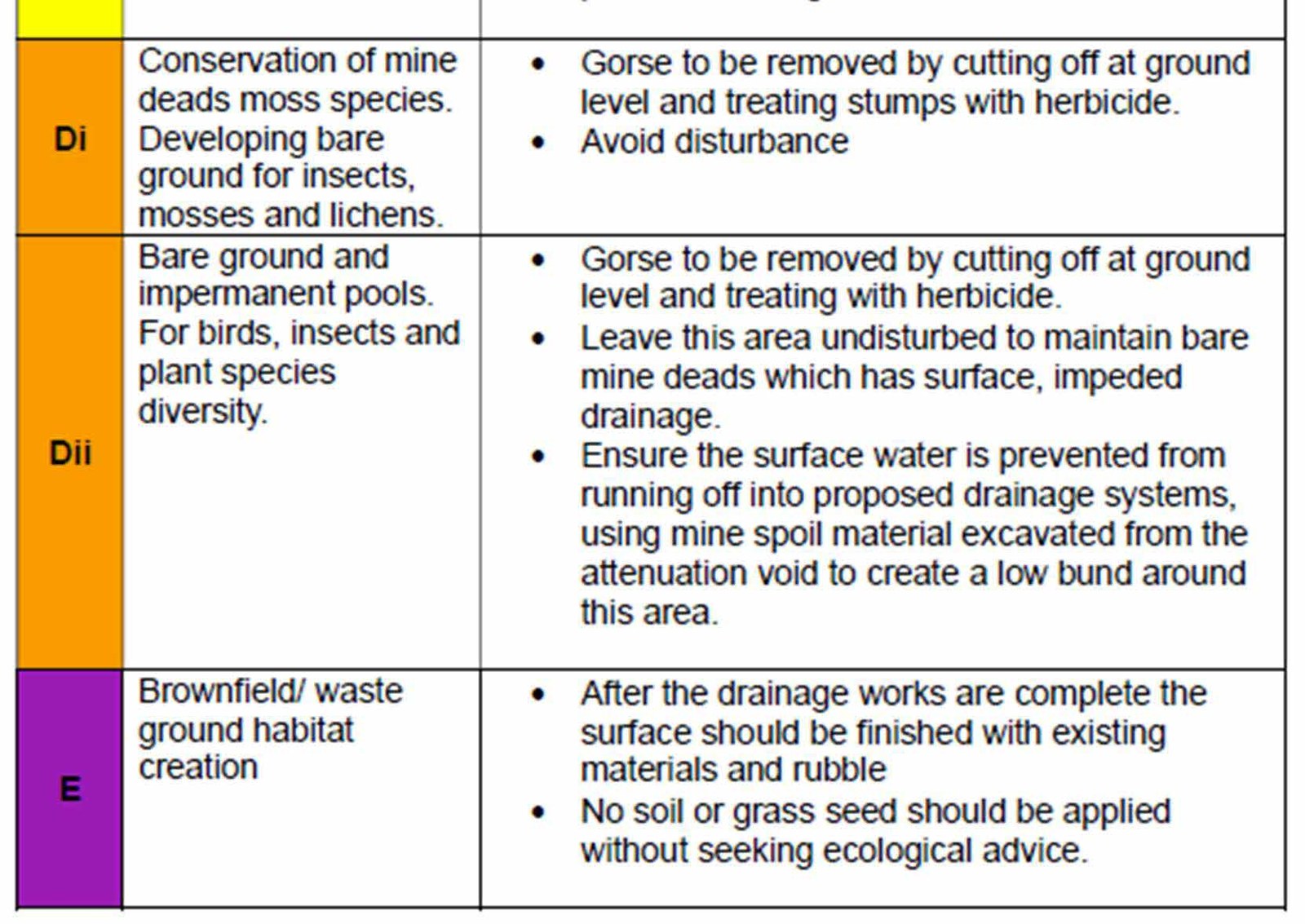
3.1 The ecological objectives for the site were provided in Table 1 of the ECOP report and are provided below to cross reference with the 'Ecological Plan –Drawing 004' in Appendix I.
Table 1: Ecological aims and methods
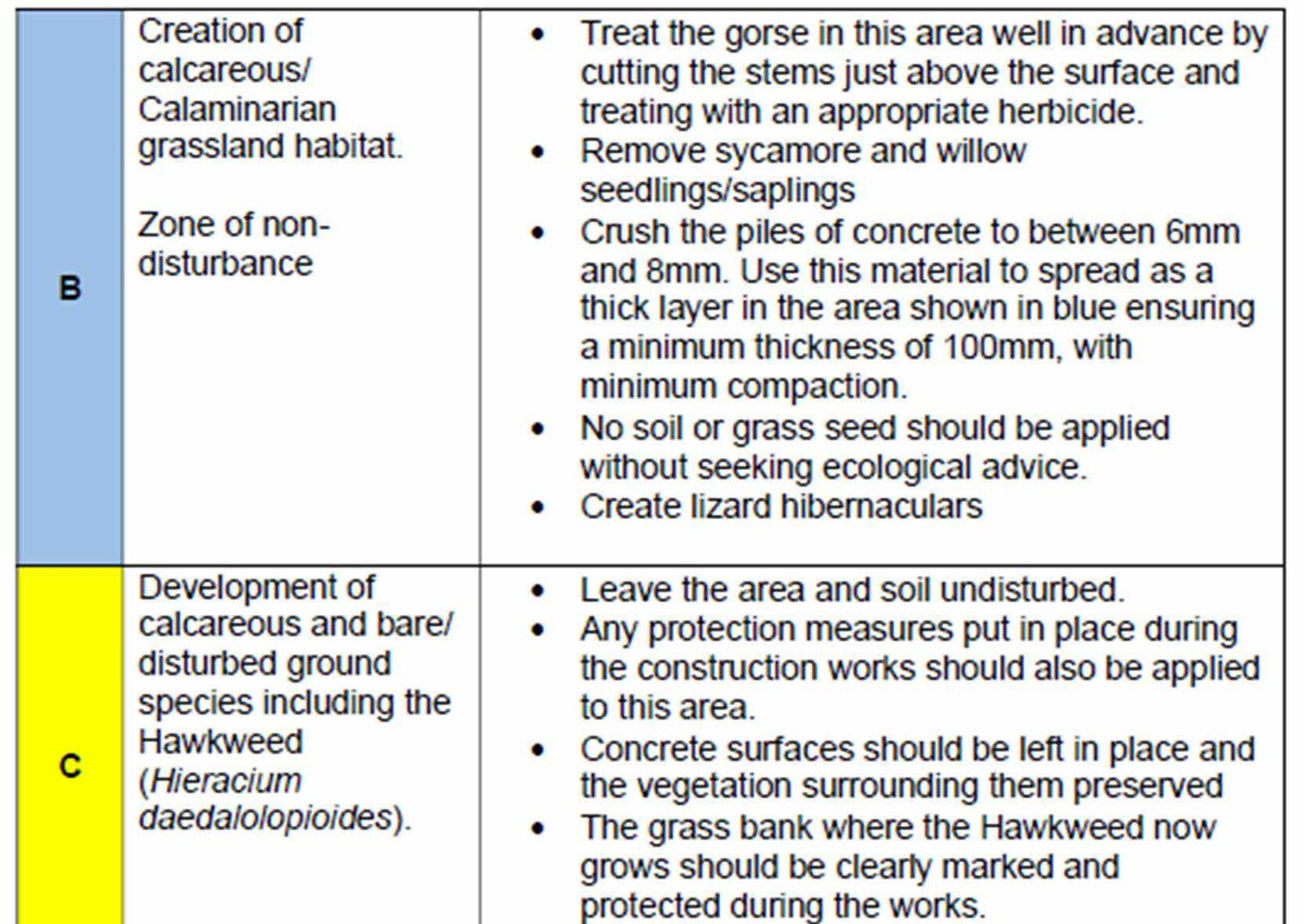
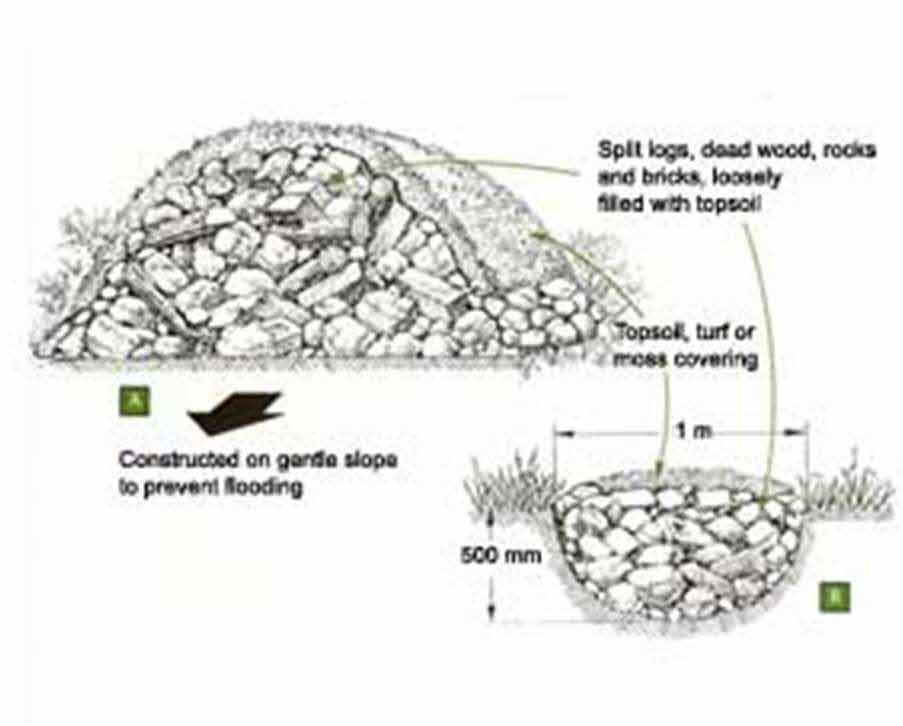
| B | Creation of calcareous/Calaminarian grassland habitat. Zone of non-disturbance | • Treat the gorse in this area well in advance by cutting the stems just above the surface and treating with an appropriate herbicide. • Remove sycamore and willow seedlings/saplings • Crush the piles of concrete to between 6mm and 8mm. Use this material to spread as a thick layer in the area shown in blue ensuring a minimum thickness of 100mm, with minimum compaction. • No soil or grass seed should be applied without seeking ecological advice. • Create lizard hibernaculars |
| C | Development of calcareous and bare/disturbed ground species including the Hawkweed (Hieracium daedalolopioides). | • Leave the area and soil undisturbed. • Any protection measures put in place during the construction works should also be applied to this area. • Concrete surfaces should be left in place and the vegetation surrounding them preserved • The grass bank where the Hawkweed now grows should be clearly marked and protected during the works. |
| Di | Conservation of mine deads moss species. Developing bare ground for insects, mosses and lichens. | • Gorse to be removed by cutting off at ground level and treating stumps with herbicide. • Avoid disturbance |
| Dii | Bare ground and impermanent pools. For birds, insects and plant species diversity. | • Gorse to be removed by cutting off at ground level and treating with herbicide. • Leave this area undisturbed to maintain bare mine deads which has surface, impeded drainage. • Ensure the surface water is prevented from running off into proposed drainage systems, using mine spoil material excavated from the attenuation void to create a low bund around this area. |
| E | Brownfield/ waste ground habitat creation | • After the drainage works are complete the surface should be finished with existing materials and rubble • No soil or grass seed should be applied without seeking ecological advice. |
| Area | Proposed treatments and management |
| All | • Continue monitoring and treatment of JK and HB for as long as necessary. • Remove any other non-native invasive schedule 8 species that appear, as appropriate (with advice from DEFA). |
| A | • Cut back or trim gorse and broom along the inside edge of area A when it spreads onto areas B, C, or D. |
| Ai | • Continue the control of gorse, as above |
| B | • Mowing/strimming regime: as required with ecological advice • Only between September and March and not in period of prolonged wet weather • As needed |
| C | • Mowing/strimming regime, if needed. Parts of this area might be treated differently. • Only between September and March and not in period of prolonged wet weather • Annual |
| Di | • Annual gorse removal • Monitoring of potential moss species |
| Dii | • Bi-annual mowing or strimming as needed |
| E | • Minimal management in this area • Mowing/strimming regime, if needed. Parts of this area might need to be treated differently. • Only between September and March and not in period of prolonged wet weather |
| All | Arisings from gorse clearance and mowing should be removed well away from the areas of habitat creation and bare ground for onsite composting or if necessary remove for incineration at the energy from waste plant. The area for onsite composting to be agreed by a competent ecologist. |
4.1 Habitat Management Prescriptions were provided in Table 2 of the ECOP report and are provided below. These have been reviewed with some additional instruction for site management/contractors. Areas are to be cross referenced with the Ecological Plan in Appendix I.
Table 2: Long-term management prescriptions Key: JK = Japanese Knotweed / HB = Himalayan Balsam
main flowering period April to August) mowing to promote open grassland structure including rare Hawkweed species.
mulch in ecologically low value areas as directed by an ecologist.
period (typically March to August) wherever practically possible. Should clearance be required during the breeding season, a pre-clearance nesting check should be undertaken and any nests safeguarded until all young have fledged and are independent of the nest. Checks are to be no more than 5 days prior to works continuing. (NOTE –nests are also protected whilst in the process of being built). Ideally this should be by an experienced Ecologist but can be undertaken by site operatives. If in any doubt all work should be temporarily suspended and advice sought by DEFA Ecosystem Policy Team
(651577).
for the presence of nesting activity at all times. Evidence includes (but not exclusively) agitated calling adult birds, distraction displays by adults, adult birds carrying nesting material and/or food for young, a fresh nest, eggs and sounds of calling young.
Invasive Plant Species
Ecology Vannin Clocktower Industrial Estate EMMP 8
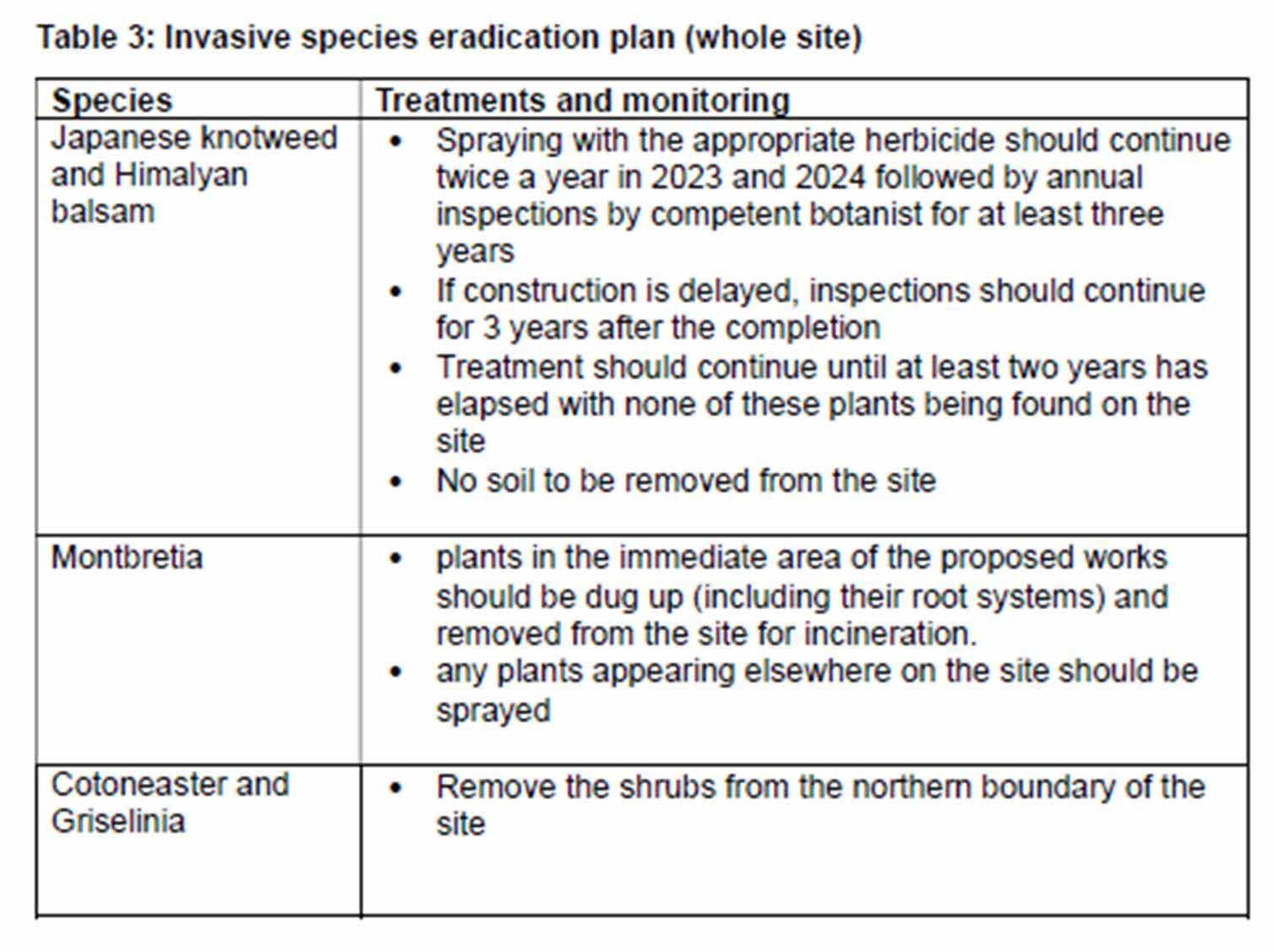
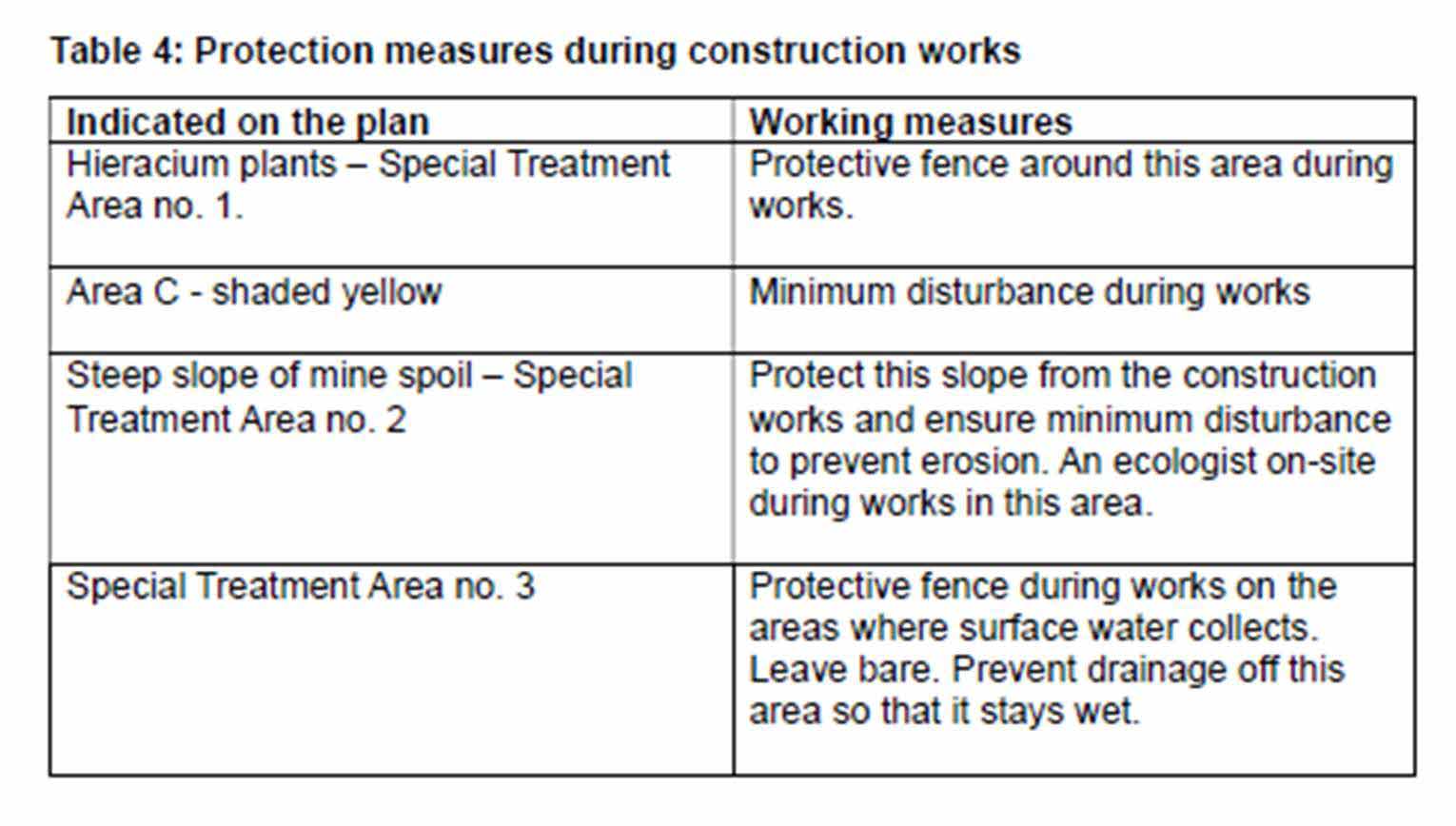
5.1 Table 4 of the ECOP report (provided overleaf ) outlines the key protection measures required. These have been reviewed and extra instruction for site managers and contractor provided.
Ecology Vannin Clocktower Industrial Estate EMMP 9
protection measures are adhered to. In addition, site induction should include ecological information on sensitive areas and species.
and Himalayan Balsam avoidance areas are to be staked out to prevent incursion by site traffic and operatives.
particularly, soils containing heavy metals entering the catchment. Methods such as sedi-mats and straw bales are typically deployed. Additional advice from DEFA Inland Fisheries is strongly recommended to ensure best practice is followed.
compliance with the 5-year post-construction period stated in Condition 13.
Common Lizard and Common Frog Rana temporaria(see Appendix II).
Figure 1 Example reptile hibernacula
Ecology Vannin Clocktower Industrial Estate EMMP 10
Hawkweed Hieracium daedalolopioidesin plant refuge area at a favourable status (i.e. no reduction in number of flower spikes from baseline survey).
prevent further spread in the wider countryside. Successful control will be no further expansion in distribution from baseline surveys and likely significant reduction from successful treatment options provided.
and advise on any alterations as required.
beneficial changes required. Habitats should be of expected species composition, area and structure for optimal ecological functionality.
any changes/replacements as necessary.
compliance with planning conditions as specified.
Ecology Vannin Clocktower Industrial Estate EMMP 11
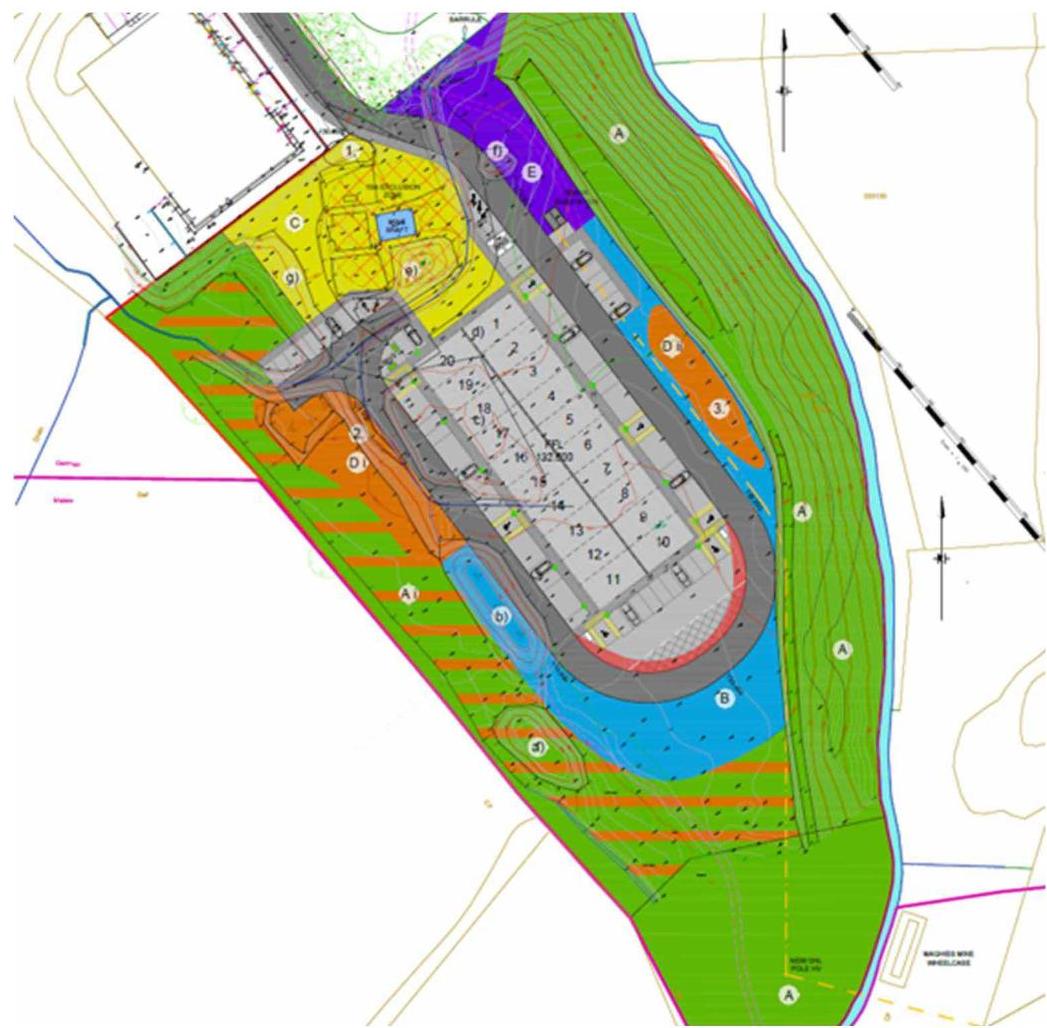
(i) Ecological Mitigation Plan
KEY A AREA OF ECOLOGICAL VALUE Ai ROTATIONAL GORSE MANAGEMENT B ZONE OF NON-DISTURBANCE C PLANT REFUGE D LEAVE UNDISTURBED BUT MANAGE GORSE E WASTE GROUND
SPECIAL TREATMENT AREAS
CONCRETE RUBBLE / SPOIL HEAPS a) RETAIN AS WILDLIFE REFUGIA b-f) CRUSH AND USE FOR SURFACING AREA B g) USE CONCRETE AS a) ABOVE USE STONE TO BUILD LIZARD HIBERNACULUM / REFUGIA
PLEASE USE THIS PLAN IN CONJUNCTION WITH THE ACCOMPANYING REPORT: CLOCK TOWER INDUSTRIAL ESTATE - PROPOSED EXTENSION ECOLOGICAL CONSTRAINTS AND OPPORTUNITIES PLAN, CURRAGH ENVIRONMENTAL CONSULTANCY, AUGUST 2023, PART 2. TABLES 1-4.
Working methods for enabling and construction work should include the following Reasonable Avoidance Measures (RAMs):
Protected species information sheet to be provided in site briefing of all operatives for due
consideration of Common Frog and Common Lizard presence and potential for injury and mortality. To be supplemented by ‘toolbox talks’ on site if considered necessary. This should be done prior to the commencement of work.
clearance is recommended to be undertaken by hand, or proceed with caution for the protection presence of lizards and frogs.
February). Outside this period clearance should be undertaken in a one-way direction to enable any frogs/lizards that may be active to move out of the way into adjacent habitat ahead of machinery.
rather than on remaining grassland areas. If this is not possible, materials must be kept off the ground in a compact, defined area to minimise disturbance and avoid protected species using them for shelter.
each working day.
operations, work must stop immediately, and advice sought from Ecology Vannin (844432) or DEFA (651577). Licences may be required to undertake translocation into neighbouring habitat.
and mortality of frogs and lizards.
Ecology Vannin Clocktower Industrial Estate EMMP 14
Copyright in submitted documents remains with their authors. Request removal
View as Markdown