Loading document...
RECEIVED ON
DEPARTMENT OF INFRASTRUCTURE PLANNING AND BUILDING CONTROL DIVISION Town and County: 11099 Design Statement
101
ASH D O W N E H O U S E
Ballavale Road, Santon, Isle of Man, IM4 1EH
Issue Status PLANNING APPLICATION Prepared For DEPARTMENT OF INFRASTRUCTURE For and on behalf of RICHMOND SQUARE ESTATES LIMITED
June 2011
1101/X/DS/01
The Estate Office, Oak Hill, Port Soderick, Isle of Man IM4 1AT, British Isles www.richmondsquaregroup.com 101624 625610 F 01624 625611 Richmond Square Design is a trading name of Richmond Square Design Limited Incorporated in the Isle of Man No: 121882C Directors: J. K. Brookman, J. A. Wilson
1.0 CONTENTS 2.0 INTRODUCTION 3.0 EXISTING SITE 4.0 PLANNING HISTORY 5.0 PRE-APPLICATION CONSULTATIONS 6.0 PLANNING POLICY 7.0 SCHEME PROPOSAL 8.0 SUMMARY
This Design Statement accompanies the detailed planning application for the demolition of the existing residential property known as Ashdowne House and subsequent erection of a new residential property.
In this Design Statement the existing site, details of pre application consultations and the development proposals are discussed in full and should be read in conjunction with the following:
The residential property known as Ashdowne House is located in the South of the Isle of Man within the parish of Santon.
The application site covers approximately 4909 square metres ( 0.490 hectares / 1.21 Acres) and is the residential curtilage of the property known as Ashdowne House.
Aerial view {{image:21407}}
A two storey brick residence currently occupies the site. The property is not of any particular architectural interest and is non-traditional in form and materiality in relation to its semi-countryside setting.
Roadside elevation {{image:21409}}
Front elevation
The quality of the architectural style and the property's materiality are also at odds with those of the existing neighbouring properties. The surrounding dwellings are generally substantial residences in their own grounds with architectural styling which is more in keeping with large houses in the Manx countryside.
The existing property is set within densely mature gardens and access to the site is via the existing vehicular access from Ballavale Road which is a narrow minor road.
A topographical survey has been conducted on the site, the information from which is included on the submitted existing site plan, $1101 \times 001$. Additional photographs are also included on that drawing.
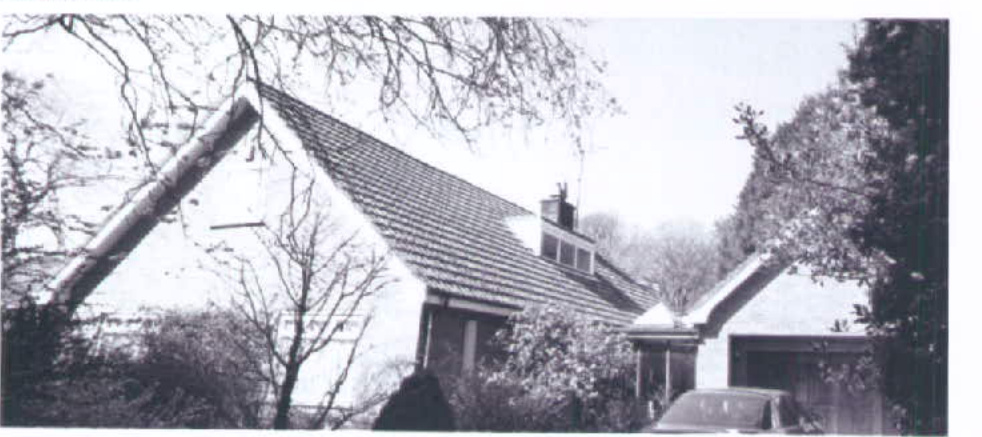
The most recent planning applications for the site are listed below:
| Ref | Date Granted | Details |
|---|---|---|
| $90 / 01845 / B$ | Granted | Installation of 450 litre LPG tank |
| $10 / 01883 / B$ | Refused | Erection of replacement dwelling |
Application 10/01883/B was also submitted by Richmond Square Design. Whilst the Planning Officer recommended the scheme for approval, the Planning Committee did not agree with the evaluation and the submission was refused. The reasons given for the scheme's refusal were as follows:
R1. The proposal would fail to comply with Housing Policy 14 in that the existing dwelling is not judged to be of 'poor form' and as such the significant increase in size and floor area proposed would be unjustified.
R2. The scale of the proposed building would result in an increased visual impact compared with the existing situation which would be detrimental to the character and amenities of the surrounding area contrary to Environmental Policy 1 and Environmental Policy 2.
This submission seeks to address the above comments.
Throughout the design process of this scheme, as well as the previous scheme, pre-application consultations have taken place with Mr Steven Stanley, Planning Officer. These consultations have been in the form of site visits and meetings at the planning office, telephone conversations and e-mail correspondence.
The initial design concepts and design development drawings for the principal elevation as discussed with Mr Stanley during the development of the previous submission are included in this document for reference. These drawings illustrate how the advice given in these preapplication consultations influenced the design development of the previous scheme, resulting in a scheme that the Planning Officer supported.
After that application was refused an appeal application was submitted. This was again supported by the Planning Officer. Despite this, and after careful consideration, we chose to withdraw the appeal application, instead choosing to redesign the scheme in its entirety.
A good working relationship has been established with the Planning Officer and this application has been developed after further consultations and discussions regarding our revised scheme. The Officer's early comments that our initial new proposal lacked the architectural quality of the previous scheme with elements that were clearly new build resulting in an incongruous development have been taken into account and addressed.
There is currently no Area Plan in operation for the area of Santon and therefore reference has been made to the 1982 Development Plan. On this plan, the site is demarcated as being within an 'Area of High Landscape or Coastal Value and Scenic Significance' (AHLV).
Within the Isle of Man Strategic Plan 2007, we believe that the following policies are of particular relevance to this application. For brevity the relevant Strategic Objectives and Policies have been referenced only and the following should be read in conjunction with the published Government Document.
a) This proposal seeks to optimise the use of currently developed land by expanding on the existing residential use of the site. b) The proposal makes efficient use of the site by re-using the existing access c) The proposal utilises the existing infrastructure, facilities and services of the site.
This application follows the Strategic Objective to encourage "high quality development throughout the island" ${ }^{1}$.
It is felt that our proposal will enhance the character of the area b) This scheme proposes to emulate the character of the local vernacular and utilises local materials.
b) This proposal seeks to enhance the landscape quality of the site and retain as much of the existing mature gardens as possible.
A concern of the Planning Committee regarding the previous scheme was the perceived visual impact of the proposal. This concern has been addressed by reducing the overall scale of the property, including the front façade. An element of the scheme has now been incorporated underground. The scheme also incorporate a sedum roof and will seek to incorporate rainwater harvesting.
It is felt that this proposal will make a positive contribution to the location and complements the surrounding natural beauty of the site.
This Design Statement takes into account the Strategic Aims and Policies.
All of the points (a to n) as listed in this policy have been considered and, where relevant, they have been addressed as part of the design development and are described in detail in this document.
This proposal is for a dwelling on a site that is currently demarcated as residential usage and does not encroach on the surrounding countryside to any extent. This proposal remains within the residential curtilage of the site. The existing property sits within mature and well established gardens which assist in reducing the visual impact of the current property. These gardens are proposed to be retained as much as possible with the further introduction of wild flowers with the more formal structured gardens being retained in the immediate vicinity of the property. The concept is for the perimeter wild flowers to be viewed as dissipating towards the surrounding fields. The site is already developed and this proposal seeks to create a dwelling that is more in keeping with the neighbouring homes.
a) The property is sited within an AHLV. It is not felt that this proposal is detrimental to the character or quality of the landscape, rather it seeks to improve the character of the area by creating a property that complements its neighbours and is a property of more traditional form. The scale of the property has been reduced as a direct response to the concerns of the
Planning Committee. The materiality of the scheme has also been selected to be more in keeping with its countryside setting.
This proposal is identified as a 'Replacement Dwelling in the Countryside' (8.11) and therefore the following policies have been taken into consideration:
a) The existing main dwelling is still used as residential accommodation.
b) None of the buildings on the site are of particular architectural merit or historic interest.
The proposal is in the vicinity of the "footprint" of the existing property which has been outlined on drawing 1101 P 001 for comparison.
The floor area of the current approved scheme on the site exceeds the guideline of a 50% increase in floor area from the original existing property. The floor area of the existing property is circa 300.85 sqm (3238.32 sqft). This floor area has been calculated in accordance with the definition as outlined in Appendix 1 of the Isle of Man Strategic Plan. Following this same definition, this revised proposal has a floor area of 812.50 sqm (8,745.68 sqft) excluding the garage accommodation. In addition there is a subterranean basement level proposed which has an internal area of 300.36 sqm (3,232 sqft).
As reported by the planning officer the previous scheme proposed an increased floor area of circa 213%. Following this same calculation, this submission proposes an increased floor area of 170% (excluding the subterranean level basement), which is a significant reduction and, therefore, a large decrease in the perceived visual impact of the property. As already noted, this was a concern of the Planning Committee regarding the previously submitted scheme.
It is felt that the existing property is not of positive form and its building fabric, whilst of its time, it is not of traditional local vernacular or appropriate to its surroundings and location. In this instance, primarily due to its location and surroundings, it is felt that the existing property is of surprisingly poor form.
This scheme incorporates local materials and finishes typical to large homes in the countryside and follows the archetypal local vernacular.
1101/X/DS/01
DESIGN STATEMENT
page 8
The existing dwelling is not yet connected to the IRIS system. Surface water from the proposed property will discharge to the existing water courses which run through the site.
The existing property's foul drainage system runs to a septic tank. It is proposed that this system will be removed and backfilled with a more environmentally friendly new domestic bio-disc system for foul drainage incorporated into the scheme.
Careful consideration has been given to the guidelines outlined in the above policy, details of which are discussed in the following.
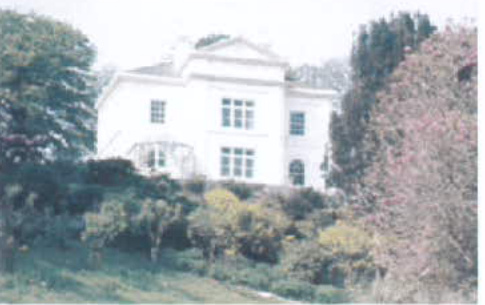
The proposal seeks to demolish the existing property known as Ashdowne House that currently occupies the site to enable the creation of an elegant and understated private residence.
The design objectives from the outset have been to develop a proposal that:
The site is approximately 101.2 m deep by 45.5 m wide with a full width frontage parallel to Ballavale Road on the east side. The Isle of Man railway tracks run the length of the site near the north boundary, with neighbouring fields to the south and west edges. The site is densely vegetated with large mature trees concealing the property from the road and making the site extremely private.
The surrounding properties are comparatively grand in scale in contrast to the existing modest property of Ashdowne House and all of varying architectural aesthetic. This planning application proposes to erect a dwelling that will be more in keeping with the grandeur of the surrounding properties and the prestigious character of the area. The proposal does not seek to compete with or emulate these properties; rather it seeks to create a property that is more sympathetic to the area.
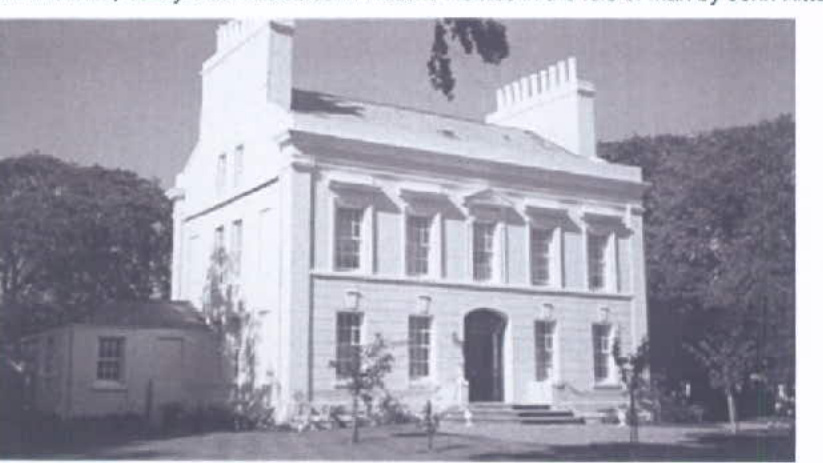
Neighbouring property Ballavale, Santon as illustrated in Historic Homes in the Isle of Man by John Kitto.
It is not felt that any of the other neighbouring properties are in close enough proximity to be materially affected by the proposal. Consultations with the immediate neighbours have taken place as part of the design process of this scheme.
Our proposal emulates the orientation of the existing property in that the principle façade addresses Ballavale Road as it is felt that this was the most suitable orientation as this is the façade that could be most discernable from Ballavale Road.
The orientation of the dwelling has also been considered in respect of the existing vehicular access which is to be retained.
As stated, it is felt that the scale of the existing property is disproportionately small for the size of the site and in relationship to the neighbouring properties. We believe that our proposal is more fitting in scale for its location especially when the surrounding context is taken into consideration.
The initial concept images below were presented to lan McCauley and Steven Stanley in May 2010. At the time, the consensus was that a property of this type of scale and massing would be deemed inappropriate. This comment has also been considered in the development of this submission.
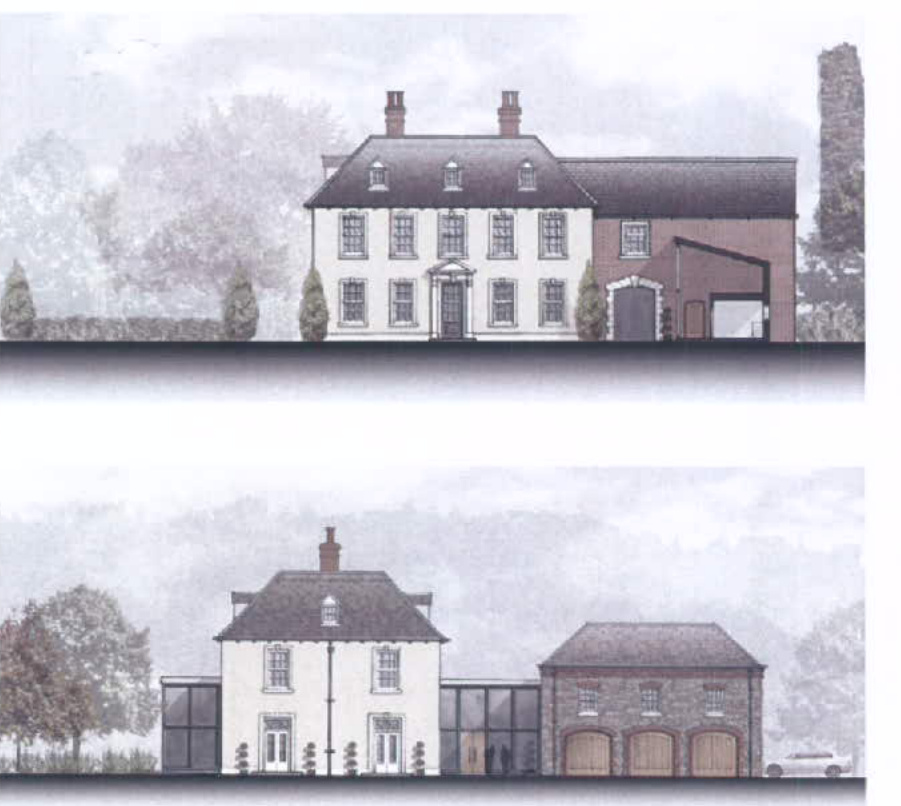
As already discussed, Steven Stanley was also consulted during the design development of this new submission. The image below formed the basis of the initial discussions that took place with Mr Stanley. The feedback was that this initial revised proposal was not as refined as the original submission and would read as an obvious new build.
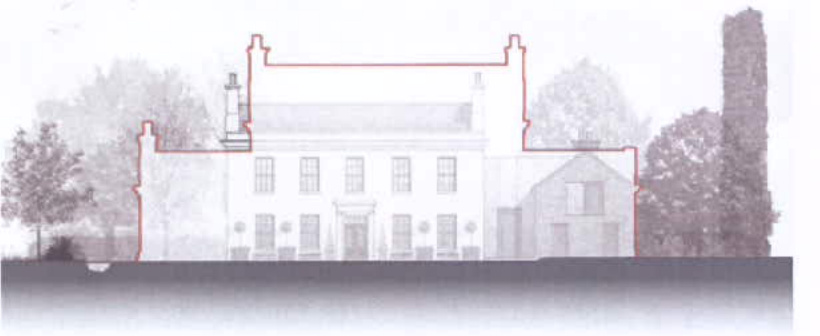
The comments of Mr Stanley, and those of the Planning Committee in relation to the previously submitted scheme, have been considered and addressed as part of this submission. The result is a dramatically reduced scheme. An outline comparison of the previous scheme with this proposal is shown below.
Red line indicates previous application
The house is composed of three principal elements which are arranged to read as a property which is to give an appearance of being extended and linked over time with a frameless, 'invisible', glazed link connecting the three.
The principal volume of the house would reflect the original Manx farm house which could have belonged to one of the larger surrounding properties as part of an estate and follows the architectural aesthetic of an extended Manx house.
The garage building is designed to read as a modified and converted traditional stone out building. This building is of traditional proportions with functional detailing.
Conceptually, at the rear of the property there is a contemporary extension which is to be read as being built adjacent to the existing stone wall. This element uses traditional Manx stone with contemporary detailing and is deliberately different in scale to read as a true addition.
The principal residence is to be linked to the more rustic stone single storey elements with a lightweight double height link - a true glass box with glazed roof and walls therefore reducing the visual impact of the space.
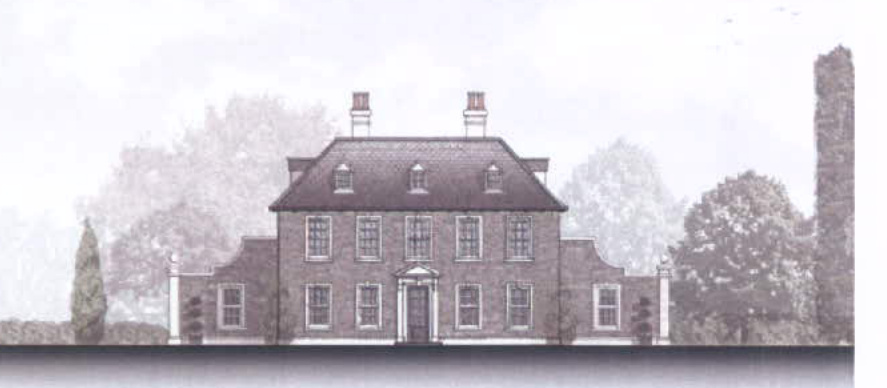
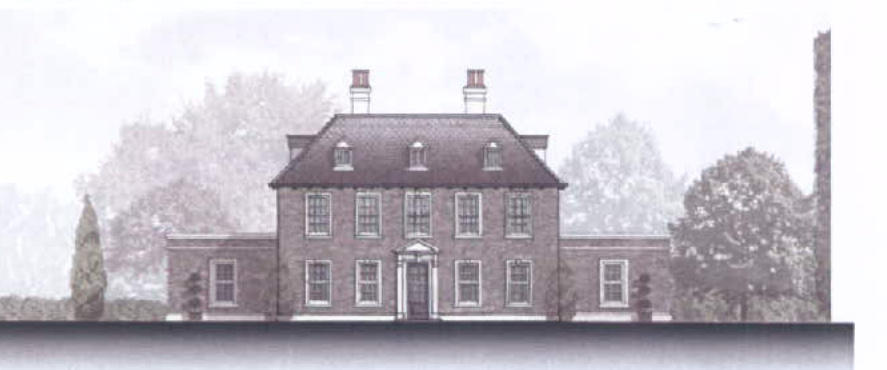
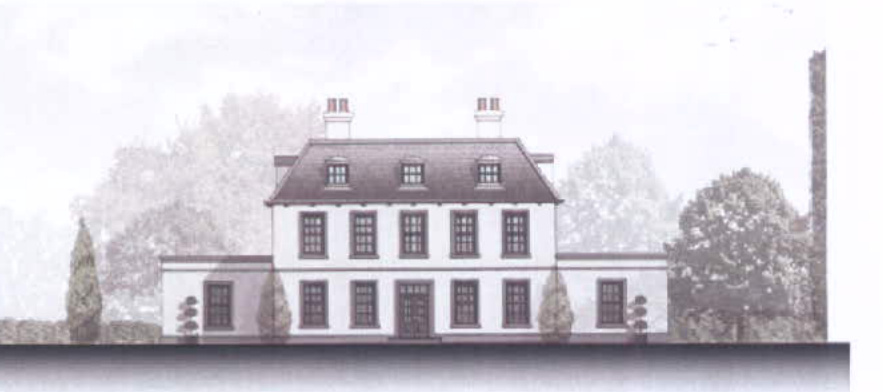
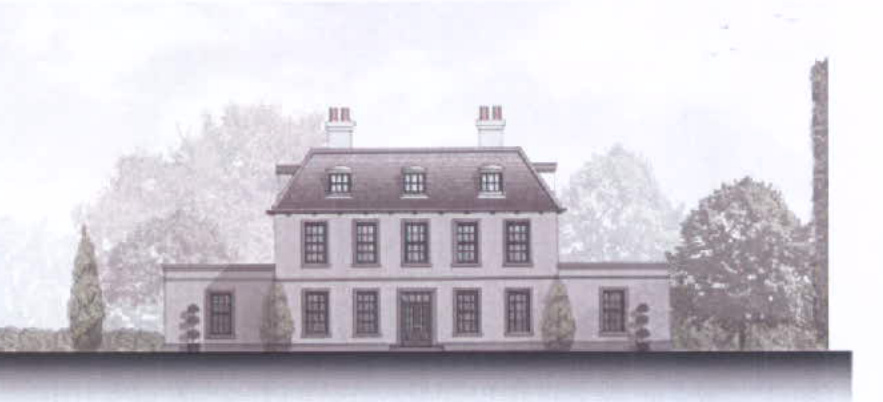
The principal volume retains the aesthetic of the previous submission. The images below are design development drawings of the principal façade as previously submitted, were generated for discussion with Steven Stanley and explore classical architectural styles and variations in materiality.
i. Classical proportions, omate wings, Manx stone, stone detailing
II. Simplified wings
III. Steeper roof pitch, amended dormers, revised front entrance
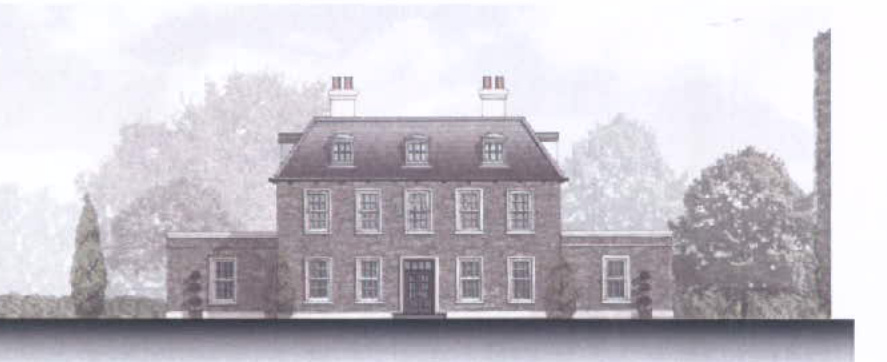
iv. Change material to light coloured render
v. Dark render
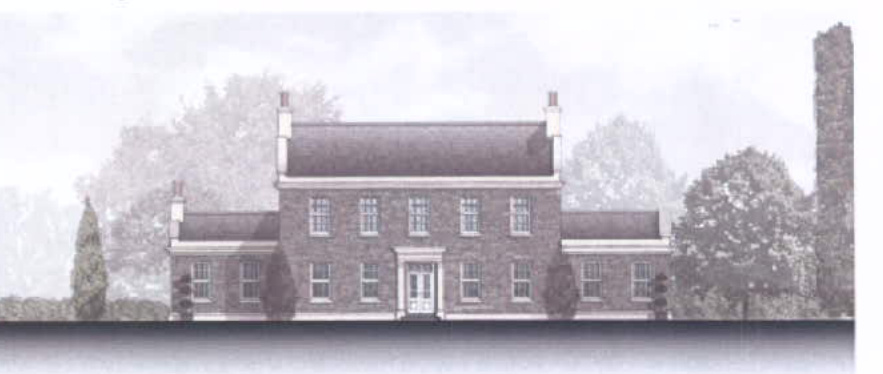
Option B _ Typical Large Manx Country House i. Traditional proportions, gable end chimneys, classical embellishments, Manx stone, stone detailing
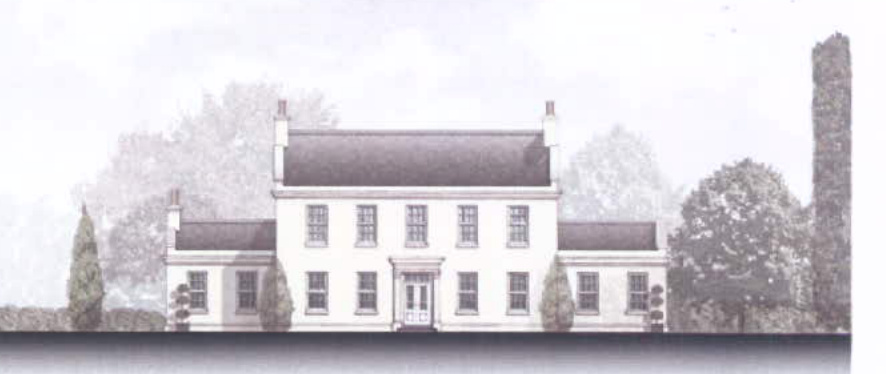
ii. Traditional proportions, gable end chimneys, classical embellishments, rendered
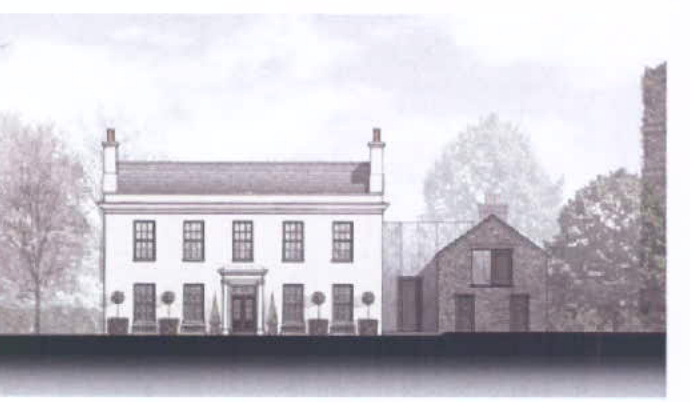
At the time, it was felt that the strongest scheme and the one that is most appropriate for the site is B.ii as shown above, and it is deemed that this is still true. This elevation is a rarer extended version of a traditional symmetrical elevation of a vernacular dwelling as described in Planning Circular 3/91.
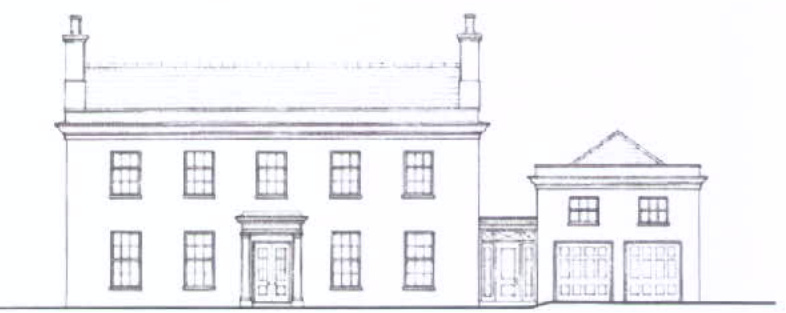
This proposal (as shown above) follows this same rationale. As previously highlighted, there is a strong precedent for properties following this rationale as illustrated below.
Thornhill Manor, Lezayre as illustrated in Historic Homes in the Isle of Man by John Kitto.
Initial concept studies as part of the previous scheme explored the feasibility of the vernacular style of a single pitch using a square grid to establish chimney proportions. During design development it was felt that the resultant proportions of the chimney stack would be excessively wide and would increase the overall massing of the property. Therefore, a gable profile of two narrower, more proportionate chimneys was opted for.
As stated, whilst the overall aesthetic has been retained the scale of the main house has been significantly reduced to assist in reducing the perceived visual impact of the property which was highlighted as a concern of the Planning Committee.
There is a single storey Manx stone building to the side of the property which could be perceived as existing outbuildings that have been incorporated to create a cohesive whole, all connected by a minimally obtrusive glazed link.
The perceived single story stone extension at the rear of the property has a contemporary aesthetic to it. This is to enable the introduction of large glazed elements to take full advantage of the private secluded gardens afforded to the property as well as reflecting the more contemporary use of the spaces within a modern home. These elements have been kept to the rear of the property in order to preserve the strong traditional front façade. In addition to this the integral garages have been located to the side of the property to retain the traditional frontage of the scheme.
This proposal seeks approval of a hidden subterranean level basement to the property. This design solution was reached as a response to the reduction in the overall scale of the property above ground and the need to incorporate leisure facilities in a property of this type. The creation of a lower floor of the same footprint as the ground was decided upon due to the cost and effort involved in this type of excavation. This has allowed the creation of a service floor which includes the leisure facilities, plant room and garaging, including a car lift, which serves the floors above.
This floor would not be discernable to the public and therefore it was agreed with Mr Stanley that this floor could be omitted within relevant area calculations.
The materiality of the scheme was explored throughout the design process of the original submission as illustrated.
The principal material for the scheme is to remain unchanged. This is proposed as a smooth render with architectural detailing in stone with slate roof tiles on the pitched roofs and dark coloured cast iron rainwater goods. The traditional timber sash windows, paned doors and roof lantern are to be painted a dark heritage colour timber.
The contemporary glazed elements are to be powder coated graphite grey metal frames. An area of sedum roof is incorporated at the rear of the property. The glazed link is solely made from glass including the roof structure.
The existing vehicular access to the site off Ballavale Road is proposed to be retained for access to the site.
Provision for parking and areas for manoeuvrability in front of the property for the future residents and visitors is substantial. This was a particular design consideration as parking on the road would not be viable due to its narrow width.
The majority of the existing principal trees are to be retained as illustrated on drawing 1101 P 001, with only a few trees proposed to be removed. In particular the registered trees on the road side of the property are to remain untouched. The extensive mature gardens are proposed to be retained as much as possible.
During the design development of the scheme Peter Keenan of DEFA was consulted with regard to the landscaping of the property's gardens. The current grounds have not been fully maintained and will therefore require some revisions. It is the intention to develop the landscaping scheme for the site with a specialist to ensure that any proposals are incorporated sympathetically and will serve to enhance the gardens.
In summary we feel this scheme should be supported because:
In light of the above and the enclosed documents we hope that this application will be recommended for approval.
Copyright in submitted documents remains with their authors. Request removal
View as Markdown