**Document:** APL Planning Statement
**Application:** 22/01158/B — Erection of a stable block within Field 324071 with hardstanding, creation of a new access Field 321618 and Change of Use of Field 324071 from agricultural to Equestrian use
**Decision:** Refused
**Decision Date:** 2023-02-01
**Parish:** Marown
**Document Type:** report / planning_statement
**Source:** https://planningportal.im/a/9609-marown-garth-road-stable-change-use/documents/960762
---
# APL Planning Statement
## Planning and Design Statement
Erection of a stable block Field 324071 with hardstanding and Creation of New access Field 321618, Garth Road, Crosby, Isle of Man IM4 2HB
##### Contents
- 1.0 Site and Surroundings
- 2.0 The Proposals & Justification
- 3.0 Planning History and Policy
- 4.0 Drainage
- 5.0 Environmental
- 6.0 Parking and Access
- 7.0 Summary
- 1.0 Site and Surroundings
- 1.1 The proposed area has a long history of being used for equestrian usage. Field number 321618 & 324071 are in our ownership and are all zoned for Equestrian usage.
- 1.2 The site which is currently laid to grass, is surrounded by open fields on all its boundaries, with the nearest property with buildings, Upper Garth Farm, situated about 114m North East of the nearest point of the proposed Stable. The site frontage which abuts Garth Road is lined with Manx sod hedging along its entire stretch, only opening up at the field access.
- 2.0 The Proposals & Justification
- 2.1 This application looks to address the overriding issues that brought the refusal of the previous planning application 21/00957/B
- 2.2 This is a stand alone application and not linked to any other.
- 2.2 The proposal is for a stable block situated in Field 324072 with a new entrance within field 321618. The existing entrance in field 321618 will be closed off for access into these fields.
- 2.3 For the avoidance of doubt the stables are for the sole private use of the applicant and not to be used in a commercial use.
- 2.4 The corner of the field requires levelling as there is a gathering of stones and soil that has been dumped over the years, the hedge as it stands at the minute (not including the growth) is approx 5ft (the growth takes it higher) as shown in the photos.
- 2.5 The new proposed stable block is to be constructed from wood and will be supplied by a supplier whose buildings have already been used in previous planning applications.
- 2.6 We purchased land in this area as it has always been known for having a strong equestrian reputation, the majority of the area has horses grazing and stables and equestrian buildings dotted all over. Directly opposite our land is Upper Garth which has horses grazing, stables, an agricultural building and a paddock/menage which is actively used. There is an equestrian track (owned by Ashdene) that runs up the side of our land and there are "caution equestrian" signs in place on our road. There is no reason why we thought that horses or being able to house horses in this area would be an issue. After losing two horses previously to sycamore poisoning and another being poisoned by a shiny leaf plant, we wanted to purchase land that would be free from these kinds of dangers. One of our horses also suffers extremely badly with sweet itch and is allergic to midges and flies which gather under trees and shady moist areas. Buying this land gives us the opportunity to strategically plant trees etc to screen and create shelter but also manage his condition.
- 2.7 Over the years we have been very lucky to rent small private yards to house our horses. One by one these yards are reducing in numbers due to owners developing the sites into dwellings or holiday accommodation. The one we are on at the moment has started a growing commercial business and for safety and security, we have had to think about our horses future. Livery yards are not an option for our animals because
- 1. Trying to find one to accommodate 5 horses is an issue
- 2. Some of our horses have behavioural issues and have been unwanted or difficult for others to manage. We can cope and work with their issues, but they certainly wouldn't be welcome on a livery yard. i.e.one in particular is a bully and is very particular with who he shares a field, we have to be careful, when we have introduced new animals as he can be extremely savage, which would be dangerous, distressing and very unwelcome on a livery yard.
- 3. Our horses are older animals and some have reoccurring health issues, most of which would be difficult to manage on a livery yard.
- 4. Carriage driving isn't really welcome on livery yards and if they do allow carriage drivers, they won’t allow you to use the facilities that they provide.
- 5. Alot of the livery yards are full and the larger yards futures are in question at the minute, one has been sold and there are rumours that another is planning to re-purpose the site.
When looking at our options, having to split our animals wasn't a great option and also the cost, it made more sense to purchase our own land so that our horses futures are secure.
- 2.8 The need For Stables 50 years ago horse management was a lot different to what it is today, things that were acceptable years ago are now unacceptable.
Not only do stables provide protection from the elements (rugging can only do so much) they provide a place of warmth and comfort especially in the case of an emergency, injury or sickness.
Our horses aren't getting any younger and all suffer health issues, arthritis and if not managed correctly have reoccurring injuries, the only way to do this is creating a routine between field and stable. They often require the vet and also treatments all of which couldn't be done from the field.
- 2.9 All our horses are stabled in the winter to protect them from the elements and to also make sure they are getting sufficient nutrition, so they maintain their weight and condition during the winter months. It also helps protects the land from being poached and also prevents injuries from slipping or suction injuries from trying to walk through the mud, three of our horses have had back and hip injuries, that can reoccur if left out in the field.
On top of their injuries there a few conditions they suffer with if left out, I will include the British Horse society's information on these, all of these can be prevented if the animals are brought in and allowed to dry Abscesses Thrush Mud Fever Rain Scald
All our horses are prone to Laminitis (again I will include The BHS info on this) and the only way this can be dealt with correctly, is by stabling and being able to control and monitor, what the horses are eating. This is usually Summer time routines
We have four coloured horses (Black & white, Brown & White) their skin underneath their white parts is mainly pink, so therefore are prone to sunburn, on extremely sunny days or if the sunscreen doesn't work, bringing them in is the only way to manage and treat/sooth their skin
One of our horses suffers extremely badly with sweet-itch, he is allergic to midges and when bitten, will itch his skin till he is bald and red raw with open wounds (Again I will include The BHS info on this) thankfully with field and stable management, he has been in great condition and successfully competes.
Our horses, despite their issues, do work and a couple successfully compete in carriage driving. Our horse with sweet-itch is the current Manx Masters Champion an accolade he would never have had achieved if he wasn’t in top condition, which he would never have been having to live in a field without access to a stable. Another has qualified to go across to compete, again without correct management, he would still be stood lame in the field.
- 3.0 Planning History and Policy
- 3.1 Planning History - Area
- o 21/00544/B – No Objections
- o 21/00426/B – No Objections
- o 21/00453/B – No Comments Raised
- o 20/00503/B – No Objections
- 3.2 Planning History – Field 321618
o 21/00957/B - Erection of a stable block, creation of associated paddock / hard standing and widening of access – Refused
- 3.3 The new proposal removes the sand paddock.
- 3.4 The sable block has been reduced in size and materials changed from Metal to Timber clad and the position moved to the adjoining field to make reduce its visible appearance to the surrounding area.
- 4.0 Drainage
- 4.1 New Surface water channel positioned field side of the new entrance, channel to connect into new Land drainage tails running into the field. final position to be determined on site in conjunction with DoI Highways if required. A row of bullnose kerbs (BN3) with 25mm - 40mm upstand to be installed across the site access at the back edge of existing carriageway with the first 6m of access road (bound material) falling back into the site at a gradient between 1:20 and 1:40. To prevent runoff from the highway draining onto the site and runoff from the site draining onto the highway.
- 5.0 Environmental
- 5.1 Manx Wildlife Trust conducted an ecological survey for planning application 21/00967/B. As the Proposed New Entrance for that application and this application are identical the report is still valid. The report is attached within the appendices.
- 5.2 It is our intension as part of the proposal to create additional sod hedging to create screening around the stables and along the length of the new driveway. This would mean that the stables would be completely screened on three sides, it would also shelter the site, it would also encourage wildlife and habitats to form.
- 5.3 We have planted along the hedge in the field above, which will screen the back of the new proposal and when established will make the stables very difficult to spot from the Foxdale road. These are extra to the trees that have already been planted and the hawthorn hedge that has also gone in.
- 6.0 Parking and Access
- 6.1 New Entrance to allow better vehicular access and egress. Existing Gate Entrance to be closed off. Creation of new entrance has less impact on the sod hedge as the overall height to give 1.050m sight lines does not require reduction. Existing high spots are bracket and thorn, not hedge.
- 6.2 The proposed new entrance has been designed with consultation with the DoI Highways and the proposed position gives sight lines of 90metres and does not require the reduction of any of the existing sod hedging.
- 7.0 Summary
- 7.1 This planning statement has been prepared, in support of a full planning application.
- 7.2 I really hope I have supplied enough info to show the need for stables, in this day and age where an animal’s quality of life and welfare is a must, I really hope that the new proposed site is supported.
- 7.3 I would also like to add that the public are more aware of animal welfare issues and can be a lot more vocal than they used to be, we received complaints during the winter, about our horses being stood in mud in the field. The horses that were being referred to were in the next field up, nothing to do with us. We have been unable to use our land, except for the odd week here and there, because as stated above without stables, we can’t manage our horses conditions or fitness.
- 7.4 I do not think that this building will have a detrimental impact on the area, as the property across the road, which runs alongside our land, is a very active equestrian site. Upper Garth has stable blocks, an agricultural building and also a regularly used paddock/ménage, in which they have a full set of show jumps, all very clearly equestrian. This property is very much on view when coming down the Foxdale road and I feel would distract attention from a discreetly placed, sympathetically screened, wooden stable block and if not, our building would blend in.
###### Appendix 1: Supporting Picture Evidence
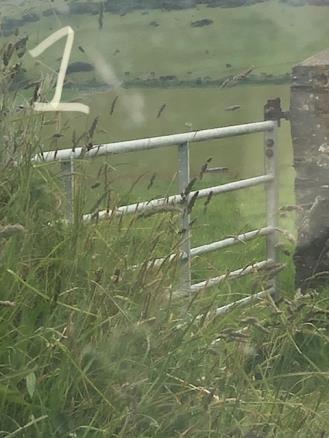
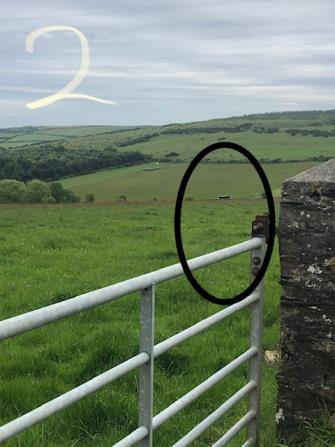
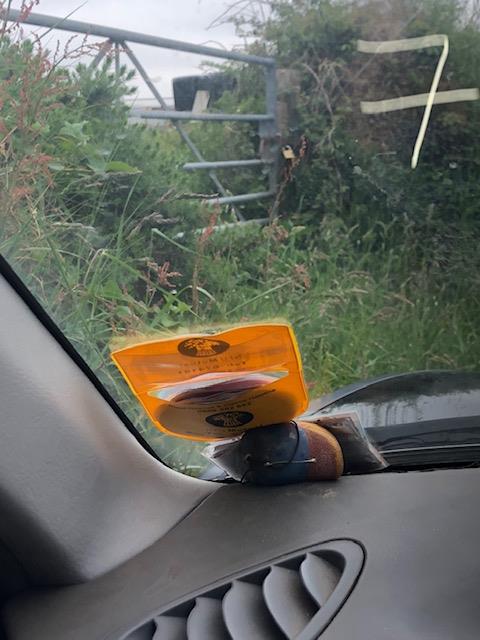
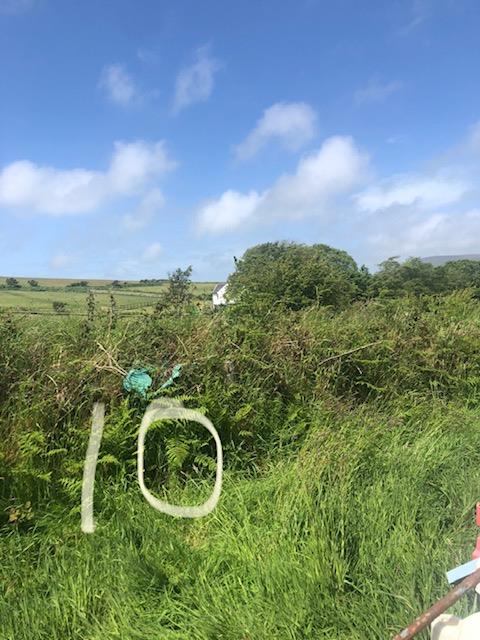
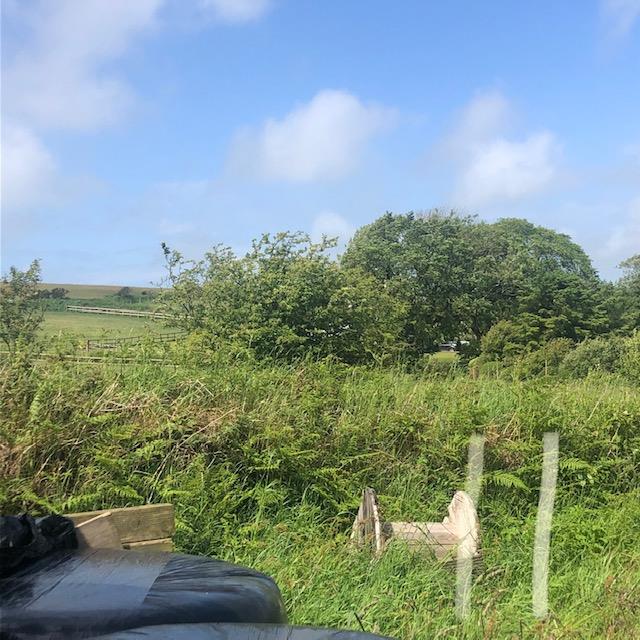
The new position for the proposed stable block at the minute houses round bales of hay, which are wrapped in black and are approximately 8ft high. I have taken pictures and focused on the bales as I think it shows that our proposed building will have little visual impact on the area.
We have driven around all the roads surrounding our land and the only place that the land can be seen at a distance, is from the road from Foxdale coming down the hill, it has to be looked for and also is a flashed view (seconds)
Our plan (as discussed) is to plant a hawthorn hedge along the back of the stables in the field above, this will screen this view once established.
The land is in a dip and cannot be seen from any other approaching road.
I have included photos of the proposed site, taken from the Foxdale road, please note these are taken from a passenger seat of a high vehicle not a standard car.
| |
|---|
|1.This picture was taken from the gateway (I had to get out of the car) the weather was a bit hazy so waited for it to clear as the bales are more or less impossible to see|
|---|
| |
|---|
|2.The view from the gateway, again I had to stop and get out of the vehicle and go into the gateway to take this.|
|---|
| |
|---|
|3.This picture is from the hill, where visibility of the site is seconds and has to be looked for.
I had to get out of the vehicle and climb the hedge to take this, I have also zoomed in, as I think photo 2 shows the actual view.|
|---|
| |
|---|
|4.Coming down from the crossroads, this is the view of what would be the back of the proposed stables, at approx 8ft this is the height before any digging to level has taken place. We also propose to plant a hawthorn hedge along the back of the stables to screen.|
|---|
| |
|---|
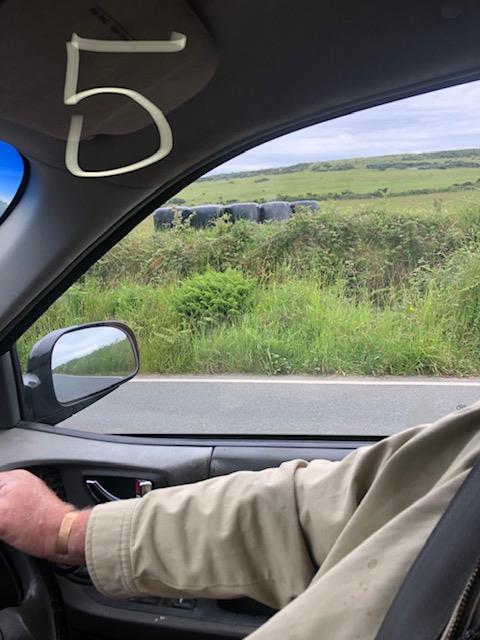
|5.This is right outside the proposed site, there is at least 3ft of digging that would need to be done to level the corner so this would be the maximum height that would be on show. Opposite the site, Upper Garth have two trees on their hedge side which along with the very established trees, surrounding their home, should screen the proposed stables and not affect their view in anyway.|
|---|
| |
|---|
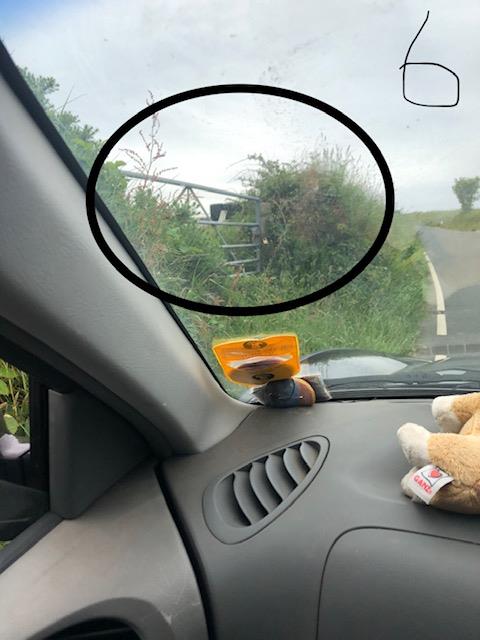
|6.Driving up Garth road, this is the first view of the proposed site, which is outside our gate way, we can block this view by screening the gate.|
|---|
| |
|---|
| |
|---|
|7.Is a zoomed in version of number 6|
|---|
|8.This is the bales as seen from the road, driving up past|
|---|
| |
|---|
|9.Zoomed in version of number 8|
|---|
| |
|---|
|10.taken from the hedge behind the proposed stable block, which shows how little of Upper garth is visible.|
|---|
| |
|---|
|11.Taken from the proposed siting of the stable block, as you can see Upper Garth’s view is screened by very well-established trees on their own property.|
|---|
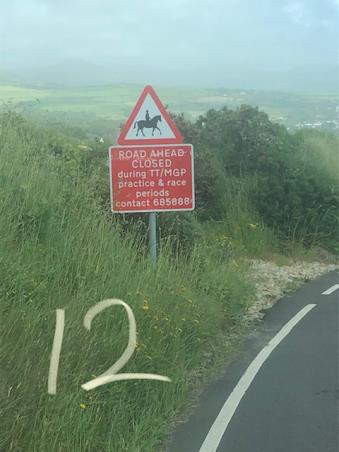
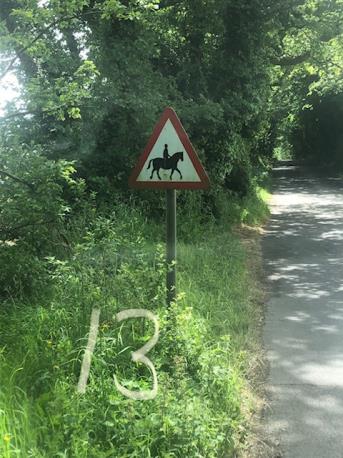
12 and 13. These are photos of the warning signs taken on Garth Road,12 is before you hit our land coming from the crossroads and 13 is at the other end coming from Ellerslie
This corner was cleared as the brambles and fern that were growing had overtook this area, however if left and managed correctly (allow the brambles and ferns etc to grow in a controlled manner) the hedge in photo no.5 could be managed to naturally screen, the side of the proposed stables.
There is a minimum of 3ft digging required to level the corner which when using the bales as an 8ft guide, hopefully show there will be very little of this stable block showing in this area.
I have included the road signs as these surely show that this area is not only known as a strong equestrian area, it is also recognised as one?
###### Appendix 2: Manx Wildlife Trust
### Consultancy Services
Ecological Advice & Solutions
#### Precautionary Working Method Statement (PWMS): Common Lizard (Zootoca vivipara).
Date: 16th December 2021 Author: Sarah Hickey (Ecologist) – MWT Consultancy Planning application reference: 21/00967/B: Erection of a stable block, creation of associated paddock / hard standing and widening of access, Field 321618 Garth Road, Crosby, Isle of Man, IM4 2HB.
- 1.0 Rationale
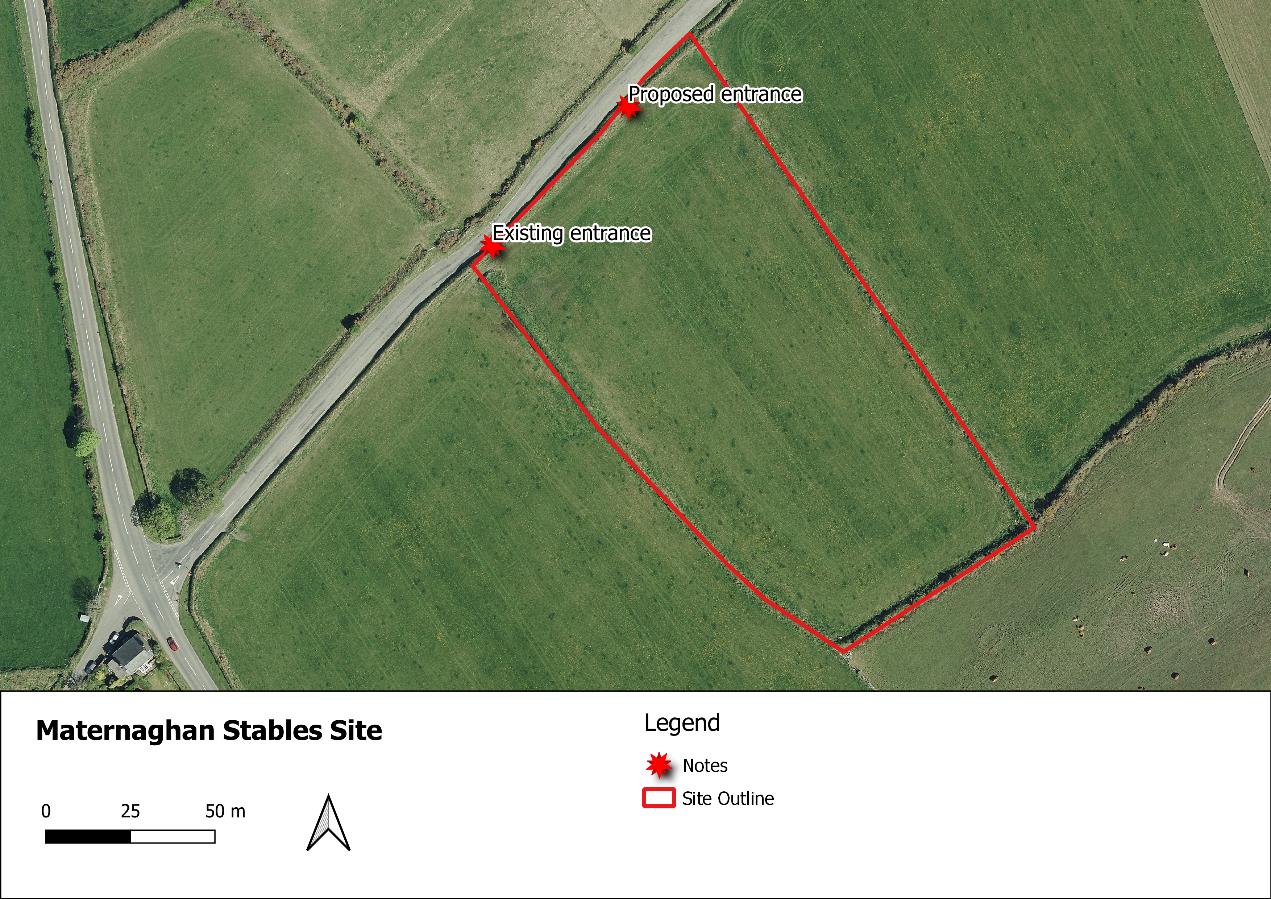
- 1.1 The above planning application involves the removal of approximately 4m of existing hedgebanks at the north-western edge of the site. Common Lizards have been recorded using the hedgebanks in this area so the PWMS below must be followed as mitigation.
- 2.0 Field Survey
- 2.1 For the location of the proposed hedgebank removal, refer to Figure 1 overleaf.
- 2.2 A site visit was undertaken on 15th December 2021, in mild, sunny conditions, in order to consider the appropriate mitigation for Common Lizard.
- 2.3 No Common Lizards were seen during the visit, but this was to be expected due to the time of year.
- 2.4 The hedgebank to be removed is approximately 1.5m high and had recently been cleared of scrub on the field side, leaving areas of exposed earth. The road side was largely comprised of grasses cut to approximately 20cm.
- 2.5 The hedgebank appears to be constructed largely of earth, with few stones visible. Animal burrows or varying sizes were noted on the field side of the hedgebank. These may provide hibernation sites for Common Lizard.
Figure 1: Location of proposed hedgebank removal.
Photographs 1 & 2: The hedgebank from the interior of the site (left) and the road side (right).
- 3.0 Precautionary Working Method Statement for Common Lizard
- 3.1 The hedgebank to be removed must first be made unsuitable for lizards through the cutting back of the grass to no less than 10cm on both sides. This work must ideally be undertaken during the non-active season for common lizards (typically November to February).
- 3.2 The hedgebank should be removed on warm days (at least 12oC) early in the lizard active season (April to early June) to avoid the vulnerable birthing period. Removal should be done from the south-west to the north-east to allow any lizards present to relocate to adjacent habitat.
- 3.3 If removal is required in the vulnerable period of hibernation and limited activity (November to March), a supervised removal will be required to avoid injury and mortality of lizards that may be hibernating in the hedgebank.
- 4.0 Potential enhancement of the site for biodiversity
- 4.1 There are plans to plant trees within the site for privacy and shelter. These should ideally be suitable native species (refer to Appendix I). Nectar-rich species, such as Hawthorn (Crategus monogyna), will improve the site for invertebrates, birds and bats.
- 4.2 The remaining hedgebanks could be managed to benefit Common Lizard. This could include rotational cutting to improve structural diversity.
- 4.3 A strip of rough grassland (grassland that is infrequently mown or grazed) at the field margins would improve the habitat for lizards. This could be managed through rotational cutting.
- 4.4 The placement of bird and bat boxes on the new stable building would create additional nesting and roosting opportunities for a number of species.
##### Appendix I: Isle of Man Native Woody Species
[Table omitted in markdown export]
|Table 1: Isle of Man native woody species|Table 1: Isle of Man native woody species|Table 1: Isle of Man native woody species|
|---|---|---|
|English Name|Latin Name|Notes|
|Ash|Fraxinus excelsior|Not currently suitable for planting due to ash die-back. Thrives in most habitats, esp. richer soils.|
|Aspen|Populus tremula|A good tree for wet places.|
|Bay willow|Salix pentandra|Uncommon but widespread. Wet woodland species.|
|Blackthorn, sloe|Prunus spinosa|Tolerant of coastal conditions and native to most of the Island – hence more suitable than hawthorn for most native planting.|
|Bog myrtle, gale|Myrica gale|A fairly low-growing aromatic shrub, very attractive. Thrives in boggy conditions.|
|Brambles|Rubus fruticosus agg.|Very variable, with lots of varieties indigenous to the Isle of Man. Bramble usually spreads by itself. If it is to be planted, the use of stock local to the area is strongly recommended, with cultivated varieties (many of which are over-vigorous) to be avoided.|
|Burnet rose|Rosa pimpinellifolia|A distinctive, very prickly wild rose with black rosehips. Thrives on welldrained soils near the sea.|
|Common alder|Alnus glutinosa|A good tree for wet places, except where the soil is very acid.|
|Common sallow|Salix cinerea ssp. oleifolia|Common in wetland habitats throughout the Island. Some doubt as to how native this species is on the Island.|
|Crab apple|Malus sylvestris|Native trees (thought to be very rare) occur in sessile oakwood; otherwise much planted.|
|Dog rose|Rosa canina|A group of closely related wild roses, of which the Isle of Man tends to have types which are typical of north-west England. In general, these are downier than the dog roses found in southern England.|
|Downy birch|Betula pubescens ssp tortuosa|As above, but a more shrubby, upland subspecies. Has distinctive aromatic foliage.|
|Eared willow|Salix aurita|A bushy, low-growing sallow of wet, acid moorland and curragh. Forms good bird habitat.|
|Elder|Sambucus nigra|Tolerant of coastal conditions; strong cultural significance.|
|Goat willow; pussy willow|Salix caprea ssp caprea|Uncommon on the Island. Prefers drier, more calcareous soils than the common grey "sallie".|
|---|---|---|
|Hawthorn|Crataegus monogyna|Common and widespread, grows best in full sun.|
|Hazel|Corylus avellana|Thrives in most habitats, esp. richer soils on sheltered sites.|
|Holly|Ilex aquifolium|Thrives best on fairly dry sites.|
|Honeysuckle|Lonicera periclymenum|Hedges and scrub; tolerates coastal conditions.|
|Juniper|Juniperus communis|Very rare as a native plant; a plant of heather moorland. Tolerates exposed sites.|
|Manx native oak; oak hybrids|Quercus robur, Quercus robur x petraea hybrids|More typical of drier, lowland areas than sessile oak. It has been planted extensively and many oaks on the Island are intermediate in characteristics between the two species. These hybrids are themselves variable.|
|Purple willow|Salix purpurea|Native to the Central valley only. Wet woodland species.|
|Raspberry|Rubus idaeus|Usually occurs on the edges of woodland and heath.|
|Rowan|Sorbus aucuparia|strong Manx cultural significance|
|Sessile oak|Quercus petraea|Occurs on wetter, more upland areas and more acidic soils than English oak and is the more typical oak on the Island; however hybridisation between the two species make it difficult to find ‘100% sessile’ trees.|
|Sherard’s downy-rose|Rosa sherardii|A fairly common scrub and hedge species.|
|Silver birch|Betula pendula|Prefers well-drained sites.|
|Spindle|Euonymus europaeous|Very rare as a native but sometimes planted. Prefers base-rich dry soils.|
|Wych elm|Ulmus glabra|Much-planted; possibly native (hard to tell). Suitable for sites with base-rich soils.|
[Table omitted in markdown export]
---
*Data sourced from the Isle of Man public planning register under the [Isle of Man Open Government Licence](https://www.gov.im/about-this-site/open-government-licence/).*
*Canonical page: https://planningportal.im/a/9609-marown-garth-road-stable-change-use/documents/960762*