**Document:** Farm Business Outline
**Application:** 25/91221/B — Alterations to existing building to create new dwelling, workshop, garaging and farm office (retrospective)
**Decision:**
**Decision Date:**
**Parish:** Onchan
**Document Type:** report / planning_statement
**Source:** https://planningportal.im/a/130616-onchan-bibaloe-moar-whitebridge-dwelling/documents/1592938
---
# Farm Business Outline
## Manx Beef Ltd, Bibaloe Moar Farm
Farm Business outline and extra informa on re planning aspects
### Contents
- 1. Introduc on ............................................................................................................................... 2
- 2. Current situa on ........................................................................................................................ 2
- 3. Business Objec ves .................................................................................................................... 3
- 4. Marke ng ................................................................................................................................... 4
- A. Fresh calved or in calf heifers or second lacta on cows for Pedigree breeding stock .......... 4
- B. Commercial Highland finished stock for meat ....................................................................... 4
- C. Commercial Highland store animals ...................................................................................... 4
- D. Cull Pedigree breeding stock, leaving the suckler herd for meat .......................................... 4
- E. Cull Pedigree breading stock, leaving the suckler herd for further use by pedigree or commercial producers ............................................................................................................... 4
- F. Hor cultural produce ............................................................................................................ 5
- G. Silage ...................................................................................................................................... 5
- 5. Summary of the intended use of each of the exis ng and proposed buildings ........................ 5
- 1.Hard standing area (J) ............................................................................................................. 5
- 2.Exis ng Modern Agricultural Building (B) ‒ Exis ng Permission for agricultural use ............. 6
- 3.Refurbished cart store and stabling (C1) ‒‒ Retrospec ve Permission sought ..................... 7
- 4.Refurbished stockman’s co age (C2) ‒‒ Retrospec ve Permission sought .......................... 7
- 5.Exis ng tradi onal building (D) ............................................................................................... 8
- 6.Exis ng tradi onal building (E) ............................................................................................... 9
- 7.Greenhouse (F) ‒ Planning Permission sought. ..................................................................... 9
- 8.Two storey replacement of exis ng single-storey buildings (G) ‒ Retrospec ve Permission sought. ....................................................................................................................................... 9
- 9.New Feed and Ca le shed (H) - Planning Permission sought .............................................. 10
- Appendix 1 ‒ Current Business labour requirements ....................................................................... 11
- Appendix 2 ‒ Proposed Business Labour Requirements ................................................................... 12
- Appendix 3 ‒ Proposed Building capacity ......................................................................................... 13
- Appendix 4 ‒ Bibaloe Moar Farmed Area ......................................................................................... 14
- Appendix 5 - DEFA’s Blue Tongue Control measures ........................................................................ 15
- Appendix 6 ‒ Performance data on Highland ca le ......................................................................... 16
### 1. Introduc on
The rather dilapidated farm was purchased by Whitebridge Property Limited in 2021 and both the exis ng tradi onal buildings, the main farmhouse and surrounding farmland has been subject to significant investment to re-establish their commercial agricultural func ons.
The intended beef suckler herd of pedigree Highland ca le is to be established by selec ve purchasing from exis ng high calibre pedigree herds in the UK. This process commenced with a search for high pedigree Highland ca le, which were carefully selected and purchased soon a er the farm was purchased, with the inten on of bringing them onto the Island as each lorry load of ca le had been purchased and assembled.
However, since November 2023, the Isle of Man’s Department of Environment, Food and Agriculture has banned any import of live ca le from the UK, as part of their measure to prevent Blue Tongue disease reaching the Island. This effec vely prevents the development of the core farm business at this point. The purchased ca le have had to remain on the holding unit (Scar Close, Carnforth) since that point and the search and purchasing has been suspended un l there is a route to bring ca le onto the Island.
The applicant has therefore con nued to focus their investment into the infrastructure and facili es, whilst wai ng for the borders to be re-opened. A substan al forage growing and sale enterprise is currently taking place on the farm, which will evolve as soon as ca le can be imported from the UK.
### 2. Current situa on
- 161 acres, with 151 acres of grazing and cu ng grassland, plus infrastructure (Appendix 4)
- Grassland and fencing in need of improvement, with reseeding and fencing commencing imminently.
- Good outdoor wrapped silage bale storage facili es in the lower yard.
- Range of improved tradi onal buildings which allow equipment and inputs storage.
- Small scale hor culture enterprise is being developed.
- A successful forage sales enterprise, selling hay and silage/haylage in large bales.
- Contractors are currently used for farming opera ons, as there are no ca le on the site.
- Scope to over winter sheep following the grass harvest, un l future youngstock are outwintered.
- The exis ng business has now been formally confirmed as an Eligible Farming Business for the DEFA support schemes as part of DEFA’s new requirement for eligibility to be assessed as part of the annual applica on. The unit already requires 0.6 Standard Labour Units (SLUs), which is well above the DEFA minimum size criteria (See Appendix 1).
- The forage produc on opera on is significantly larger at than previously iden fied in DEFA Head of Agriculture’s response to the Planning team dated 30th July 2025 which indicated 0.12 SLUs, which is accepted by DEFA through their confirma on of the Business’s eligibility for the Agricultural Development Scheme.
- An embryonic herd of highland ca le has been purchased by the applicant over the last 24 months, which had been expected to have been imported onto the Island by this point. These animals, plus others to be purchases will form the basis of the herd. The herd will then
- be grown over the next few years through reten on of a high propor on of the calves for breeding purposes.
- The Isle of Man maintains a Bluetongue disease-free status which is of significant value for future sale of breeding stock, However, a major part of DEFA’s disease preven on strategy is that since November 2023, the Isle of Man has suspended imports of live sheep, ca le and goats from Great Britain, due to cases of Bluetongue there.
- Therefore, the herd is currently in temporary accommoda on in the UK, which is preven ng the establishment of the Isle of Man herd and preven ng the commencement of a pedigree breeding programme on site.
### 3. Business Objec ves
- Expand the exis ng (currently off Island) tradi onal hardy breed Beef Suckler herd to achieve a herd of 120 Highland cows, which are expected to be in or out wintered according to weather condi ons and will be Spring and Autumn calving.
- The split herd with Autumn and Spring calving batches will ensure a year-round supply of high-quality beef to be produced, which will enable a premium product to be marketed with reliable and consistent product available. This is a key objec ve to ensure direct marke ng of the branded meat.
- Their youngstock would be weaned at around 8 months, to allow the pregnant suckler cows to regain condi on – at grass for the Autumn calvers, or for the Spring calvers - whilst over wintering in the new shed (or at grass according to weather), ready for their next calving.
- Establish a beef youngstock rearing enterprise with three components:
- 1. Commercial beef youngstock rearing, for sale as young steers/heifers (6 or 12 months old) or finished stock through the IOM Meat plant, according to weather and forage availability.
- 2. Pedigree youngstock rearing for sale as Pedigree Breeding stock
- 3. Pedigree youngstock rearing for reten on as replacement suckler cows for the herd.
- b. The opera on is expected to use stock bulls for the commercial youngstock produc on and Ar ficial Insemina on for the pedigree stock.
- c. Stocking rates will be adjusted according to seasonal grass growth and supplemental feed availability, using op ons such as purchase or sale of youngstock, contract rearing off site, purchase or sale of haylage, purchase of barley & protein or mixed feed - according to the season and condi ons.
- d. Develop the hor cultural enterprise to become a local market provider of fresh local vegetables, which will be enhanced with the establishment of the proposed greenhouse.
- e. The nature of the farm business means that during the periods when the herd are calving, there will need to be 24-hour supervision to ensure herd welfare and minimise calving losses.
- f. The Standard Labour Units calcula ons (see Appendix 2) demonstrate a total of 4,459 Hours and allowing a further 5% extra for management and marke ng overheads, the total figure of 4,683 indicates two full me workers will be required, plus either significant seasonal over me or a third person working part me (to achieve 2.46 Labour Units). This will allow suitable animal welfare cover, even during the cri cal calving period.
- g. Grassland management will be more intensive than currently, to allow target stocking rates of about 1 cow equivalent/acre across the year (see a ached calcula ons using the DEFA calculator in Appendix 1).
- h. The opera on will be fully in line with and support the Department of Agriculture, Environment and Food’s relevant strategies – the Food Security Plan 2024 and Agricultural Strategy 2024.
- i. The current business scale is limited by the current farm size and efforts are being undertaken to find extra land or extra feed sources with a view to further expansion in the future, a er ca le imports are resumed.
### 4. Marke ng
The business will have a diverse range of products to sell and intends to use some innova ve routes, where possible, which should enable significant premiums to be established.
##### A. Fresh calved or in calf heifers or second lacta on cows for Pedigree breeding stock
These will be the premium product, which are expected to be sold directly to pedigree breeders for use in their herds, ini ally mainly in the UK, though in me are expected to become global as the herd reputa on is established and interna onally marketed. The split herd approach with Autumn and Spring calving will enable a steady supply of animals for each of these two markets.
##### B. Commercial Highland finished stock for meat
These will be Highland or Highland cross animals which slow grown, grass finished at 24-30 months old. The split herd approach with Autumn and Spring calving will enable a steady supply of animals for each of these two markets. They will be slaughtered through Isle of Man Meats and ini ally contract butchered, then later in-house butchered, to create a dis nc ve branded premium product. The target market will be premium restaurants on and off Island. Lower value cuts will be made into sausages and burgers to enable brand premiums.
##### C. Commercial Highland store animals
These would be Highland cross youngstock, sold opportunis cally through local or UK livestock markets to balance grass and fodder stocks, during seasons with lower grass produc on levels.
##### D. Cull Pedigree breeding stock, leaving the suckler herd for meat
These will be end of breeding life cows, sold for slaughter and meat produc on. Whilst ini ally these would probably be sold to the Isle of Man Meats, there will be scope to develop products for direct to retail market once a brand has been established.
##### E. Cull Pedigree breading stock, leaving the suckler herd for further use by pedigree orcommercial producers
These will be market pedigree breeding cows which have been in the herd for one or two seasons and are reasonable though not top quality, which are likely to be sold to pedigree or commercial breeders through the Isle of Man or UK livestock markets.
##### F. Hor cultural produce
This produce will be from the greenhouse and exis ng hor cultural area. It is expected to be marketed to local restaurants as a seasonal product.
##### G. Silage
The livestock numbers have been calculated on normal grass growth pa erns, assuming 4.8t/acre of Dry Ma er, however, there will be years with up to 30% lower or higher produc on. The low produc on years would be addressed through livestock sales or feed purchases, whilst the high produc on years will allow opportunis c sale of silage to local farmers.
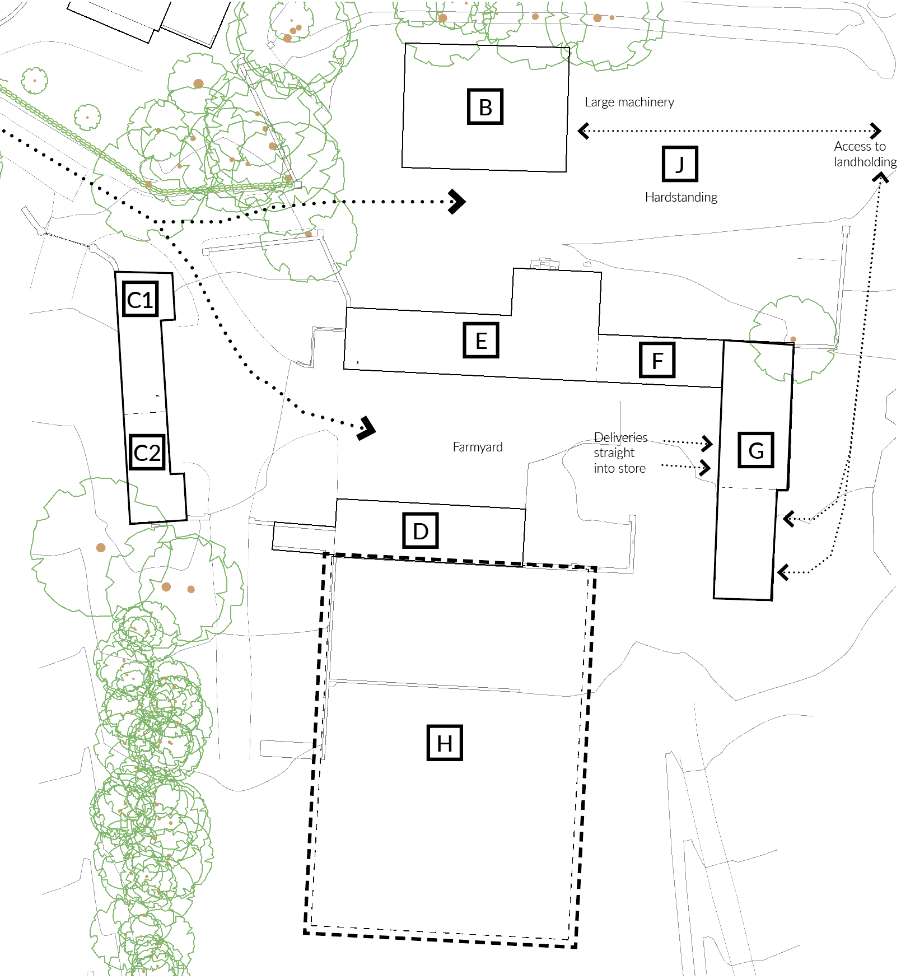
### 5. Summary of the intended use of each of the exis ng andproposed buildings
### 1. Hard standing area (J)
The Area around Building is a contained yard area, delineated by the exis ng bunding to the north, the exis ng tradi onal buildings to the south and fencing to the East. The surface was previously a mix of thin, mostly broken concrete, tarmac and compacted hard core, which was in places heavily overgrown. This surface very quickly started to break up and disintegrate once modern agricultural equipment was turning in the yard.
The only material change is that the previous hard standing has been re-concreted with improved drainage, for three main reasons:
- A. To stop the vegeta on encroachment which can be seen in other more recent photos in the Planning Statement, which occurred due to the patch work nature of surface during the periods when the farm ac vity was in decline.
- B. To provide a reasonable turning circle and surface for modern agricultural machinery to access the adjacent storage and workshop building B.
- a. Regulatory Turning Circle Envelope used in European Direc ve 97/27/EC and Regula on (EU) 1230/2012 require Ar culated HGVs to be able to turn within a swept path with an outer radius of 12.5 metres, or combined diameter of 25m, which the yard only just enables.
- b. Modern large tractors towing large, trailed equipment such as ca le movement trailers or grass rollers will typically require a similar sized turning area.
- C. To provide safe hard standing for outdoor bale storage which is likely to be required in the late summer to early winter period.
Recent photos of the upper yard (J) being used for storing and loading of silage bales onto a HGV for transport.
### 2. Exis ng Modern Agricultural Building (B) – Exis ng Permission
##### for agricultural use
This is a large machinery storage shed and workshop area which has exis ng Planning permission for Agricultural purposes. The access to the building with large equipment requires use of the yard (J) with space for a substan al turning circle.
Over the last few months, due to the inability to import livestock for the new pedigree Highland ca le herd, the building has occasionally been used for helicopter storage, however, the helicopter has now been relocated with effect from 3rd November.
## 3. Refurbished cart store and stabling (C1) — Retrospective Permission sought
This will be used for general purpose storage of garden and horticultural equipment and is part of the retrospective Planning Application referring to the new roof and front windows which replace the previous, non-original, steel door.
Photos extracted from The Planning Statement by Sarah Corlett.
Eastern elevation of Building C prior to works
## 4. Refurbished stockman's cottage (C2) — Retrospective Permission sought
The southern part of the building which has now been refurbished as an agricultural Workers Dwelling, was in a dilapidated condition when the farm was purchased. It is understood that this part of the building had previously been accommodation, noting the chimneys, windows and pedestrian door in the photos from the Planning Statement showing the building prior to the works being undertaken and after completion (repeated below). There is an existing septic tank to the southwest of the building from previous use.
Photos extracted from the accompanying Planning Statement.
The farm is a substantially livestock and forage-based unit, requiring staff to be present 24 hours per day during periods of peak seasonal livestock activities, most notably during calving and early lactation. This staffing level is required for around ten weeks over each of the two calving periods (spring and autumn). The frequency and duration of the 24-hour welfare watch periods means the
out of hours cover cannot realis cally by covered by one individual. Therefore, the team will need to rotate responsibili es and enable me off, to ensure the workload is sustainable throughout the two calving and early lacta on peaks.
As previously commented in Sec on 3:
- The split herd with Autumn and Spring calving batches will ensure a year-round supply of high-quality beef to be produced, which will enable a premium product to be marketed with reliable and consistent product available. This is a key objec ve, to enable direct marke ng of the branded meat.
- The Standard Labour Units calcula ons (see Appendix 2) demonstrate a total of 4,459 Hours and allowing a further 5% extra for management and marke ng overheads, the total figure of 4,683 indicates two full me workers will be required, plus either significant seasonal over me or a third person working part me. This will allow suitable animal welfare cover, even during the cri cal calving periods of Spring and Autumn.
- The opera on will be fully in line with and support the Department of Agriculture, Environment and Food’s relevant strategies – the Food Security Plan 2024 and Agricultural Strategy 2024.
Therefore, the site will require living accommoda on for two different workers during the two calving & early lacta on periods of Autumn and Spring and as such alongside the exis ng house, the business jus fies a second small farm workers co age. This need for a second dwelling is now supplied by a single bedroomed co age in the south end of Building C, iden fied C2. The co age and main House both have sight over the adjacent field which is expected to be used for the majority of outdoor calvings.
It is essen al that whichever worker is on duty out of normal business hours, must be able to quickly check individual animals, both to iden fy cows expected to calve imminently to ensure they are in a suitable loca on for calving and then to frequently check on those individuals as their calving progresses. Close monitoring is also required during the post-partum period. The majority of cows are expected to calve outside, though some will be calved in the proposed new Ca le and feed shed (H). Whilst those in the shed could be par ally monitored remotely with CCTV, the externally calved cows could not be properly monitored this way. In either circumstance, the animals would s ll need regular a en on in person to check their breathing, temperature, temperament and stage of labour to ensure the calving is proceeding correctly or to make interven ons if problems are developing.
There are currently other proper es for sale within the vicinity, for example No 2 Whitebridge Road (h ps://graysestateagents.com/lis ngs/residen al_sale-RX466192-isle-of-man) a 3 bed property for £349k. The nearest 2 bed property iden fied on the market is on Baldhoon Road, Laxey, IM4 for £295k with Manx Move. However, no one bedroom proper es or proper es with exis ng agricultural es were iden fied within a reasonable proximity of Bibaloe Moar.
The refurbished dwelling is within an exis ng low, tradi onal building which sits within the exis ng farmyard, with no increased visual intrusion into the countryside and an improved visual impact within the farmyard.
### 5. Exis ng tradi onal building (D)
This is a tradi onal farm building with low ceilings and pedestrian access only to most of the building. The eastern end of the ground floor of the building houses a general-purpose workshop
with a range of maintenance equipment for woodworking and general repairs. The western end provides dry storage and welfare facili es for the farm workers and has larger doors. There will be an animal isola on pen, which enables sick animals or new arrivals to be kept separate from the rest of the herd, un l they are assessed as safe to join the main herd.
There have been minor repairs to the building such as reglazing the exis ng window frames, though no material changes.
### 6. Exis ng tradi onal building (E)
This is a tradi onal farm building with low ceilings and pedestrian access only. As the direct marke ng of the hor cultural and beef products grows, it is expected that the building will be par ally developed to provide a demonstra on kitchen to allow poten al product purchasers to sample the produce, however, no exterior changes are expected as part of this work.
It is expected that a small laboratory for Ar ficial Insemina on equipment and product tes ng facili es will be established in this building.
The upper floor does not have good access, though will be used for periodic dry storage of infrequently used equipment and stores, plus over spill storage of personal good from the house, as the house does not have an a c. The northern side of the building extends into the yard area and is the farm office with ablu ons.
There have been minor repairs to the building such as reglazing the windows, though no material changes. The roof has been replaced some me ago, well before the current owner bought the site in 2021.
### 7. Greenhouse (F) –Planning Permission sought.
This is expected to be converted into a greenhouse, for hor cultural purposes and grass type growth tes ng. It is expected to produce herbs to accompany the directly market Manx premium beef. Target herbs are Thyme, Bay, Sage, Rosemary, Sweet Marjoram, Basil, Parsley and Fennel which compliment various cuts of beef. The remaining space will be used for the seasonal produc on of high value so fruit and tomatoes for sale to restaurants locally, as part of the hor cultural enterprise.
### 8. Two storey replacement of exis ng single-storey buildings(G) – Retrospec ve Permission sought.
The is a tradi onally styled building which matches the style of the surrounding farmyard, whilst being designed to enable modern agricultural usage. There are substan al vehicle access points into the lower yard and the track to the East of the building, which enable it to provide storage for palle sed goods & medium sized machinery on the ground floor which can be transported in and out of the building with modern agricultural machinery.
The first floor has a good loading access onto yard J and is expected to develop into the cu ng, packing, storage and dispatch area for the premium Manx Beef. This will enable direct and postal
sales to be dispatched from the site, as this part of the enterprise develops. It is expected there will be chilled storage with carcase/joint hanging and packaged product space, a butchery area and a product packing area. There will also be administra ve and quality control facili es associated with dispatch of goods in and out. The first-floor access to the upper yard (J) will allow clean goods in and out, without risk of cross contamina on from livestock in the lower yard.
### 9. New Feed and Ca le shed (H) - Planning Permission sought
This is a ca le and feed storage shed for the housing of silage bales and calving ca le, with the capacity to store all the suckler herd during periods of poor weather. The low roof is pitched to allow the south facing slopes to have solar panels, which should generate most of the site’s electricity consump on for much of the year. The north facing glass panels will provide light and ven la on which is essen al for the stable storage of silage and for animal welfare.
The shed has two components, the larger sec on (to the south) will provide 1,064 m2 of space for ca le and calving space, which by early winter would allow the whole herd of 115 cows to be housed, plus provide some autumn storage space for extra silage and straw bales. The slightly smaller sec on will provide 4,256m3 of useable storage space, which can store around 1,100 round bales of silage (see Appendix 3).
The roof type has been selected to minimise the visual intrusion and avoid disrup ng the appearance of the adjacent tradi onal farmyard. There was previously a large agricultural cubicle shed on much of the footprint, see 2012 aerial photo adjacent, extracted from the Planning Statement prepared by Sarah Corle .
## Appendix 1 – Current Business labour requirements
[Table omitted in markdown export]
### Existing business:
Standard labour units/year
1900
52
36.54 hours per week
calculated Standard Labour Days
1,078.40
Calculated Standard Labour Units required
0.57 FT equivalents
## Appendix 2 – Proposed Business Labour Requirements
[Table omitted in markdown export]
## Proposed Business:
Enterprise specific Standard Labour Units
Marketing and Overheads
4,459.7
223.0
@ 5%
4,682.7
Hours per Standard Labour Unit/year
1900
Calculated Standard Labour Units required
2.46 Full Time equivalents
### Appendix 3 – Proposed Building capacity
| |Approximate internal area & capacity of proposed agricultural building
|Approximate internal area & capacity of proposed agricultural building
|Approximate internal area & capacity of proposed agricultural building
|Approximate internal area & capacity of proposed agricultural building
|Approximate internal area & capacity of proposed agricultural building
|Approximate internal area & capacity of proposed agricultural building
|Approximate internal area & capacity of proposed agricultural building
|Approximate internal area & capacity of proposed agricultural building
| |
|---|---|---|---|---|---|---|---|---|---|
| | | | | | | | | | |
| | | | | | |Height|Height|useable volume| |
| | | |Length (m)|Width (m)|Area (m2)|Max|Min|m3| |
| |feed store area|feed store area|14.5|38|551|5.65|3|1653| |
| |Cattle store area|Cattle store area|28|38|1064|6.32|4|4256| |
| | | | | | | | | | |
| |Combined|Combined|42.5|76|1615| | | | |
| | | | | | | | | | |
| | | | | | | | | | |
| | | | | | | | | | |
| | | | | | | | | | |
| | | | | | | | | | |
| | | | | | | | |Silage capacity of feed store
|Silage capacity of feed store
|
| |Volume per bale
|Volume per bale
| |1.2 x 1.2m bales| |useable volume| |Bales|tonnage|
| | |volume per round bale|volume per round bale|1.35|m3| | | | |
| | |volume in square stacks|volume in square stacks|1.73|m3|1653|m3|955|621|
| | |volume in hex packing *4|volume in hex packing *4|1.5|m3| | |1,102|716|
| | |average weight per bale|average weight per bale|650|Kg| | | | |
| | | | | | | | | | |
| |straw yard area per cow requirements *3
|straw yard area per cow requirements *3
|straw yard area per cow requirements *3
|straw yard area per cow requirements *3
| |useable area| |Cattle capacity *1
|Cattle capacity *1
|
| | | |Large cows|9.0|m2/head| | |118| |
| | | |small cows|7.0|m2/head|1064|m2|152| |
| | | |Average area/cow|8.0|m2/head| | |133| |
| |small spring calving suckler cow *2|small spring calving suckler cow *2|small spring calving suckler cow *2|8.2|m2/head| | |130| |
| | | | | | | | | | |
| | | | | | | | | | |
| |* Notes
| | | | | | | | |
|1|This does not allow for youngstock housing, which assumes they will outwinter|This does not allow for youngstock housing, which assumes they will outwinter|This does not allow for youngstock housing, which assumes they will outwinter|This does not allow for youngstock housing, which assumes they will outwinter|This does not allow for youngstock housing, which assumes they will outwinter|This does not allow for youngstock housing, which assumes they will outwinter| | | |
|2|Spring calving cows may require some seperation to allow cows to calve in smaller batches|Spring calving cows may require some seperation to allow cows to calve in smaller batches|Spring calving cows may require some seperation to allow cows to calve in smaller batches|Spring calving cows may require some seperation to allow cows to calve in smaller batches|Spring calving cows may require some seperation to allow cows to calve in smaller batches|Spring calving cows may require some seperation to allow cows to calve in smaller batches|Spring calving cows may require some seperation to allow cows to calve in smaller batches|Spring calving cows may require some seperation to allow cows to calve in smaller batches| |
|3|Good ventillation would be critical to allow these stocking levels|Good ventillation would be critical to allow these stocking levels|Good ventillation would be critical to allow these stocking levels|Good ventillation would be critical to allow these stocking levels|Good ventillation would be critical to allow these stocking levels| | | | |
|4|Excellent packing would be required to achieve the "hex packing" level of capcity|Excellent packing would be required to achieve the "hex packing" level of capcity|Excellent packing would be required to achieve the "hex packing" level of capcity|Excellent packing would be required to achieve the "hex packing" level of capcity|Excellent packing would be required to achieve the "hex packing" level of capcity|Excellent packing would be required to achieve the "hex packing" level of capcity|Excellent packing would be required to achieve the "hex packing" level of capcity| | |
| | | | | | | | | | |
### Appendix 4 – Bibaloe Moar Farmed Area
Field Number eligible acres
531558 3.18 531564 4.69
- 534023 8.57
- 534024 14.56
- 534025 19.92
- 534074 15.84
- 534075 4.01
- 534077 13.32
- 534078 10.14
- 534079 15.18
- 534083 13.39
- 534084 13.16 534522 15.50
Total eligible acres 151.46
### Appendix 5 - DEFA’s Blue Tongue Control measures
The Isle of Man is currently Bluetongue Virus (BTV) free, and DEFA has implemented a precau onary framework including voluntary vaccina on, import restric ons, and mandatory repor ng to prevent an outbreak.
Disease Status and Surveillance
- As of October 2025, the Isle of Man remains free of Bluetongue Virus, despite rising cases in Great Britain (95 cases of BTV-3 and 1 case of BTV-8 since July 2025).
- DEFA closely monitors outbreaks in the UK and maintains access to the Bluetongue case map to track infected premises.
Voluntary Vaccina on Program
- Voluntary vaccina on against BTV-3 was approved from 11 July 2025, following consulta on with UK, Welsh, and Sco sh authori es.
- Three commercial vaccines are approved for use. Livestock owners may vaccinate at their discre on, in consulta on with a private veterinarian.
- Vaccina on must be reported to DEFA using the designated form, ensuring traceability and oversight.
Import Restric ons
- A ban on livestock imports to the Isle of Man remains in place, with no current plans to li it. This measure is under con nuous review based on disease prevalence in Great Britain.
- Export requirements: Isle of Man animals do not need to be vaccinated against BTV-3 prior to export, reflec ng the Island’s disease-free status.
Transmission and Public Safety
- Bluetongue is transmi ed by infected midges, not by people, vehicles, or materials.
- It does not affect humans or food safety—meat and milk from infected animals remain safe to consume.
- Ver cal transmission (from dam to calf during pregnancy) is possible, reinforcing the importance of early detec on and control.
Further details can be found here: Isle of Man Government - Bluetongue Disease
### Appendix 6 – Performance data on Highland ca le
A Highland steer raised on a forage-based diet typically takes 24 to 30 months to reach slaughter weight, depending on pasture quality, management, and target carcass traits.
Highland ca le are a slow-growing, heritage breed known for their hardiness and lean, flavourful beef. When finished on forage alone—without grain supplementa on—their growth rate is significantly slower than conven onal beef breeds. Here's a breakdown of the meline and influencing factors:
Typical Growth and Finishing Timeline
- • Birth to Weaning (0–6 months):
- • Calves nurse and begin grazing.
- • Weaning occurs around 6 months, with weights typically between 180–250 kg.
- • Growing Phase (6–18 months):
- • Steers graze on pasture or hay-based diets.
- • Average daily gain (ADG) is modest, o en 0.5–0.8 kg/day on good forage.
- • By 18 months, weights may reach 350–450 kg.
- • Finishing Phase (18–30 months):
- • Con nued forage feeding, ideally with high-quality pasture or haylage.
- • Animal Daily Liveweight Gain (ADG) may improve slightly in spring/summer but remains below grain-fed rates.
- • Slaughter weight typically targeted at 500–600 kg live weight, yielding a carcass of 280–340 kg depending on frame and fat cover.
Breed Characteris cs:
- • Highland ca le mature slowly and deposit intramuscular fat later than conven onal breeds.
- • Their meat is o en leaner with dis nc ve flavour, but marbling may be limited without grain.
- • High-protein, energy-rich forage (e.g., legumes, rota onal grazing) can improve gains.
- • Poor-quality forage or overgrazed pasture will extend the finishing period.
- • Winter feeding with hay or silage is essen al in temperate climates.
- • Mineral supplementa on and parasite control are cri cal to maintain growth.
---
*Data sourced from the Isle of Man public planning register under the [Isle of Man Open Government Licence](https://www.gov.im/about-this-site/open-government-licence/).*
*Canonical page: https://planningportal.im/a/130616-onchan-bibaloe-moar-whitebridge-dwelling/documents/1592938*