**Document:** Noise at Work Survey Report
**Application:** 24/90990/B — Internal/external alterations, lean-to extension to rear northwest elevation and refurbishment works to existing industrial building.
**Decision:** Permitted
**Decision Date:** 2024-11-15
**Parish:** Malew
**Document Type:** report / planning_statement
**Source:** https://planningportal.im/a/33062-malew-barrule-house-extension/documents/1578027
---
# Noise at Work Survey Report
Ref: S-74401
Version 12 (12/22)
Page 1 of 27
### Noise at Work Survey
(The Control of Noise at Work Regulations 2005)
Ref: S-74401
Client Contact
Rippal Baxi
Client Address
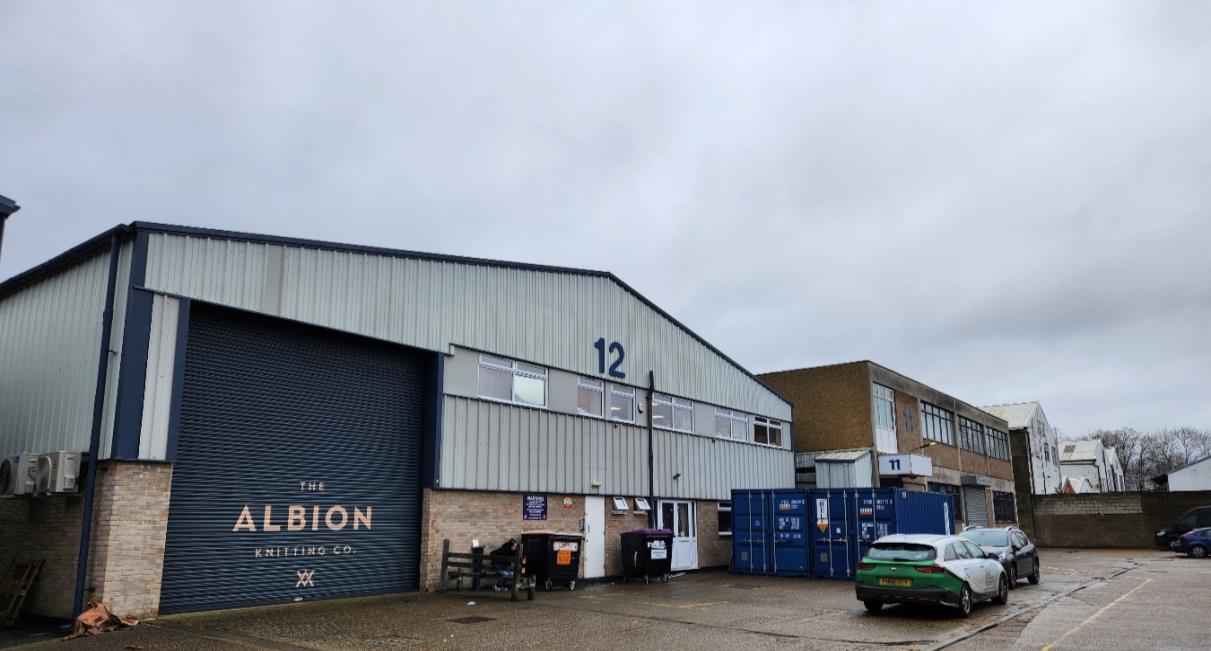
Unit 12, Crusader Industrial Estate, Hermitage Road, Harringay Warehouse District, London, N4 1LZ
Survey Date
14/02/2024
Site Address
Unit 12, Crusader Industrial Estate, Hermitage Road, Harringay Warehouse District, London, N4 1LZ
Report No.
S-74401
Report Date
26/02/2024
Assessors Name
Ioannis Katsifarakis MSc, AFOH
Authorised by
Chris Senior MBA, BSc, CoCa, CertOH, LFOH
## REVIEW DATE: February 2026
HEAD OFFICE Euro Environmental Ltd, Atlas 6, Balby Carr Bank, Doncaster, DN4 5JT Tel: 0870 7019170 Fax: 0870 7019171 www.euroenvironmental.co.uk
Version 12 (12/22) Page 2 of 27
CONTENTS EXECUTIVE SUMMARY
- 1. BACKGROUND
- 2. MATERIALS & METHODS
- 3. CURRENT LEGISLATION
- 4. RESULTS OF THE ASSESSMENT
- 5. DISCUSSION
- 6. CONCLUSION
- 7. DISCLAIMER
- APPENDIX A: PHOTOGRAPHIC EVIDENCE
- APPENDIX B: DOSE BADGE RESULTS
- APPENDIX C: GLOSSARY OF TERMS
- APPENDIX D: SHORT REFERENCE GUIDE TO LEGISLATION
- APPENDIX E: HEARING PROTECTION GUIDANCE
- APPENDIX F: COMMON NOISE REDUCTION SOLUTIONS
Ref: S-74401
Version 12 (12/22) Page 3 of 27
Ref: S-74401
## Executive Summary
As a part of their continuing commitment to comply with The Control of Noise at Work Regulations 2005 (CNWR), Albion Knitting Co Ltd requested Euro Environmental Ltd to carry out an assessment of occupational exposure to noise within their manufacturing facility on Hermitage Road in London.
The objectives of this exposure assessment were to quantify the levels of noise exposure in the workshop area, provide critical commentary on result alignment with The Control of Noise at Work Regulations (CNAWR) 2005, and offer recommendations to mitigate exceedances if present.
The noise assessment was undertaken according to the requirements of the Control of Noise at Work Regulations 2005 and relevant guidance. This was accomplished using precision sound analyser Pulsar Model 44, Class 2, serial number: PN1664, Acoustic Calibrator Model 106, serial number: 82967. Personal exposure was measured using Pulsar dose badges.
The monitoring results from the background and personal exposure assessments show that workers would not be exposed to daily personal exposure levels (LEP, d) above the lower action level of 80dB(A). However, with Peak Sound Pressure above the lower action value of 135dB, it is recommended that a hearing conservation program (see section 6.3) is implemented.
Mandatory hearing protection zones are not required to be implemented within the facility (noise levels above Upper Action Value of 85dB).
With Peak Sound Pressure above the Lower Action Value of 135dB at the washing and ironing area, hearing protection must be provided, however its usage is voluntary.
Employees would not be exposed to a “daily (LEP, d) or weekly (LEP,w) personal noise exposure level” at the Exposure Limit Value of 87 dB(A) or the peak sound pressure level of 140 dB(C) with the hearing protection provided. Though it would provide significant over-protection. See section 4.4 & 5 for further information.
To comply with The Control of Noise at Work Regulations 2005 it is recommended that the noise control measures suggested in this report are implemented.
Version 12 (12/22) Page 4 of 27
Ref: S-74401
## 1. Background
- 1.1 Company Background
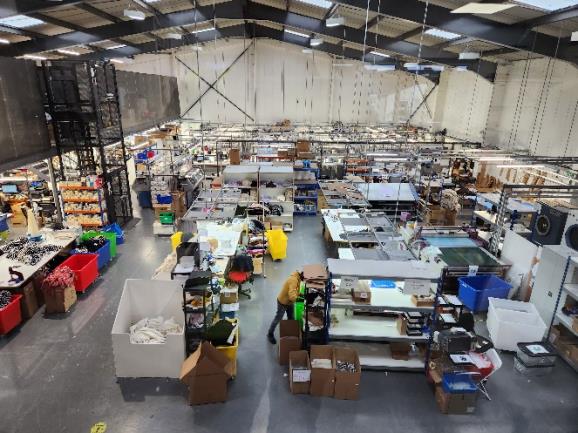
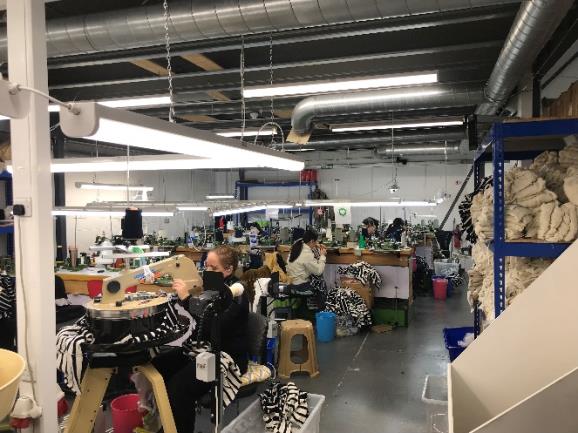
The Albion Knitting Co Ltd site is located on Hermitage Road and specialises in knitwear production. The site is an open plan workshop that consist of several working areas including the knitting department, the linking department, the hand sewing department, the quality control, and the area with the washing and drying machines.
- 1.2 Previous Assessments No formal previous assessments have been carried out at the site.
- 1.3 Working Shifts
The standard shift pattern for operatives working in the workshop is 8:30am – 5:30pm. All employees have breaks totalling approximately 90 minutes per shift. The results of the assessment are based on a 7.5 hour working day.
- 1.4 Noise Generating Activities
The main noise generating activities originate from the following activities / processes:
- 1. Operation of the knitting machines
- 2. Operation of the linking machines
- 3. Washing machines and dryers
- 1.5 Objectives
The objectives of this exposure assessment was to quantify the levels of noise exposure in the workshop area, provide critical commentary on result alignment with The Control of Noise at Work Regulations (CNAWR) 2005,
and offer recommendations to mitigate exceedances if present. The office / welfare areas were not included in this assessment. Version 12 (12/22) Page 5 of 27
Ref: S-74401
## 2. Materials And Methods
To achieve the objective of the assessment the following measurements were carried out:
- • Measure A/C-weighted average and C-weighted peak sound pressure levels
- • Octave band frequency analysis
Static measurements were taken at six [6] positions using precision sound analyser Pulsar Model 44, Class 2, serial number: PN1664, Acoustic calibrator Model 106, serial number: 82967. Five [5] personal exposures were measured using Pulsar dose badges.
The sound level meter was calibrated prior and after measurements at 94 dB and 1KHz frequency. The noise assessment was undertaken according to the requirements of the Control of Noise at Work Regulations 2005 and relevant guidance. The regulations specify the responsibilities of employers, employees, and machinery manufacturers in reducing the risk of hearing damage due to excessive noise at work.
Measurements of A-weighted sound pressure levels and C-weighted peak sound pressure levels were taken at the employees’ ear position, whilst they were carrying out typical work operations. The daily personal exposure was then calculated from the measured noise and the time the employee is likely to be exposed to noise. Additional measurements include C-weighted sound pressure levels and Octave band frequency analysis of selected exposures.
The information produced can more confidently be used as a base for an action plan to minimise the risk of exposure to excessive noise for occupants and maintenance operatives. Please note only the locations and activities described within this report will have been assessed during the site visit.
Version 12 (12/22) Page 6 of 27
Ref: S-74401
## 3. Legislation
The Control of Noise at Work Regulation (CNAWR) 2005 requires that an assessment of employee’s noise exposure is required, and such assessment shall be reviewed regularly.
It further requires: Identification of all employees exposed to a daily (or weekly) exposure level in excess of the Lower Action Value of 80 dB(A) or the Peak Action Value of 135 dB(C); identification of all employees exposed to daily (or weekly) exposure levels in excess of the Upper Action Value of 85 dB(A) or the Peak Action Value of 137 dB(C) ; identification of all employees exposed to daily (or weekly) exposure levels in excess of the Limit Value of 87 dB(A) or the Peak Limit Value of 140 dB(C).
Version 12 (12/22) Page 7 of 27
Ref: S-74401
## 4. RESULTS 4.1 Walk Through Observations
- 4.1.1 Knitting Department
The manufacturing facility is an open plan workshop. The process starts from the knitting department which is located at the far-right hand side of the facility. The knitting department consists of approximately 23 knitting machines. Typically, there are 2 operators working in this area. The operators are responsible for preparing the yarns and placing them into the machines’ tension mechanisms. The knitting process is automated and requires minimum supervision by the operatives.
- 4.1.2 Linking Department
The linking department is located at the far-left hand side of the facility. The linking department consists of approximately 32 circular linking machines. Within the linking department, the knitting technicians are responsible for joining the various garment pieces such as sleeves, collars, and panels together to create the final garment.
- 4.1.3 Hand Sewing Department
After linking, garments may undergo additional finishing touches which may include trimming excess threads, pressing the seams and preparing the garments for the next stage of production, such as washing, labelling, or packaging.
- 4.1.4 Quality Control
Quality control personnel are present to inspect the linked seams and overall construction of the garments. They ensure that the seams are strong, durable, and free from any defects or irregularities. Any garments that do not meet the quality standards are identified and rectified or rejected.
- 4.1.5 Washing and ironing
Garments are initially sorted based on their fabric type, colour and washing requirements. Then the garments are loaded into washing machines. Once garments are dry, they undergo ironing or pressing to remove wrinkles and creases. Garments are ironed using steam irons and pressing machines.
- 4.1.6 General Observations
- • The workshop areas were of a similar construction i.e solid brick / tin clad walls and metal framed apex ceilings above the quality, washing and ironing and knitting department and low ceilings above the linking and hand sewing department. No sound absorbent materials of any significance were observed.
- • The company provides 1 type of hearing protection (Honeywell Laserlite Disposable Earplugs SNR
35) which were readily available to all staff.
- • No current baseline or annual audiometry testing program is in place. No awareness training is provided to staff or management.
- • The management have not reported any issues of noise induced hearing loss from staff historically.
- • See appendix A for photographic evidence.
Version 12 (12/22) Page 8 of 27
## 4.2 Static Background Noise Results
Ref: S-74401
The static noise measurement ranges from 63 LEP, d at the hand sewing department to 78 LEP, d at the knitting department [see Table 1 below]
- Table 1: Static Noise Measurement
|Location / Activity|LAeq|LCeq|LCpeak|Daily Exp.|LEP,d dB(A)|
|---|---|---|---|---|---|
|Background / Quality Control Department|75.3|77.4|104.8|7.5 hrs|75|
|Background / Hand Sewing Department|63.4|66.9|84.9|7.5 hrs|63|
|Background / Washing and dryer machines|71.4|75.9|89.7|7.5 hrs|71|
|Washing and dryer machines - Ironing|72.5|75.6
|93|7.5 hrs|72|
|Background / Knitting Department|78.1|78.9|97.6|7.5 hrs|78|
|Background / Linking Department|68.1|73.3|89|7.5 hrs|68|
|Note: static measurements were taken over a representative 3 min duration in each location|Note: static measurements were taken over a representative 3 min duration in each location|Note: static measurements were taken over a representative 3 min duration in each location|Note: static measurements were taken over a representative 3 min duration in each location|Note: static measurements were taken over a representative 3 min duration in each location|Note: static measurements were taken over a representative 3 min duration in each location|
4.3 Personal Dose-badge Noise Results
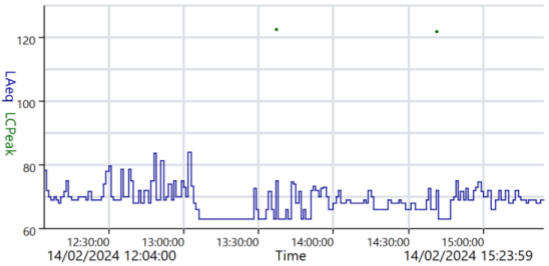
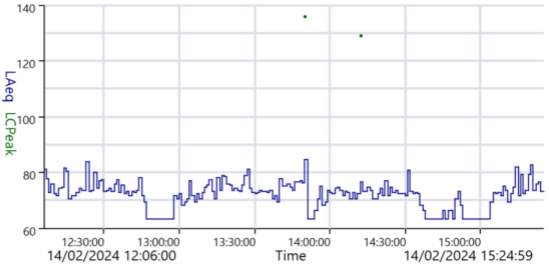
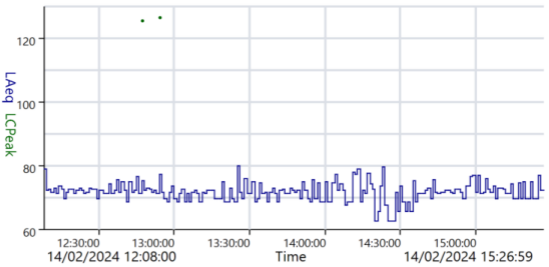
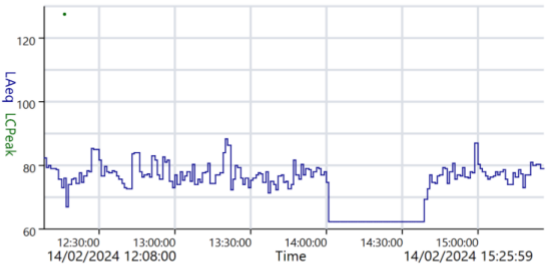
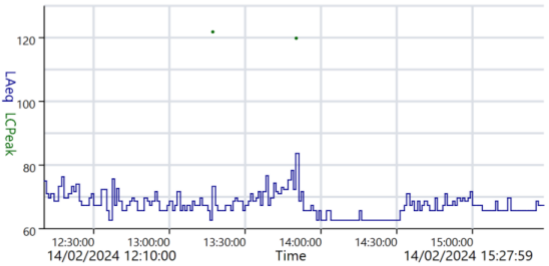
The personal noise exposure results range from 70 LEP, d by a worker at the hand sewing department to 78 LEP, d by a worker at the knitting department [ see Table 2 below], and appendix B for graphical details.
- Table 2: Personal Noise Exposure
|Name / Activity / Location|LAeq|LCpeak|LAeq Time|Daily Exp.|LEP,d dB(A)|
|---|---|---|---|---|---|
|Bernice Prabakar - Operator / Quality Control|71.8|122.4|200 min|7.5 hrs|72|
|Imola Szasz - Operative / Washing and Ironing|74.9|136.1|199 min|7.5 hrs|75|
|Niue Xinzng - Knitting Technician / Knitting Department|77.8|127.4|198 min|7.5 hrs|78|
|Zheng Yufang - Seamstress / Hand Sewing Department|70.2|122.0|198 min|7.5 hrs|70|
|Andrea Servan - Seamstress / Linking Department|73.0|126.5|199 min|7.5 hrs|73|
Version 12 (12/22) Page 9 of 27
Ref: S-74401
Noise level between the Lower and Upper Action Value 80-85 dB(A) or Peak sound pressure level between 135-137 dB(C).
Noise level at or above the Upper Action Value of 85 dB(A) or Peak sound pressure level at/or above 137 dB(C).
The daily personal exposure levels (total LEP, d) for employees are based on a standard 8 hour working shift. For greater hours the following corrections should be made to the LEP, d’s stated. The calculated values have been rounded up or down to the nearest whole number [ see Table 3 below]
The daily personal exposure levels (total LEP, d) for employees are based on a standard 8 hour working shift. For greater hours the following corrections should be made to the LEP, d’s stated. The calculated values have been rounded up or down to the nearest whole number [ see Table 3 below]
- Table 3: Normalization of cumulative noise exposure greater than 8hours.
|Hours worked|Add to LEP, d(dB)|
|---|---|
|9|+ 0.5|
|10|+ 1|
|12|+ 2|
4.4 Selection of suitable hearing protection
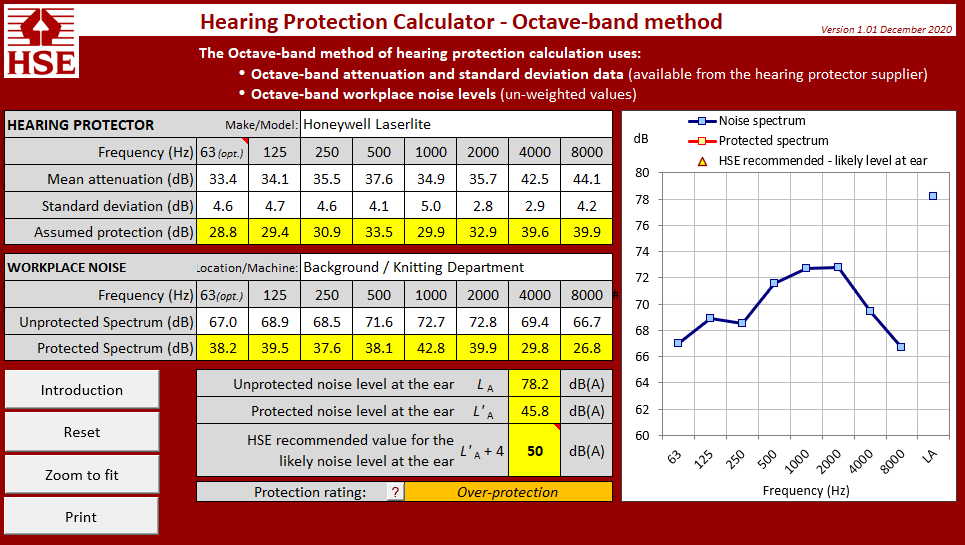
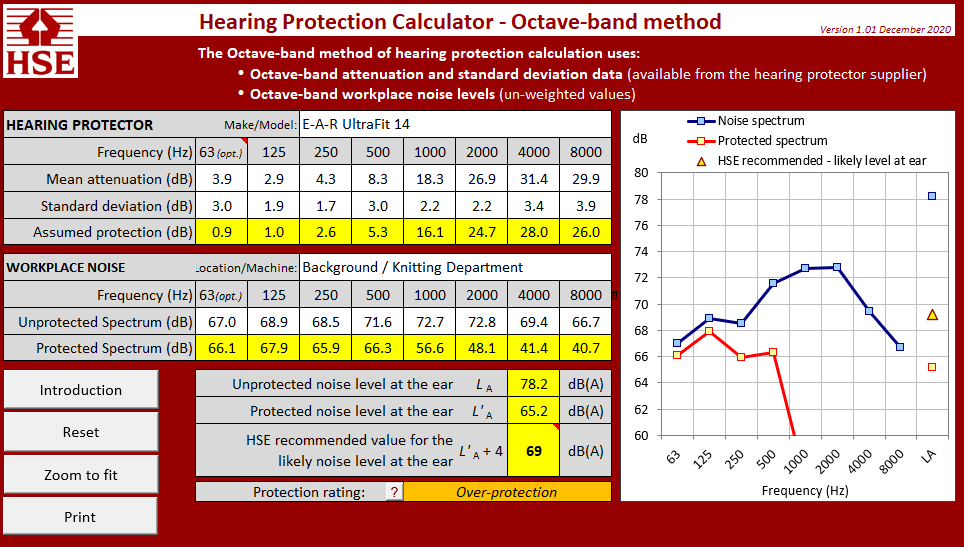
To enable selection of suitable hearing protection, an octave band analysis of area [Background / Knitting Department] with highest sound pressure level was measured [see Table 4]. Using the UK HSE hearing protection calculator, this was analysed together with octave band data of several hearing protections [see Tables 5 and 6, and Figures 1 & 2] until the E-A-R UltraFit 14 earplugs were found to provide a likely noise level at the ear closest to the HSE recommended value [see Figure 2, and Table 6].
- Table 4 - Octave Band Frequency Analysis Results
|Location / Activity|63 Hz|125 Hz
|250 Hz
|500 Hz
|1k Hz|2k Hz|4k Hz|8k Hz|
|---|---|---|---|---|---|---|---|---|
|Background / Knitting Department|67.0|68.9|68.5|71.6|72.7|72.8|69.4|66.7|
|Note: static measurements were taken over a representative 3 min duration in each location|Note: static measurements were taken over a representative 3 min duration in each location|Note: static measurements were taken over a representative 3 min duration in each location|Note: static measurements were taken over a representative 3 min duration in each location|Note: static measurements were taken over a representative 3 min duration in each location|Note: static measurements were taken over a representative 3 min duration in each location|Note: static measurements were taken over a representative 3 min duration in each location|Note: static measurements were taken over a representative 3 min duration in each location|Note: static measurements were taken over a representative 3 min duration in each location|
Version 12 (12/22) Page 10 of 27
Ref: S-74401
- Table 5 – Honeywell Laserlite Disposable Earplugs
|Honeywell Earplugs|63 Hz|125 Hz
|250 Hz
|500 Hz
|1k Hz|2k Hz|4k Hz|8k Hz|
|---|---|---|---|---|---|---|---|---|
|Mean Attenuation, dB|33.4|34.1|35.5|37.6|34.9|35.7|42.5|44.1|
|Standard Deviation, dB|4.6|4.7|4.6|4.1|5.0|2.8|2.9|4.2|
|Assumed Protection, dB|28.8|29.4|30.9|33.5|29.9|32.9|39.6|39.9|
|SNR = 35, HML = 34, 32, 31|SNR = 35, HML = 34, 32, 31|SNR = 35, HML = 34, 32, 31|SNR = 35, HML = 34, 32, 31|SNR = 35, HML = 34, 32, 31|SNR = 35, HML = 34, 32, 31|SNR = 35, HML = 34, 32, 31|SNR = 35, HML = 34, 32, 31|SNR = 35, HML = 34, 32, 31|
- Table 6 – E-A-R UltraFit 14 Earplugs
|E-A-R UltraFit 14 Earplugs|63 Hz|125 Hz
|250 Hz
|500 Hz
|1k Hz|2k Hz|4k Hz|8k Hz|
|---|---|---|---|---|---|---|---|---|
|Mean Attenuation, dB|3.9|2.9|4.3|8.3|18.3|26.9|31.4|29.9|
|Standard Deviation, dB|3.0|1.9|1.7|3.0|2.2|2.2|3.4|3.9|
|Assumed Protection, dB|0.9|1.0|2.6|5.3|16.1|24.7|28.0|26.0|
|SNR = 14, HML = 22, 10, 5|SNR = 14, HML = 22, 10, 5|SNR = 14, HML = 22, 10, 5|SNR = 14, HML = 22, 10, 5|SNR = 14, HML = 22, 10, 5|SNR = 14, HML = 22, 10, 5|SNR = 14, HML = 22, 10, 5|SNR = 14, HML = 22, 10, 5|SNR = 14, HML = 22, 10, 5|
Version 12 (12/22) Page 11 of 27
Ref: S-74401
- Figure 1 – Attenuation of Honeywell Laserlite Disposable Earplug
- Figure 2 – Attenuation of E-A-R UltraFit 14 Earplug
Version 12 (12/22) Page 12 of 27
Ref: S-74401
## 5. Discussion
The monitoring results from the background and personal exposure assessments show that workers would not be exposed to daily personal exposure levels (LEP, d) above the lower action level of 80dB(A). However, with Peak Sound Pressure above the lower action value of 135dB, it is recommended that a hearing conservation program (see section 6.3) is implemented and hearing protection remain available for voluntary use by staff. The static noise measurement ranges from 63 LEP, d at the hand sewing department to 78 LEP, d at the knitting department. The personal noise exposure results range from 70 LEP, d by a worker at the hand sewing department to 78 LEP, d by a worker at the knitting department.
Present hearing protections used in the facility include Honeywell Laserlite Earplugs. Attenuation of the hearing protection failed attenuation using the UK HSE hearing protection calculator as it was found to be an ‘OverProtection’. Which can reduce the wearers ability to hear warning signals or communicate. However, attenuation test using octave band data of the E-A-R UltraFit 14 Earplugs and the [Background / Knitting Department] was found to provide a likely noise level at the ear close to the HSE recommended value and therefore recommended for use in the facility. No hearing protection of a lower protection rating could be found, as such this latter hearing protection is chosen as the nearest to the best hearing protection rating, with only 1dB overprotection. This would be much better than the current hearing protection which provides 20dB overprotection.
Version 12 (12/22) Page 13 of 27
Ref: S-74401
## 6. Conclusion
The monitoring results from the background and personal exposure assessments show that workers would not be exposed to daily personal exposure levels (LEP, d) above the lower action level of 80dB(A). However, with Peak Sound Pressure above the lower action value of 135dB, it is recommended that a hearing conservation program (see section 6.3) is implemented. To ensure noise exposures are mitigated and workers are adequately protected, the following recommendations should be implemented.
## 6.1 Recommendations
- 1. Hear Protection Devices (HPD): The Honeywell Laserlite Earplugs should be discontinued. Workers should be provided with the E-A-R UltraFit 14 Earplugs [see Appendix E for further details on hearing protection devices].
- 2. Mandatory hearing protection zones are not required to be implemented within the facility (noise levels above Upper Action Value of 85dB).
With Peak Sound Pressure above the Lower Action Value of 135dB at the washing and ironing area, hearing protection must be provided, however its usage is voluntary.
- 3. Hearing Conservation Program (HCP)
To comply with The Control of Noise at Work Regulations 2005 a hearing conservation program (HCP) should be implemented and must include the following:
- - Assignment of responsibilities
- - Implementation of hearing protection zone and placement of signage
- - Action any controls to reduce sound levels
- - Hearing protection devices (HPD)
- - Health surveillance program (As per Regulation 9 of the Control of Noise at Work Regulations 2005, employees who work in areas with levels of 85dB and above must undergo health surveillance)
- - Staff and responsible person training
- - Ongoing record keeping
- - Inform employees of survey results
- 4. Workers should be informed of the outcome of noise assessment.
- 5. See appendix D for legislative guidelines on controls
Version 12 (12/22) Page 14 of 27
Ref: S-74401
## 7. Disclaimer
It is not always possible to assess noise levels emitted by some equipment especially for non-operational equipment during the assessment or areas where equipment is placed are inaccessible due to other reasons (e.g., biohazard zones, radiation zones etc.).
We try whenever practical to inform the client of areas which may give cause for concern, however, where buildings have undergone refurbishment or plant relocation there is always a risk that noise exposure levels might have become elevated above recommended exposure levels.
Any recommendations contained herein are based on information available at the time of writing, but we are unable to take account of future developments or changes in legislation. The interpretation or use of this report does not relieve the user of the responsibility of understanding the requirements of the appropriate legislation. All documentation relating to this assessment work will be retained by us for a minimum of 2 years. Further information can be obtained from Euro Environmental Limited, at the address detailed at the front of the report.
Version 12 (12/22) Page 15 of 27
Ref: S-74401
APPENDIX A (Photographic Evidence)
| | |
|---|---|
|Workshop|Knitting Department|
| | |
|Quality Control Department|Hand Sewing Department|
| | |
|Washing and Ironing Department|Washing and Ironing Department|
Version 12 (12/22) Page 16 of 27
Ref: S-74401
| | |
|---|---|
|Linking Department|Hearing Protection|
Version 12 (12/22) Page 17 of 27
APPENDIX B (Dose Badge Results)
Ref: S-74401
## doseBadge Measurements Report
Name Start Time End Time doseBadge Reader Bernice Prabakar 14/02/2024 12:04:00 14/02/2024 15:24:17
PB859 89469
LAeq LEX8 LAE LCPeak 71.8 dB 68.0 dB 112.5 dB 122.4 dB LZPeak --- Before
- Calibration 0.70 dB After
Name Start Time End Time doseBadge Reader
LAeq LEX8 LAE LCPeak
- Calibration 1.10 dB After
Imola Szasz 14/02/2024 12:06:00
14/02/2024 15:25:26
PB860 89469
74.9 dB 71.1 dB 115.6 dB 136.1 dB LZPeak --- Before Name Start Time End Time doseBadge Reader Andrea Servan 14/02/2024 12:08:00 14/02/2024 15:26:52
PB926 89469
LAeq LEX8 LAE LCPeak 73.0 dB 69.2 dB 113.6 dB 126.5 dB LZPeak --- Before Calibration 0.40 dB After Version 12 (12/22) Page 18 of 27
Ref: S-74401
Name Start Time End Time doseBadge Reader Niue Xinzng 14/02/2024 12:08:00 14/02/2024 15:26:10
PB864 89469
LAeq LEX8 LAE LCPeak
77.8 dB 74.0 dB 118.4 dB 127.4 dB
## LZPeak --- Before
Calibration 0.00 dB After Name Start Time End Time doseBadge Reader Zheng Yufang 14/02/2024 12:10:00 14/02/2024 15:27:45
PC045 89469
LAeq LEX8 LAE LCPeak 70.2 dB 66.3 dB 110.8 dB 122.0 dB LZPeak --- Before Calibration 0.30 dB After Version 12 (12/22) Page 19 of 27
APPENDIX C (Glossary of Terms)
Ref: S-74401
`A` Weighting
A Standard weighting of the audible frequencies designed to reflect the response of the human ear to noise
`C` Weighting
A Standard weighting of the audible frequencies used for the measurement C weighted sound pressure level
dB(A)
Decibels A weighted
dB(C)
Decibels C weighted
doseBadge
An instrument used for measurement of personal noise exposure
LAeq,t
Equivalent continuous sound pressure level. A measure of the average sound pressure level during a period of time, t, in decibels dB with `A` weighting. Used to assess how noisy a piece of equipment is when operating.
LAeq,t
Equivalent continuous sound pressure level. A measure of the average sound pressure level during a period of time, t, in decibels dB with `A` weighting. Used to assess how noisy a piece of equipment is when operating.
LCpeak
Peak Sound pressure level with `C` frequency weighting, maximum sound level recorded during measurement. It is used to assess impact noise generated by equipment.
Noise Graph
Visual representation of noise level an employee is exposed to over time. Sound Level Meter An instrument for measurement of various noise parameters
Total LEp,d
Personal daily exposure of an employee calculated from the partial daily exposures and time spend working on each individual task.
H,M,L
Noise attenuation performance of hearing protection for High, Medium, and Low frequency noise.
SNR
Simplified noise attenuation performance of hearing protection. Single number rating
Overload
Dosi-badge overload occurs when noise levels are measured outside of the monitoring device’s design capabilities for impulsive sound this is >140 dB
Version 12 (12/22) Page 20 of 27
## APPENDIX D (Short reference guide to legislation)
Ref: S-74401
### Regulation 5 – Assessment of the risk to health and safety created by exposure to noise at the workplace
The assessment should be reviewed and updated when circumstances change in the workplace which might alter the level of exposure (e.g. changes in the way employees or processes work, machinery is repositioned or new machinery is installed, etc). Where there have been no changes, a review of the risk assessment should be carried out every two years.
### Regulation 6 – Elimination or control of exposure to noise at the workplace
The organisation should ensure that the risk from exposure to noise for the employees is either eliminated at source or, where this is not reasonably practicable, reduced to as low a level as is reasonably practicable by means other than the provision of hearing protection.
Where employees are exposed to LEP,d ‘s and/or LEP,w ‘s at or above the Upper Exposure Value of 85 dB(A); the regulation states that the noise exposure shall be reduced to as low a level as reasonably practicable by establishing and implementing a programme of organisational and technical measures (e.g. acoustically separating noisy machinery or processes from employees, use of acoustic screens/ shields, implementing a low noise purchasing policy for new equipment). Primary noise reduction measures should not involve provision of hearing protectors.
### Regulation 7 – Hearing Protection
Personal hearing protection should only be used where there is a need to provide additional protection beyond what has been achieved through noise control measures under Regulation 6, and as an interim measure while developing those control measures. It should not be used as an alternative to controlling noise by technical and organisational means.
For employees who are likely to be exposed to LEP,d ‘s and/or LEP,w ‘s at or above the Lower Exposure Value, but below the Upper Exposure Action Value; hearing protectors must be supplied to those that request them, but the wearing of them is optional. If the assessment shows that the measured noise level is close to the Upper Action Value the situation should be treated as if the Upper Action Value was likely to be exceeded.
Within areas where the employees’ LEP,d , LEP,w have been identified as likely to exceed the Upper Action Value of 85 dB(A), hearing protectors must be worn. Such areas should be designated as Hearing Protection Zones and marked with the appropriate signage in accordance with the Health and Safety (Safety Signs and Signals) Regulations 1996.
No employees should be exposed to noise exceeding the Limit Value of 87 dB(A) or 140 dB(C). The limit value takes into account the hearing protection worn by an employee. When selecting appropriate hearing protection 4 dB should be always subtracted from the hearing protector’s protection factor to compensate for “real world” situation.
### Regulation 8 - Maintenance and Use of Equipment
The organisation should ensure that all noise control equipment and hearing protection is properly maintained. Periodical checks on implemented noise control measures should be made. Effectiveness of implemented control measures should be checked. All employees should make full and proper use of implemented control measures and hearing protection. Periodic checks on the use of hearing protection are recommended.
### Regulation 9 – Health Surveillance
As per Regulation 9 of the Control of Noise at Work Regulations 2005, any member of staff who is exposed to peak sound pressure levels at or above an upper exposure action (EAV) value i.e., ≥137dB(C) peak sound pressure level or ≥85dB(A), are subjected to occasional exposure at or above an EAV, exposed to levels of noise
Version 12 (12/22) Page 21 of 27
Ref: S-74401
above the upper action value, exposed to occasional noise levels above the EAV or where employee’s health may be at particular risk i.e., workers with pre-existing hearing loss etc. must be provided with suitable health surveillance, including hearing tests.
The purpose of health surveillance is to:
- • Warn you when employees might be suffering from early signs of hearing damage
- • Gives you the opportunity to do something to prevent the damage worsening
- • Check that control measures are working
If you require for further information or help with establishing a health surveillance monitoring regime, please do not hesitate to contact us.
## Regulation 10 – Information, Instruction and Training
To comply with the current Noise Regulations employers have a duty to inform and train those of theirs employees who are exposed to noise at or above the Lower Action Value of 80 dB(A) about the danger from exposure to excessive noise. Information given to employees should cover the following:
- • Likely exposure and the risk to hearing the noise creates
- • Actions that are being taken to control the risk
- • Where and how can employees obtain hearing protection and how to use it properly to ensure its full effectiveness
- • How to report defects to control measures and hearing protection
- • What are employees’ duties under The Control of Noise at Work Regulations 2005
- • What symptoms they should look out for (such as difficulty in understanding speech in conversation or when using the telephone, or permanent ringing in the ears
- • Collective results of health surveillance
We offer an e-learning course designed to cover all the regulatory requirements please visit the training academy section of our website for more information on noise awareness training:
http://www.euroenvironmental.co.uk/pages/noise-awareness-training
Version 12 (12/22) Page 22 of 27
Ref: S-74401
|Action Required|Below 80 dB(A)|80-85 dB(A) Up to 135 dB(C)|85 dB(A) 137 dB(C)|87 dB(A) 140 dB(C)|
|---|---|---|---|---|
|Regulation 5
A competent person should undertake an assessment of the risk from noise to health and safety of employees.
Assess the levels of noise to which workers are exposed, review the assessment at regular intervals and keep record of the assessment|●|●
●|●
●|●
●|
|Regulation 6
Eliminate the noise at source or reduce it to as low level as reasonably practicable
Reduce the level of noise by establishing and implementing a programme of organizational and technical measures, excluding provision of hearing protection.
Ensure that no employees are exposed above the limit value if anybody is exposed above this value reduce the noise|●|●|●
●|●
●|
|Regulation 7
Make personal hearing protectors available upon request to any employee who is exposed
Provide hearing protection, make it compulsory and establish hearing protection zones| |●|●|●|
|Regulation 8
Ensure full and proper use of all control measures including hearing protection| |●|●|●|
|Regulation 9
All employees identified as being at risk should be provided with health surveillance including audiometric testing and keep the records| |●|●|●|
|Regulation 10
Provide adequate information, instruction, and training to employees about the likely noise exposure, control measures, health surveillance and use of hearing protection.| |●|●|●|
Version 12 (12/22) Page 23 of 27
Ref: S-74401
## APPENDIX E (Hearing Protection Device Guidance)
The hearing protection provided should reduce the noise level at the ear to below 85dB(A) but should not reduce the noise level to below 70dB(A) as attenuation to levels lower than this can cause other risks to be introduced.
Based on the octave band frequency analysis data collected hearing protection should be selected using the HSE’s hearing protection calculator:
https://www.hse.gov.uk/noise/hearingcalc.xlsm
### Wearer comfort and preference
Individuals differ in what they find comfortable. Some people prefer earplugs in hot environments, but others find any earplug extremely uncomfortable and prefer earmuffs. Wherever possible you should make more than one type of protector available (making sure that each is suitable for the noise and the jobs to be done) to allow the user a personal choice.
All protectors are likely to be somewhat uncomfortable, especially in hot, humid conditions. Therefore, choose hearing protection that is sufficient to control the risk, does not over protect and is reasonably comfortable to wear.
### Compatibility with other safety equipment
When selecting hearing protectors you should take account of any other personal protective equipment that the user must wear which may impair the performance of the hearing protectors you have selected. Particular examples are the use of safety glasses or goggles, the frame or band of which may interfere with earmuff seals and reduce the protection offered. Where there is a need to wear hearing protectors in combination with helmets or face-shields, space may be limited and earplugs or low-mass earmuffs may be preferred.
### Medical disorders
Part of the selection process for hearing protectors includes finding out whether the user has any medical disorder that could influence the selection. Medical disorders can mean any type of earache, irritation of the ear canal, discharge, hearing loss, or any type of ear disease or skin disorder. Where you have employees who have any such medical disorders you should seek medical advice regarding the suitability of hearing protection provided.
Version 12 (12/22) Page 24 of 27
Ref: S-74401
|Type|Description|Advantages|Notes on suitability and use|Care and maintenance|
|---|---|---|---|---|
|Earmuffs|Hard plastic cups which fit over and surround the ears, and are sealed to the head by cushion seals filled with a soft plastic foam or a viscous liquid. Tension to assist the seal is provided by a headband. The inner surfaces of the cups are covered with a soundabsorbing material, usually a soft plastic foam. Available in a range of sizes.|Easy to fit and use. Clearly visible therefore, easily monitored.|Headband can prevent use of a hard hat. Headband can be worn behind the neck or under the chin if an underhat support strap is provided. However, the protection offered may be reduced. May not be suited for use with safety glasses and other forms of personal protective equipment (check compatibility). May be uncomfortable in warm conditions. Long hair, beards and jewellery may interfere with seals and reduce protection.|Check seals for cleanliness, hardening, tearing and misshape. Check cup condition for cracks, holes, damage and unofficial modifications. Avoid over bending or twisting headband, which may degrade performance. Check tension of headband (compare with a new earmuff). Store in a clean environment. Follow manufacturer’s instructions.
|
|Earplugs|Earplugs fit into the ear or cover the ear canal to form a seal. They sometimes have a cord or a neckband to prevent loss. Some plugs are reusable and others are designed to be disposed of after one use
– check manufacturer’s instructions. Available in different sizes|Suited for use with safety glasses and other forms of personal protective equipment.
|Can be hard to fit – will only be effective when fitted properly so correct fitting is essential. See manufacturer’s instructions and provide training. Difficult to check correct fit by observation. Can work loose over time, so allow for refitting in a quiet environment every hour. May not be suitable where the hearing protection is likely to be removed often, particularly in dusty or dirty environments. May not be suitable for certain individuals due to medical conditions.|Clean reusable plugs regularly and ensure they are not damaged or degraded
– follow manufacturer’s instructions. Disposable earplugs should only be used once. Hands should be clean when fitting earplugs. Reusable plugs should be issued to an individual and not shared. Ensure adequate supplies of disposable earplugs. Follow manufacturer’s instructions.|
Version 12 (12/22) Page 25 of 27
APPENDIX F (Common Noise Reduction Solutions)
Ref: S-74401
Substitution
• Replacing electric tools with pneumatic alternatives
• Using presses rather than hammers
• Using belt conveyors rather than hammers
• Using hydraulic presses instead mechanical
• Using helical spurs in gear teeth
• Replacing gear drives with belt drives
• Replacing solid wheels with pneumatic tyres
• Welding instead of riveting
Modification
• Remote controlling noisy equipment
• Layout modification to separate noisy and non-noisy areas
• Change from impact pressure to progressive
• Reduce drop heights
• Modify linings of tumbling barrels using cork or rubber
• Avoid resonance effects by changing rotational speeds to avoid coincidence with supporting structures
• Replace solid panel guides with perforated guides
• Change air jet nozzles to noise reducing compound nozzles
• Add flexible couplings to pipework to reduce vibration noise
Other engineering controls
• Install acoustic wall or enclosure blankets
• Install sound absorbing ceiling tiles
• Add isolation mounts to equipment to reduce vibration
• Add silencers to engine exhaust pipes
• Insulate pipes with high velocity fluid flows
• Use large / slower cooling fans in motors
• Regularly replace worn parts that might lead to excessive vibration
• Ensure any rotating equipment is correctly balanced
• Maintain good levels of mechanical lubrication
• Ensure cutting tools remain sharp
Version 12 (12/22) Page 26 of 27
Version 12 (12/22)
Page 27 of 27
---
*Data sourced from the Isle of Man public planning register under the [Isle of Man Open Government Licence](https://www.gov.im/about-this-site/open-government-licence/).*
*Canonical page: https://planningportal.im/a/33062-malew-barrule-house-extension/documents/1578027*