**Document:** Arboricultural Method Statement AMS-100723
**Application:** 23/10089/AIR — Information in relation to condition 2 for PA 22/01295/GB & 22/01310/CON for Arboricultural Method Statement with associated site plans.
**Decision:** Permitted
**Decision Date:** 2023-08-24
**Parish:** Michael
**Document Type:** report / tree_report
**Source:** https://planningportal.im/a/27290-kirk-michael-holly-lodge/documents/1577868
---
# Arboricultural Method Statement AMS-100723
|Manx Roots Limited, 78 Greenlands Ave, Ramsey, Isle of Man, IM8 2PH T: 07624 259720 | E: ben@trees.im | W: https://trees.im
July 2023
Arboricultural Method Statement
for
The Refectory and Cottage, Bishopscourt
(Approved developments 22/01295/GB & 22/01296/GB)
|Site Address:|Bishopscourt, Kirk Michael|Bishopscourt, Kirk Michael|Bishopscourt, Kirk Michael|Bishopscourt, Kirk Michael|
|---|---|---|---|---|
|Client Name:|Bell Burton Associates|Bell Burton Associates|Bell Burton Associates|Bell Burton Associates|
|Document Ref:|AMS-100723|AMS-100723|Consultant:|Andrew Igoea
BSc (Hons), MArborA|
|Report Date:|10/07/23|10/07/23|Document Checked by:
|Ben Brooker
L4DipArb, TechArborA|
|Signed on behalf of Manx Roots Ltd.
| |Ben Brooker, Managing Director|Ben Brooker, Managing Director|Ben Brooker, Managing Director|
|
|---|
## Summary
The following document and its supporting plans provide details of the position and specification of tree protection measures to be implemented during planned construction work at the Refectory and Cottage, Bishopscourt.
The approved developments are in close proximity to retained trees. To ensure that damage to these trees is minimised, a condition of the planning approval is that an arboricultural method statement is produced prior to the commencement of the development.
Several Construction Exclusion Zones (CEZs) will be implemented across the site during the works. Timber post and rail fencing will be used to form a physical barrier to the CEZs, where required. Within the CEZs no access will be permitted for any construction activity. A restricted working zone will also be implemented where a boundary wall is planned to be (re-)constructed close to a large, retained sycamore tree. Temporary ground protection will also be used to reduce compaction of the soil environment adjacent to a new detached garage.
The correct implementation and on-going monitoring of protection measures throughout the development process will be critical for the successful retention of existing trees on the site. To ensure this happens it is important that the roles and responsibilities of key stakeholders are clearly defined and communicated, and that visits by the project arboriculturist occur at regular intervals. These details are provided in part 2 of the document.
## Contents
- 1. Instruction 4
- 2. Scope 4
- 3. Context 5
- PART 1: Tree Protection Measures 6
4. Fencing and Exclusion Zones 6 5. Activity within Construction Exclusion Zones 8 6. Restricted Working Zones 8 7. Temporary Ground Protection 10
- PART 2: Arboricultural Site Monitoring 11
- 8. Roles and Responsibilities 11
- 9. Sequence of Works 11
- 10. Arboricultural Monitoring 11
The following documents form part of this report but are provided as separate documents:
|Document name|Reference number|Information|
|---|---|---|
|Tree Protection Plan – Overview|TP-100723|PDF; Scale 1:500@A3|
|Tree Protection Plan – Detail, South|TP-100723-DS|PDF; Scale 1:250@A3|
|Tree Protection Plan – Detail, North|TP-100723-DN|PDF; Scale 1:250@A3|
The drawings, plans and maps associated with this report are intended for tree identification purposes only and must not be used as construction specifications.
### 1. Instruction
- 1.1. Manx Roots Limited was instructed by Bell Burton Associates to produce an Arboricultural Method Statement (AMS) to ensure that retained trees are protected throughout construction works due to take place at the Refectory and Cottage, Bishopscourt. Submission of the AMS document to the planning authority will discharge condition 2 of planning approval 22/01295/GB and condition 2 of planning approval 22/01296/GB.
- 2. Scope
- 2.1.In both planning approvals, Condition 2 is worded as follows: Prior to the commencement of…. [description of approved works], an Arboricultural Method Statement (AMS), adhering to the recommendations of BS5837:2012 (Trees in relation to design, demolition and construction - recommendations), shall be submitted to and approved in writing by the Department. The AMS should address:
- (a) The specification of the protective fencing to be used
- (b) Removal of existing structures and hard surfacing
- (c) The installation of temporary ground protection
- (d) The installation of new hard surfacing (materials, design constraints and implications for levels)
- (e) Retaining structures to facilitate changes in ground levels
- (f) Preparatory works for new landscaping
- (g) How the project arboriculturist and/or construction manager will carry out arboricultural site monitoring, including a schedule of specific site events requiring input or inspection The agreed protection measures and construction methods shall be adhered to in full. Reason: to provide a level of technical detail sufficient to provide a high level of confidence in the outcome for retained trees on the site
- 2.2.To adhere to the recommendations of BS5837:2012, the AMS should cover two topics:
- • The protection measures to be implemented.
- • The arboricultural site monitoring to take place throughout the construction phase.
### 3. Context
- 3.1. Details relating to individual trees within the site can be found in the associated Arboricultural Impact Assessment (AIA) documents, AIA-230622revE and AIA-220622-revC, both dated May 2023, and submitted as part of the planning application for the development.
- 3.2. The protection details specified in this AMS align with details of the protection measures which were outlined in the AIA submitted to the planning authority prior to determination of the applications. Incursions into the root protection areas of retained trees and their expected impact on tree health and longevity were documented in the AIA and deemed to be acceptable by the planning authority. Whilst this AMS therefore acknowledges and complies with the recommendations of British Standard BS5837:2012 (Trees in relation to design, demolition and construction – Recommendations) wherever possible, it should also be acknowledged that the protection of retained trees is just one of several competing objectives for the development of site. As a result, tree roots and soil structure will not always be treated as a priority within the RPA of retained trees.
- 3.3. This AMS relates entirely to the protection of the retained trees and must not be read as a definitive engineering or construction method statement.
|PART 1: Tree Protection Measures|
|---|
### 4. Fencing and Exclusion Zones
- 4.1. Construction Exclusion Zones (CEZs) will be implemented during the construction process as shown in the accompanying drawings, TS-100723, TS-100723-DN and TS-100723-DS.
- 4.2. The CEZs will be activated/deactivated in accordance with an agreed schedule of works – please see Part 2 for details.
- 4.3. Protective fencing will be erected at the boundary of CEZ areas, in accordance with the supporting tree protection drawings.
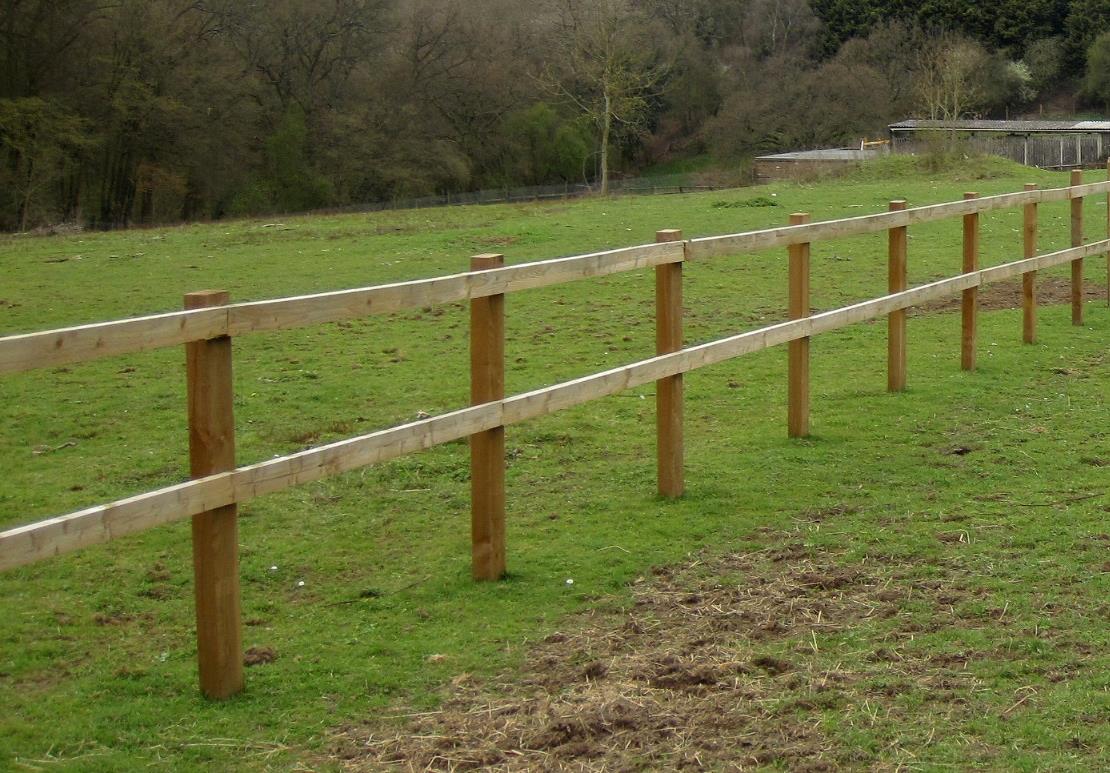
- 4.4. Protective fencing will consist of 2x 75mm wide timber rails fixed to 1.8m x 75mm x 75mm timber posts, which will be driven into the ground (not concreted). The distance between posts will vary, depending on the ground conditions, but will be no more than 2m. Each post will be driven into the ground by approximately 300mm to leave a 1.5m of post above ground level. The top rail will be at least 1.3m above ground level. The top edge of the bottom rail will be at least 300mm from the top rail. The fencing will look similar to that shown in below in Figure 1.
Figure 1. An example of how the protective fencing will look when erected.
- 4.5. All weather notices will be attached to the fence at maximum intervals of 6m, clearly displaying words such as CONSTRUCTION EXCLUSION ZONE – NO ACCESS.
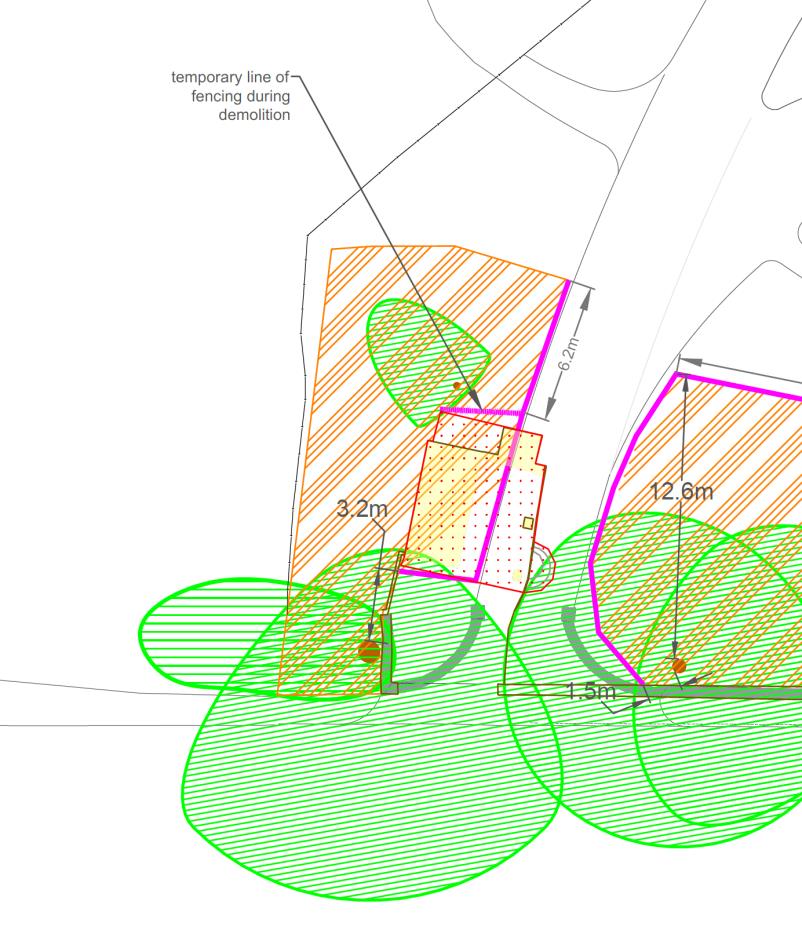
- 4.6. A line of protective fencing will be erected along the southern edge of the new driveway, as shown in drawing TP-100723-DS (see extract in figure 2 below). As the full length of fencing cannot be erected here until the old garage has been demolished, a shorter, temporary line of fencing will be used to protect the base of the elder tree during demolition. Once demolition is complete the remaining fencing will be erected.
Figure 2. Extract from drawing TP-100723-DS showing the fencing that will be erected before and after the existing garage is demolished.
- 4.7. Other than the section of fencing discussed in paragraph 4.6 above, all protective fencing will be fully installed prior to any construction activity commencing and will remain in place and fully effective until the construction of the dwelling is complete.
- 4.8. The exact location of the protective fencing will be determined on site using measurements from known points – see dimensions on supporting drawings for details.
- 4.9. Other than for the specific activity described in section 5 below, within the CEZ there will be no
access of any kind for construction related activities. Nothing will be stored, placed or disposed of above or below ground, the ground level will not be altered, no excavations will be made, nor will any fires be lit.
### 5. Activity within Construction Exclusion Zones
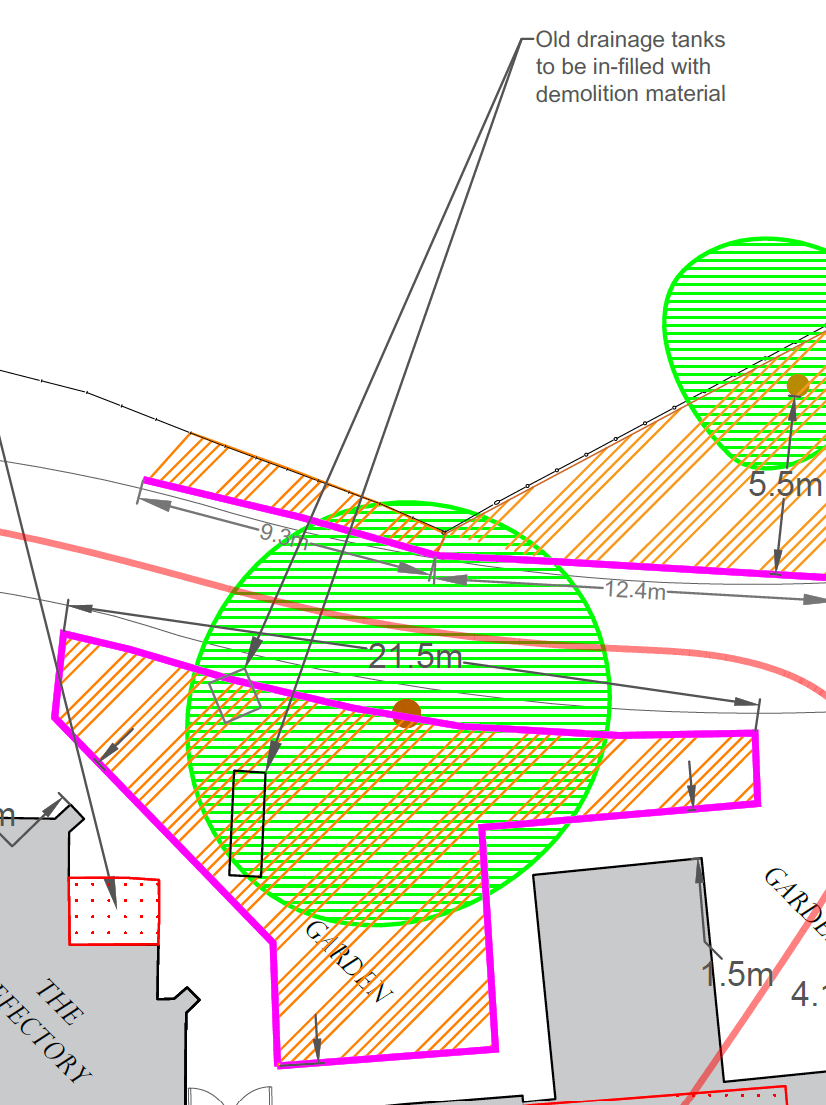
5.1.To the North of the Refectory building there are two redundant masonry drainage tanks within the proposed CEZ. To avoid excavation, these tanks will not be removed. Instead, three to four courses of brick will be removed below ground level and the tanks backfilled, using demolition material, to the top of the remaining masonry. Topsoil will be used to backfill the remaining hole and be graded to the surrounding ground level.
Figure 3. Extract from drawing TP-100723-DN showing the redundant drainage tanks that are located inside the proposed CEZ.
### 6. Restricted Working Zones
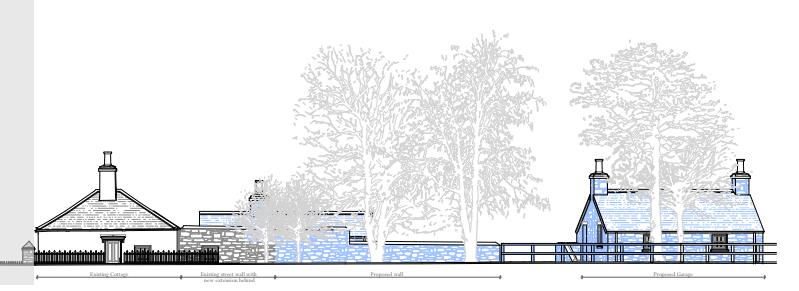
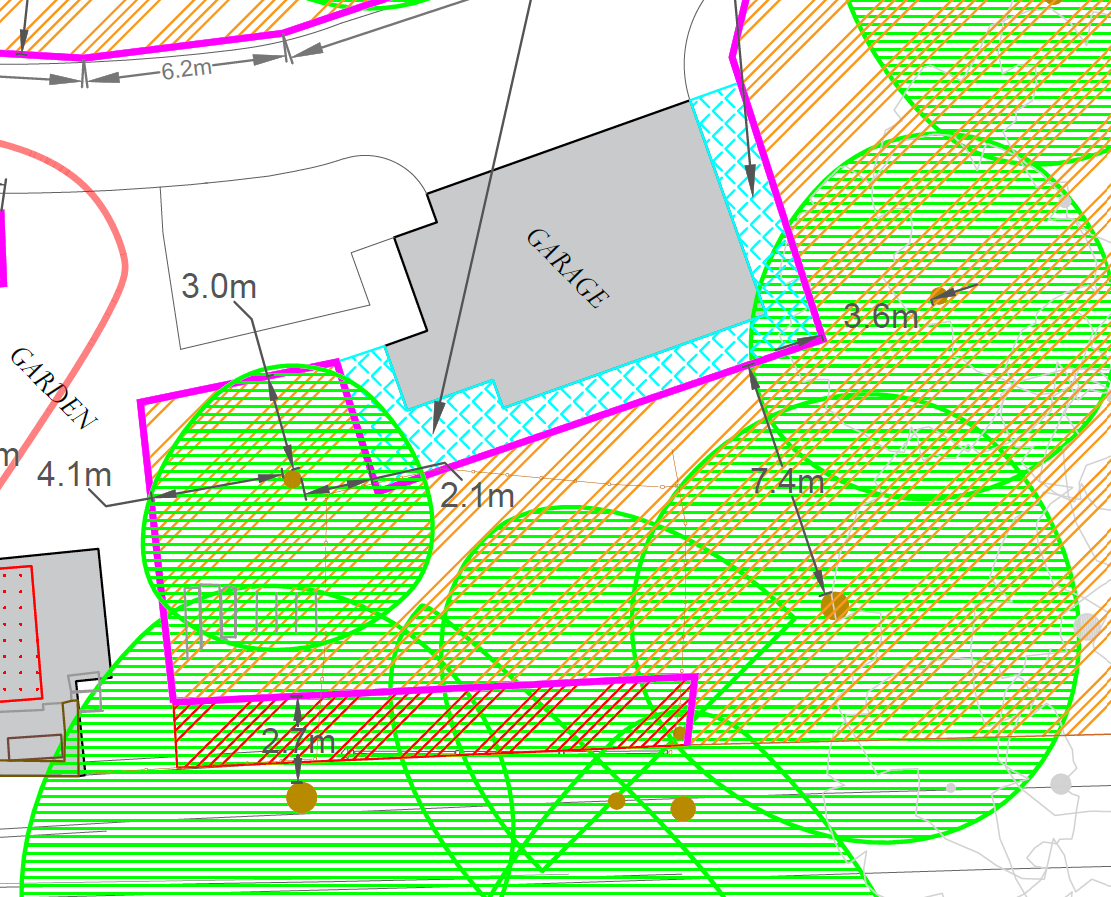
6.1.To the North of the Cottage and East of the proposed garage, adjacent to the highway, drawing TP-100723-DN shows an area of restricted access (see extract in figure 5 below). Figure 4 below
is an extract of the proposed street elevation drawing that was submitted to planning. It shows that the boundary wall will be rebuilt and extended. To minimise damage to the adjacent retained tree (visible in figure 5) no mechanical excavation will take place in this zone. Construction of the wall will be closely monitored by the Project Arboriculturist (see part 2 for details).
- Figure 4. Extract from drawing 6296 PLC21-A, drawn by Adam Architecture.
- Figure 5. Extract from drawing TP-100723-DN showing a restricted working zone adjacent to the highway (hatched red).
### 7. Temporary Ground Protection
- 7.1.To minimise compaction caused by frequent pedestrian traffic, temporary ground protection will be placed around part of the footprint of the proposed garage, as shown in Figure 5 above.
- 7.2.The temporary ground protection will be installed after the foundations for the structure have been excavated and the walls have been constructed above the surrounding ground level,
- 7.3.Temporary ground protection will consist of ¾” plywood boards placed over a minimum of 150mm of woodchip. A permeable geotextile may be placed at ground level (underneath the woodchip) to prevent mixing.
|PART 2: Arboricultural Site Monitoring|
|---|
### 8. Roles and Responsibilities
- 8.1. To ensure that the proposed protection measures are implemented in accordance with this method statement and any related planning conditions, it is important to identify who will fulfil what role, and to understand the responsibilities of each role. Table 1 below identifies the key role and responsibilities for this project.
- 8.2. Effective communication between the people fulfilling the roles identified in Table 1 is critical.
- 8.3. If there are changes in the personnel appointed to any of the roles identified in Table 1 all parties must be informed within 48 hours.
### 9. Sequence of Works
- 9.1. Table 2 outlines the approximate sequence of works expected during the construction process and shows when tree protection measures will be installed, monitored and removed.
- 9.2. The indicative programme of works shown in table 2 will be reviewed at a pre-commencement meeting (see paragraph 10.1 below) and will remain under periodic review by the PM/SM throughout the project. Progress through, and amendments to, the programme of works will be communicated to the PA by the PM so that the timing and frequency of arboricultural input and site visits can be adjusted accordingly.
### 10. Arboricultural Monitoring
###### 10.1. Prior to commencement
- 10.1.1. A pre-commencement meeting is a vital event at which all the people fulfilling the roles identified in Table 1 must be present. All tree related matters will be discussed, including the contents of this AMS, the proposed sequence/programme of works, and the frequency of visits required to undertake monitoring.
- 10.1.2. The pre-commencement meeting will be documented by the appointed Project Arboriculturist (PA) and a record of the meeting sent to all those in attendance via email within 48 hours.
###### 10.2. During the construction phase
- 10.2.1. Site visits will be made in conjunction with the sequence of works and their frequency determined by the programme of works and/or ongoing correspondence which identifies the need for additional visits.
- 10.2.2. Details of each visit will be sent to all relevant parties via email within 48 hours, including the date and time on which the visit was made; with whom the PA met and the details of those conversations; comments on the location, specification and condition of the specified tree protection measures, and details of any instances where the tree protection specifications outlined above in part 1 of this document are not being met; details of action(s) required to rectify non-compliance, including who is responsible and the deadline for undertaking the required action; and, timescales for a follow-up site visit if required.
- 10.2.3. No deviations will be made to the tree protection measures specified in part 1 of this document without the prior agreement of the PA.
###### 10.3. Procedure for non-compliance
- 10.3.1. Any deviation from the specified protection measures, observed by the PA during a site visit, will be brought to the attention of the relevant parties via email and copied to the Department of Environment, Food and Agriculture (DEFA) for their records.
- 10.3.2. If, during the follow-up site visit, any action(s) required to rectify non-compliance has not been taken, the project manager will be informed within 48 hours by email and copied to DEFA for their records.
- 10.3.3. If the action(s) detailed in the most recent email are not resolved within the specified deadline, the PA has the right to withdraw his or her services until satisfactory steps have been taken to address the issue(s).
###### 10.4. Following completion of the construction phase
- 10.4.1. Following completion of the main construction phase, but before the development is ‘complete’, some soft landscaping (i.e. tree planting) will be required within the defined CEZs. Prior to any soft landscaping operations being undertaken a precommencement meeting will take place between the PA and site manager (or the appointed landscape contractor, if different) to discuss potential tree protection issues and the need for additional/amended protection measures and ongoing arboricultural supervision.
- 10.4.2. Tree Protection measures will remain in situ throughout the soft landscaping works. Access points may be created through temporary barriers as required, under the
guidance of the PA, who will document the amendments via the process outlined above.
###### 10.5. Following completion of the development
- 10.5.1. Following completion of all development-related activity and prior to the removal of any tree protection measures, the project manager will invite the PA to conduct the final site visit.
- 10.5.2. This visit will aim to identify any damage caused to the retained trees or any noticeable deterioration in tree condition. The visit will also aim to identify any obvious risks posed by the trees and the requirement for remedial works.
- 10.5.3. Once the final site visit has been made, the PA will request that all remaining tree protection measures are removed. This will mark the end of the arboricultural monitoring process.
###### Table 1. Definitions of key roles and responsibilities for this project
|Project Manager (PM)|Site Manager (SM)|Project Arboriculturist (PA)|
|---|---|---|
|Appoint a PA and Site Manager SM to oversee compliance with the following method statement.|Communicate the required specification for construction methods and tree protection measures to all direct labour, contractors and subcontractors working on the site|Check that works are progressed in the sequence specified in the agreed sequence of works, monitor the implementation of the specified protection measures, and provide advice to the PM/SM during the construction phase if unforeseen conflict between development operations and arboricultural constraints occurs.|
|Circulate a list of key personnel and their contact details between all parties to facilitate communication relating to tree protection issues.|Communicate any foreseeable deviations from the agreed protection method statement to the PM and PA prior to it occurring, or immediately after if unforeseen.|Inform the PM of any deviation from the agreed tree protection specification.|
|Overall responsibility for ensuring that contractors and subcontractors comply with site policies and the requirements of this tree protection plan and method statement.|Liaise and co-ordinate with the PM and contractors for the agreed sequence of works.|Attend site at pre-agreed intervals and directly supervise development operations where there is an elevated risk of damaging occurring to retained trees on the site.|
|Ensure that all the equipment and materials required to implement the protection plan are available, and to provide any additional equipment and materials that might be required as the project progresses.|Provide copies of all relevant site safety policies and risk assessments to the PA for the works so that they may conduct their site visits in a safe manner.|Maintain and share records of site visits and related correspondence with the PM, SM, and any other relevant party|
###### (Table 1. Continued)
|Co-ordinate with the SM and PA to ensure the safe and proper execution of the works.|Responsible for periodically checking the tree protection measures in between PA site visits and will advise the PM and PA of any deviation from the agreed tree protection specification.| |
|---|---|---|
|Responsible for providing the PA with an up-to-date programme of works, specifically in relation to the sequence of works, so that site visits can be arranged.| | |
|Inform the Planning Authority of any deviation from the agreed tree protection specification| | |
July 2023 AMS-100723 Page 16 of 16
- Table 2. Draft sequence of works showing the approximate timing of visits/input from the Project Arboriculturist (PA) (rows highlighted green).
Approved Tree removal takes place. Pre-commencement Meeting held with Project Manager (PM), Site Manager (SM) and Project Arboriculturist (PA) CEZs become live. Temporary protective fencing and site hoarding is erected as per specification and relevant drawings PA visits to inspect fencing Meeting held between PA and Demolition Contractor Demolition work takes place Additional section of temporary protective fencing erected over footprint of old garage PA visits to inspect fencing Backfill redundant drainage tanks Strip vegetation from areas of proposed construction Excavations for new foundations Construction of garage walls to above ground level Installation of temporary ground protection around back of garage PA visits to Inspect temporary ground protection and fencing Construction to roof level Erection of scaffolding
Roof works
Installation of new windows
Repair of existing structures
Internal works
External works (decoration and guttering) Onsite meeting to discuss construction of boundary wall Construction of boundary wall – frequent monitoring by PA to take place (multiple visits) Other elements of approved landscaping take place Remaining plant, equipment and materials removed from site PA makes final visit Remaining CEZ areas are deactivated, and protective fencing is removed
##### End
---
*Data sourced from the Isle of Man public planning register under the [Isle of Man Open Government Licence](https://www.gov.im/about-this-site/open-government-licence/).*
*Canonical page: https://planningportal.im/a/27290-kirk-michael-holly-lodge/documents/1577868*