**Document:** APL Manx Bat Group Survey
**Application:** 24/10089/AIR — Information in relation to condition 2 of PA 23/01029/B in relation to bat surveys
**Decision:** Permitted
**Decision Date:** 2024-09-06
**Parish:** German
**Document Type:** report / bat_report
**Source:** https://planningportal.im/a/33050-glen-maye-waterfall-hotel/documents/1071963
---
# APL Manx Bat Group Survey
|Waterfall Hotel, Glen Maye; Report on a bat survey w.r.t. PA 23/01029/B.
- report commissioned by Mr D Reid, Fraser Reid Design Limited, by email on 18th July 2024
|
|---|
Report compiled 05/08/2024
### Quality Assurance
The author holds a Manx Bat License, previously held a UK Bat Roost Visitor’s License and has 40 years experience studying bats in both the Isle of Man and the United Kingdom.
This report has been prepared following the Bat Conservation Trust’s guidelines contained in Bat Surveys for Professional Ecologists: Good Practice Guidelines (4th ed). However, night vision equipment was not used on this survey as visibility was sufficient to observe emerging bats for up to an hour after sunset.
|CONTENTS|CONTENTS|
|---|---|
|Summary|2|
|Introduction|2|
|Methods|2|
|Results|2|
|Evaluation|4|
|Impact Assessment|4|
|Caveats|4|
|Appendix I: Mitigations|4|
### Summary
No bats were seen to emerge from the property during a one-hour emergence watch and only two potential roost features were noted, in the form of a missing slate and some raised slates, which offered only limited access.
Introduction: A bat survey was required as a condition of approval of PA 23/01029/B. Methods:
Three members of the Manx Bat Group attended on the evening of 1st August 2024 to inspect the property and assess its suitability for roosting bats. An emergence watch was conducted for one hour from sunset.
### Results:
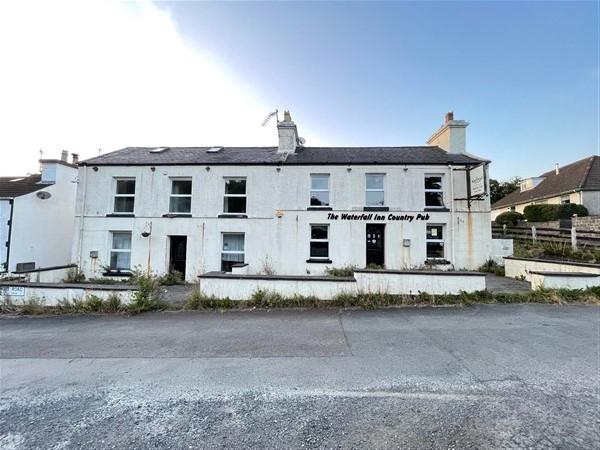
The building (Photo A) is rendered and painted with no visible cracks in any walls and no potential access points behind soffits.
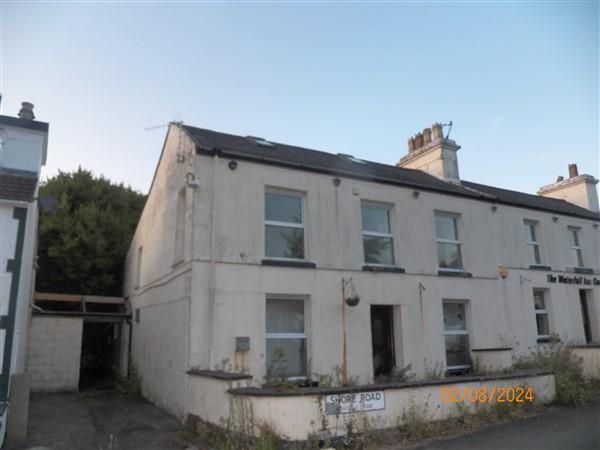
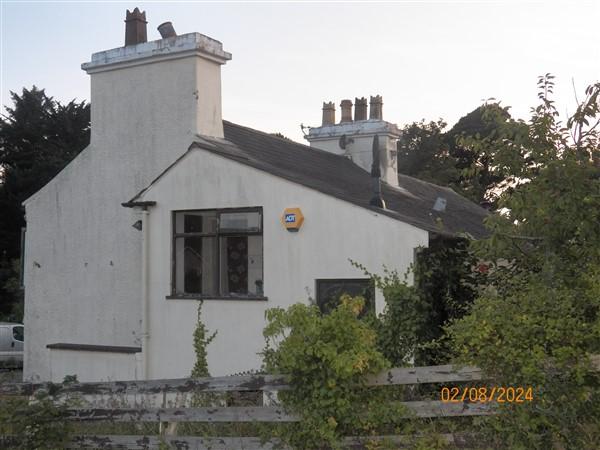
The windows and doors on the front elevation and west gable (Photo B) are all relatively new with the frames well sealed. The windows and door on the east gable external extension (Photo C) are not quite so new but are also well sealed with no external gaps.
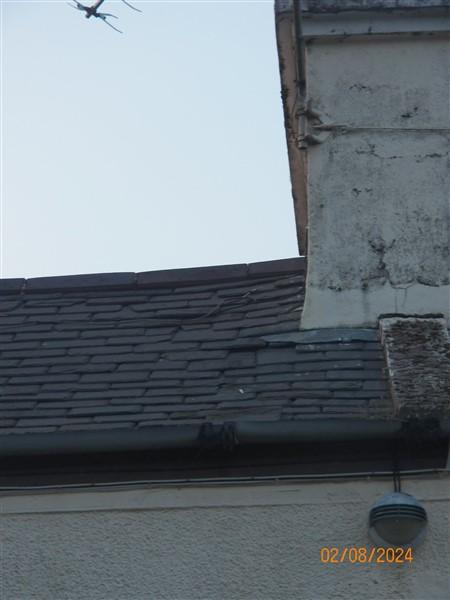
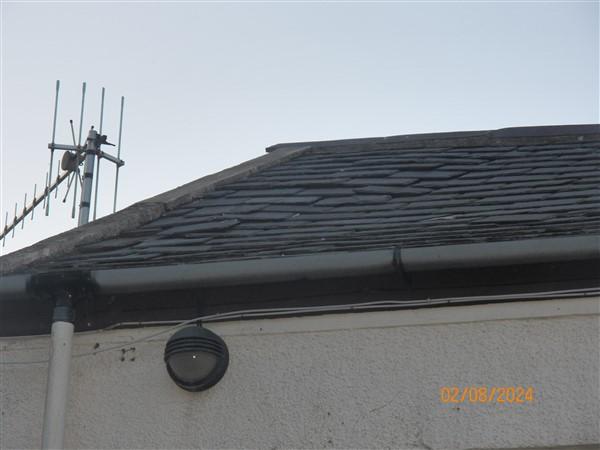
The building is in two parts, visible in the roof. The western half has the older-looking roof in slightly poorer condition. There is a missing slate below the central chimney (Photo D) and gaps between some raised slates at the western end (Photo E). Velux windows shows there to be an attic conversion in this part of the building. The ridge tiles are well seated.
The roof of the eastern half is in much better condition with no slipped or missing slates. The rear roof descends to a cat slide roof over a rear extension. The slates here are modern cement slates and are all in good condition as are the ridge tiles. The extension reaches to the rear overgrown garden rendering the eaves un-viewable
Photo C: East elevation Photo D: Missing and raised slates Photo E: Raised and uneven slates Photo F: Cat on rear roof
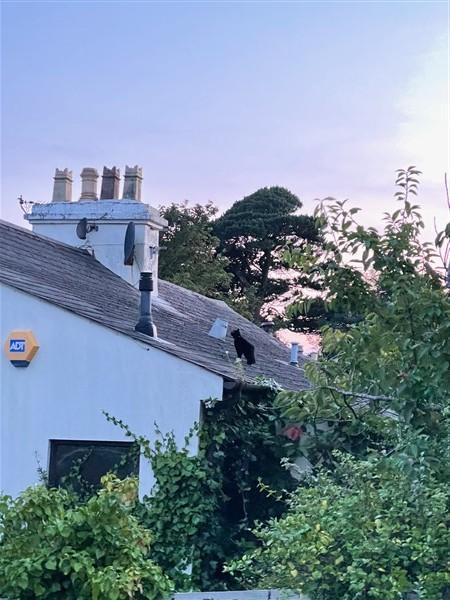
During the emergence watch no bats were seen to emerge from the building and only four bats were recorded on the detectors, a Leisler’s bat at 16 minutes past sunset and three common pipistrelles at 26, 32 and 50 minutes past sunset. A cat was seen to have climbed up onto the rear roof (Photo F).
### Evaluation
The building has been empty for some time which would make less suitable for those species of bats which like warmth. There is very limited access to only two parts of the roof, in a position where access could only be gained to any space between the slates and roofing felt. Access to the rear of the property is rendered unusable by the growth of trees and shrubs right up to the rear wall. The presence of a cat on the rear roof would argue against a bat roost in this part of the building.
Bats will switch roosts from time to time so the absence of any emerging at one particular time does not prove that there is no roost there at other times. However, the building is judged to be unsuitable for bats owing to the absence of many potential roost features.
Impact Assessment Demolition of the property will not impact the local populations of bats in any way. No mitigation is required for bats although provision for bats in the replacement buildings would support the aims of Biodiversity Net Gain (see Appendix I). Caveats
Apart from maternity roosts, bats can be found individually or in low numbers in buildings for a variety of reasons, depending on the season, from hibernating, night shelter, mating or occasional roosts. Sometimes such roosts are occupied opportunistically and cannot be predicted in advance. If a bat is found in the course of the development then work should cease and advice sought from DEFA Biodiversity officers.
### Appendix I: Recommendations
Bat Boxes On new dwellings integrated bat boxes are now favoured and the UK Bat Conservation Trust has recently announced one model as one of their Partnership products: https://www.bats.org.uk/ourwork/buildings-planning-and-development/roost-replacement-and-enhancement/partnerships However, others are available from the larger building materials suppliers or from NHBS.com. Housing developers in other parts of the island are now providing one bat integrated bat box per dwelling which would aid roost switching to which common pipistrelles and Leisler’s bats are prone.
Lighting External lighting installed as part of the development should be kept to a minimum where possible in order to avoid disturbing bats foraging or passing through the site. The Institute of Lighting Professionals and Bat Conservation Trust Guidance Note 08/18 on Bats and Artificial Lighting in the UK recommend measures such as:
- using LED luminaires due to their sharp cut-off, lower intensity, good colour rendition and dimming capability,
- using warm white spectrum lights (ideally <2700 kelvin) to reduce blue light component,
- peak wavelengths higher than 550nm to avoid the component of light most disturbing to bats,
- setting external security lighting on motion sensors and short timers,
- luminaires should lack UV elements when manufactured,
- avoiding uplighting,
- avoiding use of metal halide, fluorescent sources.
Timing of works Demolition should ideally commence outside the hibernation season (November to March) so that should any bat have chosen to take up residence it would be active enough to find alternative residence.
N J Pinder, BSc., MSc. Recorder, Manx Bat Group 05/08/2024
---
*Data sourced from the Isle of Man public planning register under the [Isle of Man Open Government Licence](https://www.gov.im/about-this-site/open-government-licence/).*
*Canonical page: https://planningportal.im/a/33050-glen-maye-waterfall-hotel/documents/1071963*